

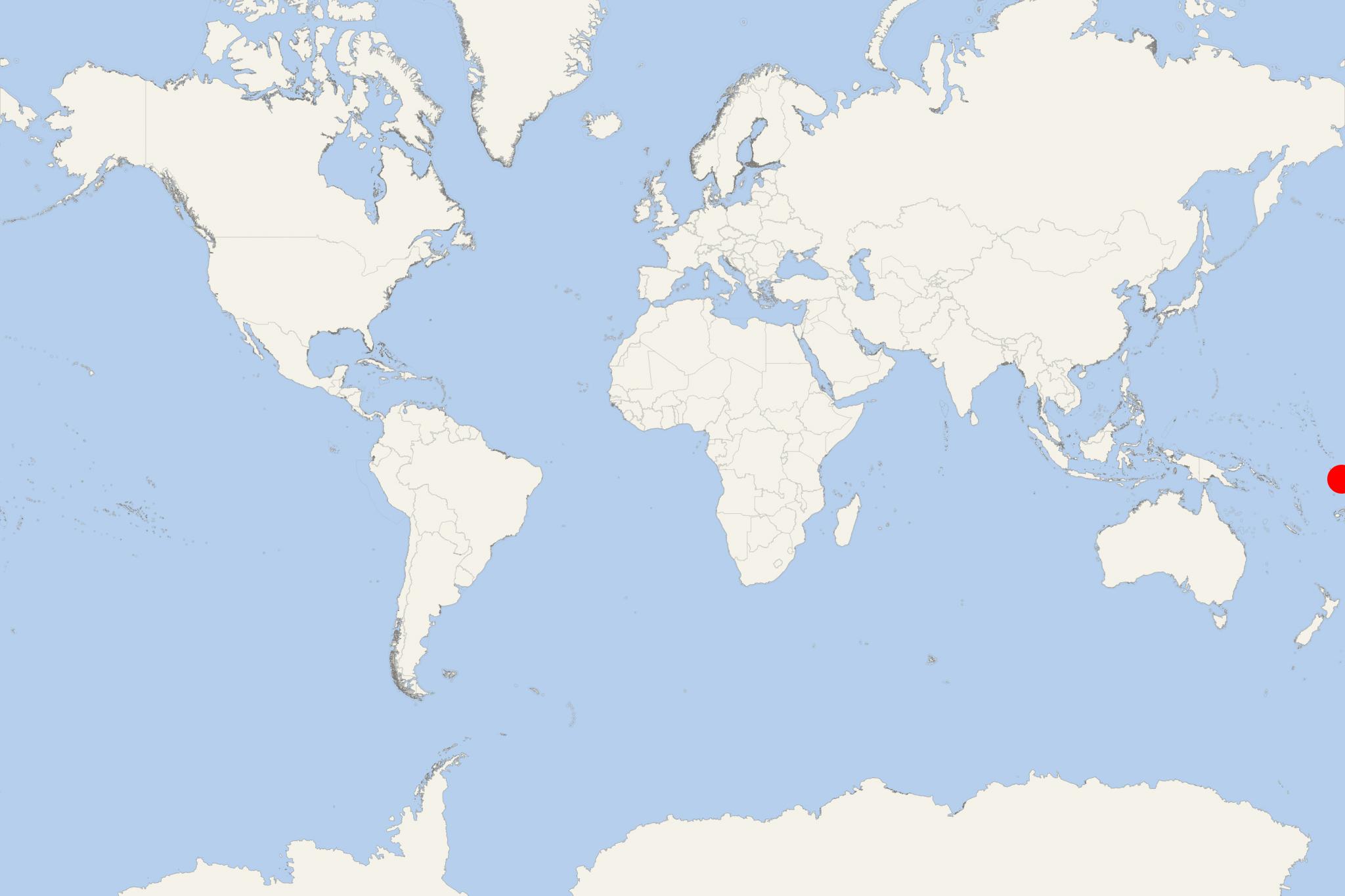
Funafuti Tuvalu (Fongafale, Tuvalu Islands)
Cruise Port schedule, live map, terminals, news
Region
Australia - New Zealand - Pacific Ocean Islands
Local Time
2026-11-16 01:33
 82°F
28°C
 Gentle breeze
4.8 m/s
 83 °F / 29 °C
82 °F / 28 °C
Funafuti Atoll (port locode TVFUN) is Tuvalu Islands' principal port (seaport and airport) as well as the country's capital city, with population around 6,000 (or ~60% of Tuvalu's total population). The atoll covers a total land area approx 2,4 km2 (0,9 mi2) and consists of narrow land ranging in width between 20-400 m (66-1312 ft). The land encircles the Te Namo (seawater lagoon) sized 275 km2 (106 mi2) or 18x14 km (11x9 mi), with avrg depth ~37 m (120 ft).
Port Funafuti (locode TVFUN) is at the Fongafale Islet and handles mainly cargo vessels and passenger ships that enter Te Namo to dock at the Fongafale Island (northeastern Funafuti). Two cargo-passenger ships connect (via roundtrips from Fongafale) Funafuti to the outer Tuvalu Islands as well as with Fiji (Suva).
Funafuti Airport is Tuvalu's only airport and serves international flights linking Tuvalu with Kiribati (Bonriki Airport on Tarawa Atoll, weekly flights by Air Kiribati) and with Fiji (Luvuluvu/Nausori Airport in Nausori/Suva on Viti Levu Island, weekly flights by Fiji Link/Fiji Airways).
Fogafale consists of 7 villages/neighborhoods (Vaiaku, Kavatoetoe, Lofeagai, Teone, Fakai Fou, Senala, Alapi) with total population around 4000. They are interlinked as a single urban area, the largest being Vaiaku (population around 500). In Vaiaku are also Tuvalu's Parliament, the National Bank, the High Court, the National Library and Archives, the country's only hotel (Vaiaku Lagi Hotel) and hospital (Princess Margaret Hospital) as well as several guesthouses, shops, a gas station.
Transportation on Funafuti Atoll is via water taxis and motorbikes (also can be rented).
Tuvalu Islands (fka Ellice Islands) is an island nation in Oceania's Polynesian region (central Pacific Ocean). The archipelago (3 islands plus 6 atolls) is approx midway between Hawaii (USA) and Australia, and borders with Santa Cruz Islands (Solomon Islands), Vanuatu, Nauru (Pleasant Island), Kiribati, Tokelau (NZ), Samoa (fka Western Samoa), Wallis and Futuna (France) and Fiji.
Independent with some planning or transport. Funafuti offers a modest, informal day ashore: exploring Fongafale’s neighborhoods, browsing local handicrafts and walking beside the lagoon. Central Vaiaku is manageable on foot once you reach it. Trips to the outlying islets and conservation area need advance arrangements and are better treated as organized excursions.
Getting from the Cruise Port
Confirm your ship’s arrangements before going ashore. Cruise visits may involve anchoring in the lagoon and tendering to Fongafale; the commercial wharf also serves passenger vessels. The landing point matters, and you should not assume you will arrive beside the airport or central Vaiaku.
If landed at the northern commercial wharf, arrange a transfer to Vaiaku unless the ship’s staff confirm a suitable pedestrian exit and walking directions. From a central landing or drop-off, the lagoon frontage, government buildings and airport-area handicraft outlets can be explored on foot.
Do not count on a cruise shuttle, waiting taxis or a scheduled public bus. Arrange any necessary vehicle and its return pickup through the ship or a local provider before setting off.
Best Ways to Spend Your Time
Explore Vaiaku and browse local crafts
Allow about 2–3 hours, plus transport from your landing point. Combine the lagoon frontage and government quarter with the Women’s Handicraft Centre near the airport. Woven fans, baskets and other locally made items are more characteristic purchases than conventional cruise-port souvenirs. The Philatelic Bureau is another worthwhile short stop for stamp collectors, subject to opening.
This is the simplest independent option. Expect an everyday residential and administrative settlement rather than a developed sightseeing district. Walking is mostly flat, but heat, limited shade and uneven roadside surfaces can make it tiring.
Take a guided drive around Fongafale
A prearranged drive is useful for visitors who want to see more of the main islet without prolonged walking in the heat. Ask for a short itinerary combining Vaiaku, residential neighborhoods and accessible lagoon- and ocean-side viewpoints. Allow roughly 2–3 hours for an unhurried outing, with the actual route agreed locally.
Confirm the vehicle, pickup point and return time in advance. Community buildings and private land should only be entered with permission; cultural performances should not be assumed unless specifically arranged.
Visit the Funafuti Conservation Area by boat
Organized excursion recommended. The protected reef, lagoon and islets lie across the lagoon from the main settlement. This is a separate boat outing, not an attraction reachable by walking from the landing.
Use a prearranged operator who can confirm council permission, guiding requirements, boat safety equipment and the complete return schedule. Reserve a substantial part of the call rather than treating it as an add-on after sightseeing. Proceed only when the operator’s total trip time fits comfortably within the ship’s shore window.
Nature viewing and an islet visit may be possible, but do not assume snorkeling is included or suitable. Confirm the specific site, current water-quality advice and sea conditions before booking any water activity.
Self-Guided Walking Route
Vaiaku lagoon frontage and airport-area crafts
Start: a confirmed central Vaiaku landing or vehicle drop-off near the government quarter. This route does not include the transfer from the northern commercial wharf.
- Begin with lagoon views from an accessible public section of the Vaiaku waterfront.
- Walk through the government quarter, viewing official buildings from public roads.
- Visit the post office or Philatelic Bureau if open; confirm its current location locally.
- Continue along public roads toward the airport terminal area.
- Browse the Women’s Handicraft Centre or any operating handicraft stalls near the airport.
- Retrace your route to the agreed central pickup or landing point.
Approximate distance: 2–3 km (1.2–1.9 mi), depending on your starting point and detours. Pure walking time: 35–50 minutes. Recommended total: 1.5–2.5 hours with browsing and rests.
Difficulty: easy terrain, with heat and exposure adding effort. Use public roads and paths; do not cross the runway or use it as a sightseeing shortcut. Keep clear of motorcycles and allow extra time where the roadside walking space is narrow.
Beaches and Swimming
Funafuti is better approached as a coastal sightseeing and boat-excursion stop than an independent swimming day. Swimming in Funafuti lagoon is discouraged because of pollution. The ocean-facing coast is not a straightforward alternative: reef edges, surf and strong currents create hazards.
Enjoy shore views from accessible public areas. For any proposed swimming or snorkeling excursion, obtain advice about the specific location rather than assuming that clear-looking water is safe.
Practical Tips for Your Call
- Carry Australian dollars in small notes; do not rely on card payments or access to cash ashore.
- Bring drinking water, sun protection and comfortable shoes. Plan shorter walks during the hottest part of the day.
- Dress modestly in residential areas and ask before photographing people or entering community spaces. Sunday trading and activities may be limited.
- Confirm opening arrangements locally before making a particular shop or office the focus of your visit.
- For an independent outing, aim to reach the landing or port entrance at least an hour before the ship’s stated last tender or all-aboard time. Allow a larger margin for boat excursions and follow any earlier deadline set by the crew.