

Aero Island Denmark (Aeroskobing)
Cruise Port schedule, live map, terminals, news
Region
Baltic - Norwegian Fjords - Russia
Local Time
2026-10-19 03:15
 51°F
51°F 10.3°C

 Mod. breeze
6.2 m/s
 54 °F / 12 °C
 49 °F / 10 °C
Port Aero Island Denmark cruise ship schedule shows timetable calendars of all arrival and departure dates by month. The port's schedule lists all ships (in links) with cruises going to or leaving from Aero Island Denmark, Aeroskobing. To see the full itineraries (ports of call dates and arrival / departure times) and their lowest rates – just follow the corresponding ship-link.
| Day | Ship | Arrival | Departure |
|---|---|---|---|
| 5 September, 2027 Sunday |  Artania Artania | 08:00 | 14:00 |
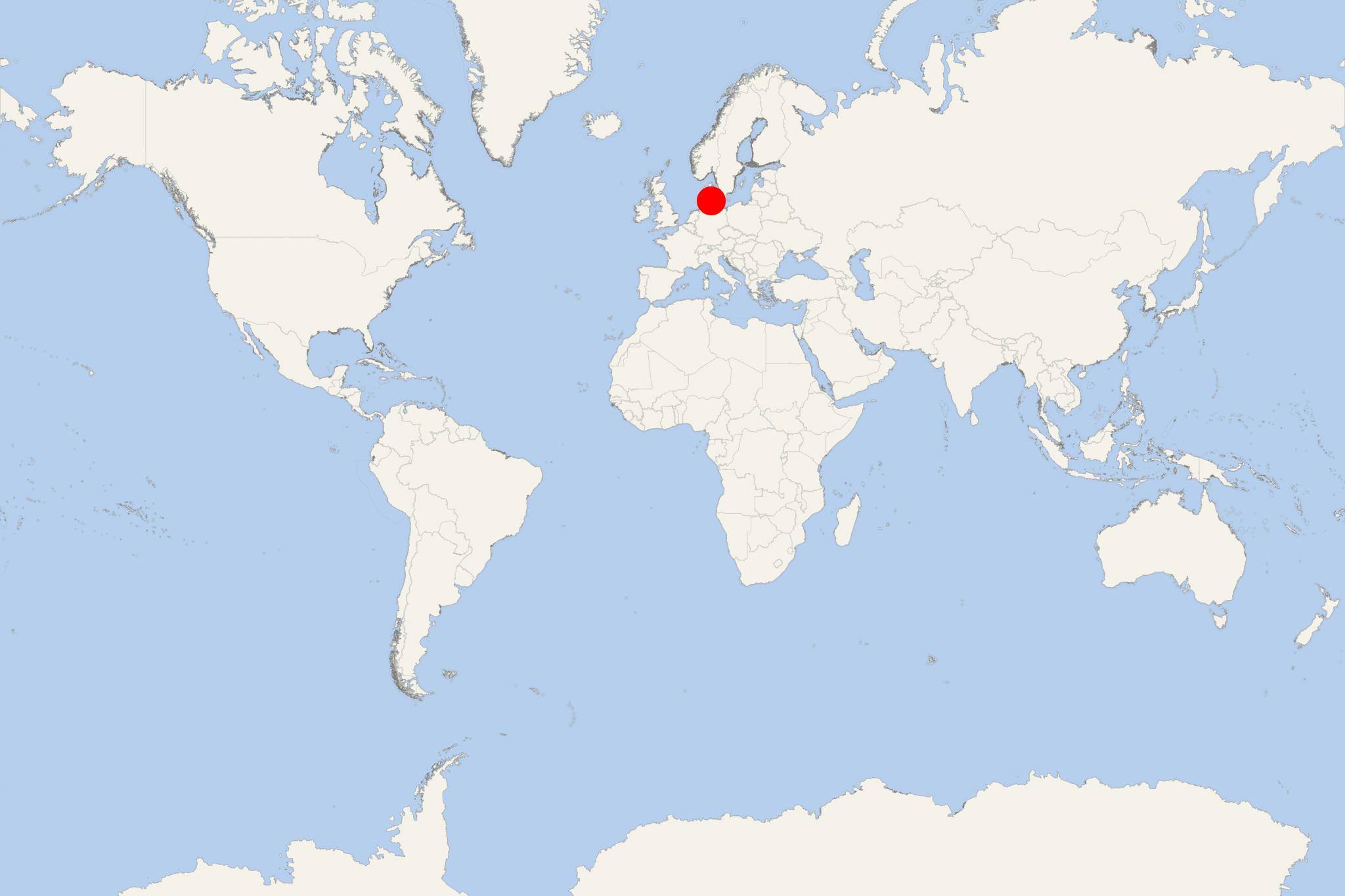
Aero Island (port locode DKARK) is one of Denmark's Baltic Sea islands, part of Southern Denmark (2007-established administrative region). The island covers a total area of approx 88 km2 (34 ml2) and has population around 7,000.
Island's name comes from the Danish "aer" (maple) and "o" (island). Since January 1, 2006, Aero Island is a single municipality. Before 2006, it had 2 separate municipalities - Marstal (in the east) and Aeroskobing (in the west).
Aeroskobing, with its narrow lanes and pretty 18th-century houses, was the island's main town and remains its principal port (and main cruise/ferry port), largest town, and commercial center.
With its low traffic density, Aero Island is a popular travel destination for cycling and hiking. The beaches also attract numerous tourists, mainly from mainland Denmark. As one of the isles making up the South Funen archipelago, Aero is favored by fine weather, offering the most sunshine hours in comparison to the rest of Denmark. The year-round temperature is a few degrees above the country's average.
Aero is the only Danish Baltic island not linked to mainland Denmark via a bridge. There are car ferries from Aero to Funen, Langeland and Als. The island's airport is near Marstal.
On January 28, 2015, "Horizon 2020" (the EU's research and innovation program 2014-2020) administration confirmed the EUR 17 million application for a demonstration E-ferry project. The objective of Europe's "Green Ferry Vision" is to perform a study for the design, construction/building and operation of innovative low-weight ferries (for passengers and cars) powered only by green electricity stored in batteries.
The world's currently most powerful all-electric (plug-in) ferryboat, "Ellen" was officially christened on June 1, 2019. It operates on the 22 nautical miles (25 ml / 41 km) crossing route between Aero and Fynshav. It is 7 times the length of any other route now served by an all-electric (plug-in) ferryboat. The vessel's naming ceremony was held at Soby Shipyard (in Soby, Aero Island's northernmost town). The E-ferry Ellen has LOA length 60 m, width 13 m, cruising speed 13-15,5 knots (max 29 kph/18 mph), passenger capacity 198 (during summer) and 147 (during winter months), cargo capacity 31 cars (or 5 trucks) parked on an open deck, battery pack 4,3 MWh. Ellen is also world's first electric ferry without an emergency back-up generator.
Aero Island Denmark cruise terminal
Most cruise ships to Aero Island dock (anchor) in Aeroskobing - port town on the central-northern coast. SOme ships may also stop in Marstal - port town on the eastern coast.
Ærø is a small island port where the main cruise attraction is the preserved town of Ærøskøbing itself. Most cruise calls anchor offshore and use tenders, normally landing close to Ærøskøbing harbour and the historic centre. Once ashore, independent sightseeing is straightforward: the old town, museums, marina and Vesterstrand beach are all within walking distance. Passengers wanting to see more of the island can use the free local bus or arrange a taxi.
At a Glance
- Independent sightseeing: Easy independently once ashore in Ærøskøbing; some planning is needed for trips elsewhere on the island.
- Arrival: Cruise ships generally anchor off Ærøskøbing and tender passengers ashore. Some itineraries may use Marstal instead, so check the ship's information for the actual landing point.
- Best for a short call: Ærøskøbing old town combined with Vesterstrand and its colourful beach huts.
- Transport: The island's public bus is free and serves Ærøskøbing, Marstal, Søby and intermediate villages. Taxis are available but capacity is limited, so advance booking is sensible for a time-critical cruise visit.
- Walking conditions: Mostly easy and level, although the historic centre has cobbles and uneven paving.
Getting from the Cruise Port
For a typical Ærøskøbing call, tenders bring passengers into the harbour area immediately beside the town. There is no long transfer into the sightseeing district: the first historic streets are only a few minutes away on foot.
The free island bus stops at Ærøskøbing Havn. Under the published timetable, the ride from Ærøskøbing harbour to Marstal harbour takes about 25 minutes. The same bus network continues west toward Søby, making an independent island trip possible when the port call is long enough.
If the ship instead lands passengers in Marstal, Marstal's harbour and maritime attractions are immediately accessible, while Ærøskøbing is about 25 minutes away by bus. Always base plans on the landing point and last-tender time announced aboard.
Best Ways to Spend Your Time
Explore Historic Ærøskøbing
Allow: 1.5–2.5 hours. Best independently.
The compact centre is the easiest choice for a short call. Walk from the harbour into Brogade and the small lanes around Torvet, looking for colourful old houses, cobbled streets and traditional doors. Ærø Museum on Brogade provides useful local context, while Hammerich's House preserves the interior and collections of an old Ærøskøbing home. The Bottle Ship Museum on Smedegade is another small maritime attraction if it is open during the visit.
Because everything is close together, passengers can simply wander without committing to transport or a fixed schedule.
Walk to Vesterstrand and the Beach Huts
Allow: 1–2 hours from the harbour, or combine it with the old town for a 2–3 hour outing. Easy independently.
Continue through the marina to Vesterstrand, a sandy beach lined with more than 70 traditional wooden beach huts. The waterfront is only a short walk beyond central Ærøskøbing, making this one of the most practical natural sights for cruise passengers. The water is shallow and the beach works equally well for a short coastal walk, photographs or a swim in suitable weather.
Take the Free Bus to Marstal
Allow: about 3–4 hours including transport and sightseeing. Independent with some planning.
The free bus from Ærøskøbing Havn reaches Marstal Havn in roughly 25 minutes. Marstal has a distinctly maritime character, and the principal attraction is Marstal Maritime Museum, with ship models, vessels and exhibits on local seafaring. Eriksens Plads beside the harbour preserves elements of the town's shipbuilding heritage and can be visited as part of a harbour walk.
If time permits, continue toward Eriks Hale for the beach and another group of Ærø's characteristic beach huts. Check the return bus before leaving Ærøskøbing and avoid relying on the final practical connection back to the tender landing.
See Voderup Klint and Rural Ærø
Allow: roughly 3–4 hours. Organized excursion or pre-arranged transport recommended.
Voderup Klint is one of the island's principal natural sights, with a 33-metre-high terraced coastal cliff and open views across the Baltic. It is not a practical walk from Ærøskøbing. A pre-arranged taxi, guided island tour or suitable cycling plan is preferable, particularly if combining the cliffs with villages, churches or other countryside stops.
This option is better for a longer call than for passengers with only a few hours ashore.
Self-Guided Walking Tours
Easy: Ærøskøbing Historic Centre
Distance: about 1.5 km (0.9 mi). Pure walking time: about 25 minutes. Recommended total time: 1–1.5 hours. Difficulty: Easy, with some cobbles and uneven surfaces.
- Ærøskøbing Harbour: Start where the tender brings passengers ashore and walk directly toward the old town.
- Brogade: Follow one of the principal historic streets toward the centre.
- Ærø Museum: Visit if time and opening hours permit, or simply view the surrounding historic streets.
- Torvet: Cross the compact town square and explore the adjoining lanes.
- Ærøskøbing Church: Continue through the old centre to the church area.
- Hammerich's House: Pass the preserved house at Gyden before weaving back through the narrow streets.
- Smedegade: Pass the Bottle Ship Museum and return toward the waterfront.
- Harbour: Finish beside the tender landing.
Moderate: Old Town and Vesterstrand
Distance: about 3 km (1.9 mi). Pure walking time: about 45–50 minutes. Recommended total time: 2–3 hours. Difficulty: Easy to moderate, mainly because of the longer distance; the route is largely level.
- Begin at Ærøskøbing Harbour.
- Walk through Brogade to Torvet.
- Explore the lanes around Ærøskøbing Church and Hammerich's House.
- Return toward the waterfront and continue through Ærøskøbing Marina.
- Follow the waterfront to Vesterstrand.
- Walk along the line of colourful beach huts and spend time by the beach.
- Retrace the waterfront route through the marina to the harbour and tender landing.
This is the most complete independent outing for passengers who want both Ærøskøbing's architecture and its best-known coastal scenery without depending on transport.
Practical Tips
- Tender operations can be affected by wind and sea conditions, so allow more return margin than at a conventional dock.
- Use the ship's announced last tender rather than the scheduled departure time when planning the day.
- For trips to Marstal or elsewhere on Ærø, check the current bus timetable before setting out and plan to be back in Ærøskøbing comfortably ahead of the last tender.
- The free bus is useful for independent sightseeing, but passengers with a tightly timed itinerary should avoid connections that leave little room for delays.
- Local bicycle rental is available in Ærøskøbing, including near the marina and in town. Cycling is suitable for active visitors on longer calls, but the island has rolling terrain and a full Ærøskøbing–Marstal circuit is about 32 km (19.9 mi).
- Passengers with limited mobility should consider both the uneven cobbled surfaces in the old town and the additional boarding requirements involved in a tender port.
Aero Island Denmark hotels
- Cruise Industry
Denmark’s First Electric Ferry Departs on Maiden Voyage
Denmark’s first ferry fully powered by electricity (MS Ellen) sailed between the islands of Aero and Als on Thursday, August 15. The...
August 15, 2019 - Cruise Industry

VIDEO: The Most Powerful All-Electric Ferry in the World Christened in Denmark
The most powerful all-electric ferryboat in the world will soon be operating on a 22 nautical miles (25 ml / 41 km) crossing between Denmark's...
June 3, 2019 - show more news