

East London (South Africa)
Cruise Port schedule, live map, terminals, news
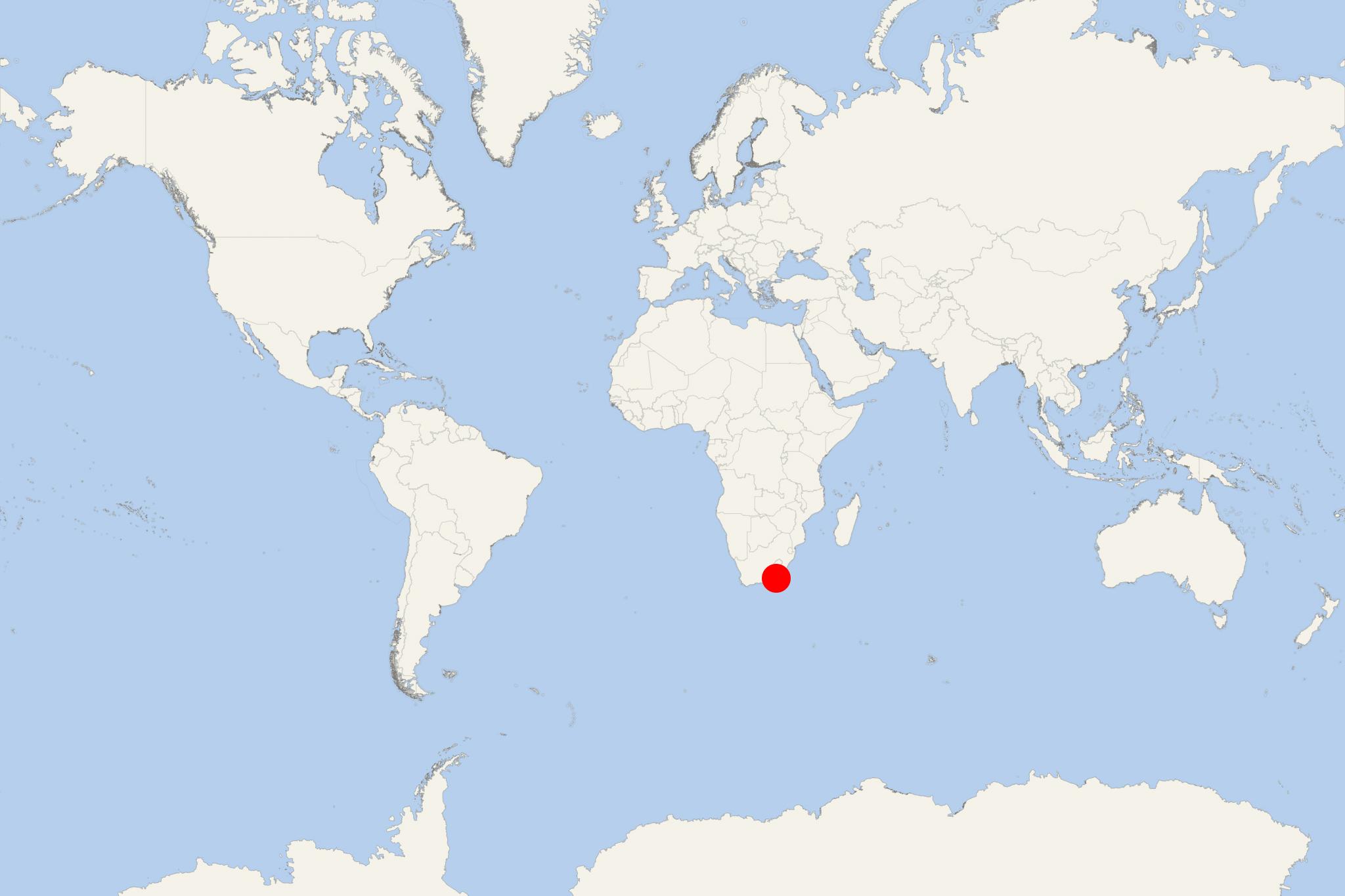
Region
Africa - Indian Ocean Islands
Local Time
2026-10-26 11:15
 66°F
19.1°C
 Mod. breeze
6.2 m/s
 69 °F / 21 °C
63 °F / 17 °C
Port East London cruise ship schedule shows timetable calendars of all arrival and departure dates by month. The port's schedule lists all ships (in links) with cruises going to or leaving from East London, South Africa. To see the full itineraries (ports of call dates and arrival / departure times) and their lowest rates – just follow the corresponding ship-link.
| Day | Ship | Arrival | Departure |
|---|---|---|---|
| 13 November, 2026 Friday |  Silver Muse | 08:00 | 23:00 |
| 23 November, 2026 Monday |  ms Europa 2 | 08:00 | 18:00 |
East London is a port city on South Africa's southeastern coast (Indian Ocean), in the Eastern Cape province. The city is located between Buffalo River and Nahoon River, thus having country's only river port. City's population is around 270,000 (metro over 755,000).
East London is province's 2nd largest seaport and industrial centre - after Port Elizabeth. The dominant employer is motor industry. A Daimler plant (Mercedes-Benz corporation) is located next to the harbour and manufactures Mercedes-Benz and other vehicles. They are produced here for the local market, and also for export to Brazil and USA. Other major industries include textiles, clothing, food processing, pharmaceuticals. To encourage investment in the city, in 2004 was established East London Industrial Development Zone (duty-free zone managed by East London IDZ Ltd). The 15 km2 (6 ml2) sized ELIDZ is on West Bank, close to both the airport and the seaport.
Resorts in East London include Areena, Cintsa East, Cintsa West, Glen Eden, Gonubie, Queensbury Bay and Yellowsands. Most popular tourist attractions include Museum, Zoo, Inkwenkwezi and Mpongo (private game reserves), Yellow Sands Caravan Park (camping). East London Museum has the unique coelacanth - prehistoric fish thought to be extinct, but in 1938 discovered live at Chalumna Mouth. The city is well known as skydiving and surfing destination, and its beaches are among the best in South Africa. The unique double-decker Buffalo River Bridge was built in 1931. It carries Arkansas Highway 7 (north–south state highway running across Arkansas State). The historic bridge has center span 49 m (160 ft) and total length 114 m (375 ft).
Port East London
Like all seaports in South Africa, East London port is managed by TNPA (Transnet National Ports Authority). This is a government corporation and division of Transnet Ltd (1990-founded, state-owned company specializing in freight rail transport, port terminal and pipeline management, logistics and engeneering).
TNPA manages seven of South Africa's largest seaports - Richards Bay, Durban, East London, Port Elizabeth, Mossel Bay, Cape Town, Ngqura, Saldanha. TNPA is also landlord responsible for master planning, marketing and developments, port navigation, services and facilities control. Transnet Port Terminals (division) manages port's terminal operations and cargo handling.
The port has 12 commercial berths (6 on West Bank, 6 on East Bank), 1 shiprepair quay (length 110 m / 360 ft), 1 pilot jetty, 1 fishing jetty. Port's total quayside is 2410 m (7910 ft). Port's entrance has max depth max draft 12 m (39 ft) and min width 170 m (560 ft). The max draft at berths (quayside) is between 8,5-10,5 m. Passenger ships (ferries and cruise liners) dock at whichever berth is currently available.
The port can handle ships with max LOA length 24 5m (804 ft). Port's anchorage area is located approx 1 mile east of the south breakwater. Pilotage is compulsory from approx 3 km northeast of the north breakwater. Tugboat assistance within the port is also compulsory. The port has 3 tugboats and 1 rescue craft . Marine services are available Monday to Friday (between 6 am - 10 pm).
The port has a dedicated grain terminal fitted with elevator and with storage (silo) capacity 76,000 tons - ranking it South Africa's largest. The modern tanker terminal serving oil tankers shipping unleaded petrol, auto diesel, kerosene (paraffin) and aviation fuel. Terminal's silo capacity is 7,6 million litres. The multi-purpose container terminal (on East Bank) handles container ships and has annual capacity 90,000 TEUs (containers). Port's drydock has capacity to handle vessels with max LOA length 200 m (656 ft) and max width 25 m (82 ft). Drydock's equipment includes 4 electric cranes plus 1 mobile crane.
The new car terminal (on West Bank) includes 4-storey parking which is connected via separate road to the adjacent Daimler factory. The new terminal has 2800 parking lots and annual capacity 50,000 cars. The facility is designed to allow future expansion (up to 8 storeys) with annual capacity 180,000 vehicles.
In 2017 were completed several infrastructure and equipment projects in East London Port, with total investment around ZAR 542 million (USD 40 million). The latest project was upgrade of the pile wharf (length 83 m / 270 ft) adjacent to Princess Elizabeth Dry Dock. The ZAR 108 million (USD 7,5 million) project was completed in October. The dock is used for both ship repairs and berthing of smaller ships,
Other completed in 2017 port development project was West Bank Foreshore protection (ZAR 176 million / USD 12 million). By this project was constructed a revetment to protect port’s infrastructure from erosion and wave actions. Also were upgraded tanker berth's fire protection system and port's security, port's rail network was replaced, Buffalo Bridge was refurbished.
Port's plans are to further enhance services and increase capacity by expanding the automotive facilities and upgrading maritime services. "Operation Phakisa" is a port development program (by country's government) to increase South Africa's marine shipping trade. By this program was refurbished the drydock (project cost ZAR 219 million / USD 15 million) and were also added new crane rails. Future projects include dredging (deepening and widening) of the entrance channel to improve manoeuvring and increase port's cargo capacity by allowing larger boxships (container carriers).
(statistics 2015) Port East London handled 330 ships, with total GT tonnage 11,475890 million tons, total cargo 2,945922 million tons (including TEUs), total bulk cargo 1,054352 million tons, breakbulk cargo 996,614 tons, total TEUs 66,293 (894,956 tons).
The car terminal was inaugurated in September 2000. Bunkering (fuel oil and marine gas oil) is via pipelines at berths S and T (West Bank). Cruise ships usually dock on East Bank berths.
Port East London's cargo and cruise shipping operations are managed by TNPA (Transnet National Ports Authority). This is Africa's largest port authority company that manages 7 large seaports in South Africa - East London, Durban, Cape Town, Richards Bay, Mossel Bay, Port Elizabeth, and Saldanha.
East London is best explored with arranged transport: visit the museum, spend time on the coast at Nahoon, or book a wildlife excursion outside the city. Independent with some planning or transport is the most practical approach for local sights; an organized excursion is preferable for a safari.
Getting from the Cruise Port
Cruise ships normally dock inside the working commercial harbour on the Buffalo River, usually on the East Bank. Berths vary, and there is no dedicated cruise terminal. The passenger exit and permitted route through the port must be confirmed on board.
Do not plan to walk directly from the gangway into town. Check whether your ship provides a shuttle, where it stops and when the last return leaves. Shuttle arrangements are call-specific. For independent sightseeing, arrange a reputable taxi or driver and confirm an authorized pickup point, return time and contact number.
The beachfront and museum are separate sightseeing areas, best linked by road. Local public transport is less straightforward for a short call than a prearranged vehicle.
Best Ways to Spend Your Time
East London Museum
Allow 1–2 hours for the museum on Oxford Street. Its main highlight is the preserved coelacanth whose discovery in 1938 changed scientific understanding of this ancient fish. Natural-history and regional cultural displays make this a useful choice in poor beach weather.
Visit independently with a taxi or driver, checking opening arrangements for your particular day. With transport between stops, the museum can be combined with a short beachfront visit in a relaxed half-day outing.
Nahoon Beach and Nahoon Point
Choose Nahoon for coastal scenery, watching surfers and a walk above the rocky shoreline. Nahoon Point Nature Reserve has boardwalks, viewpoints and an educational centre; the sandy beach offers a different, more relaxed stop. Use a vehicle between access points rather than assuming the beach and reserve form one continuous easy promenade.
Allow 2–3 hours at the coast, plus transfers. Boardwalk sections are easier underfoot than the rocky paths, but steps, uneven surfaces and exposed conditions can make longer walks moderately demanding. Arrange collection before setting out and check locally which paths are open.
Esplanade and Eastern Beach
The central beachfront suits a shorter outing: sea views, a promenade walk and a refreshment stop. The German Settlers Memorial and aquarium area provide useful landmarks. Confirm aquarium opening before including an indoor visit.
Allow 1–2 hours, plus transport. Keep to busy beachfront sections in daylight and seek current local advice before walking. Swimming is optional: surf and currents can be strong, so enter the water only where lifeguards are on duty and conditions permit.
Inkwenkwezi Wildlife Excursion
Inkwenkwezi Private Game Reserve offers guided drives in open safari vehicles. Allow approximately 45–60 minutes each way from the harbour area, depending on the berth and traffic, plus around 2.5 hours for the game drive. With check-in and a return margin, reserve roughly 5–6 hours overall.
Organized excursion recommended. A privately arranged visit is practical only with confirmed reserve admission, a drive time compatible with the call and reliable return transport. Regular departures may not fit the ship’s arrival. Wildlife sightings vary, and safari vehicles can be bumpy and require a high step to board.
Self-Guided Beachfront Walk
Short Esplanade Out-and-Back
Start: the aquarium area, reached by arranged transport or a confirmed ship shuttle. This is a waterfront walk, not a route from the commercial berth.
- Start outside the aquarium and establish your return pickup point.
- Look at the German Settlers Memorial in the adjoining Heroes’ Park area, if accessible.
- Follow the Esplanade north along the seafront.
- Pause at Eastern Beach for coastal views.
- Retrace the promenade to the aquarium-area pickup point.
Allow approximately 2 km (1.2 mi), depending on your turnaround point: 30–40 minutes of walking, or 1–1.5 hours with stops. The promenade is mostly level; beach access adds sand and potentially steps. Walk with companions, avoid quiet detours and shorten the route if local advice or conditions warrant.
Planning Your Return
- For a short call, choose the museum or coast. A safari should be the main activity of a longer call.
- Ask your driver to return you to the correct port entrance or authorized pickup point; the harbour map marker may not represent passenger access.
- Plan to reach the port at least one hour before all-aboard, allowing more time for reserve visits, traffic or an internal port transfer.
- Carry sun protection, water and secure footwear. Keep valuables discreet and avoid isolated beaches or trails.
East London hotels
- Cruise Industry
Azamara announces 44 new winter 2024-2025 itineraries
The upmarket cruise line and leader in Destination Immersion experiences Azamara announced 44 new cruises for Winter 2024-2025 spanning the world's 4...
November 12, 2022 - Cruise Industry
Azamara Cruises restarts in South Africa with Azamara Pursuit January-March 2022
Azamara Cruises announced its return to South Africa, as the country reopens international cruising. Azamara Pursuit is scheduled to set sail from...
October 6, 2021 - Cruise Industry
Cruise and Maritime Voyages Introduce Grand Round the World Cruise 2021
Sailing via the Azores and Caribbean, Cruise and Maritime Voyages-CMV's Columbus is scheduled to transit the Panama Canal visiting the islands of the...
November 3, 2019 - show more news