

Crotone (Italy)
Cruise Port schedule, live map, terminals, news
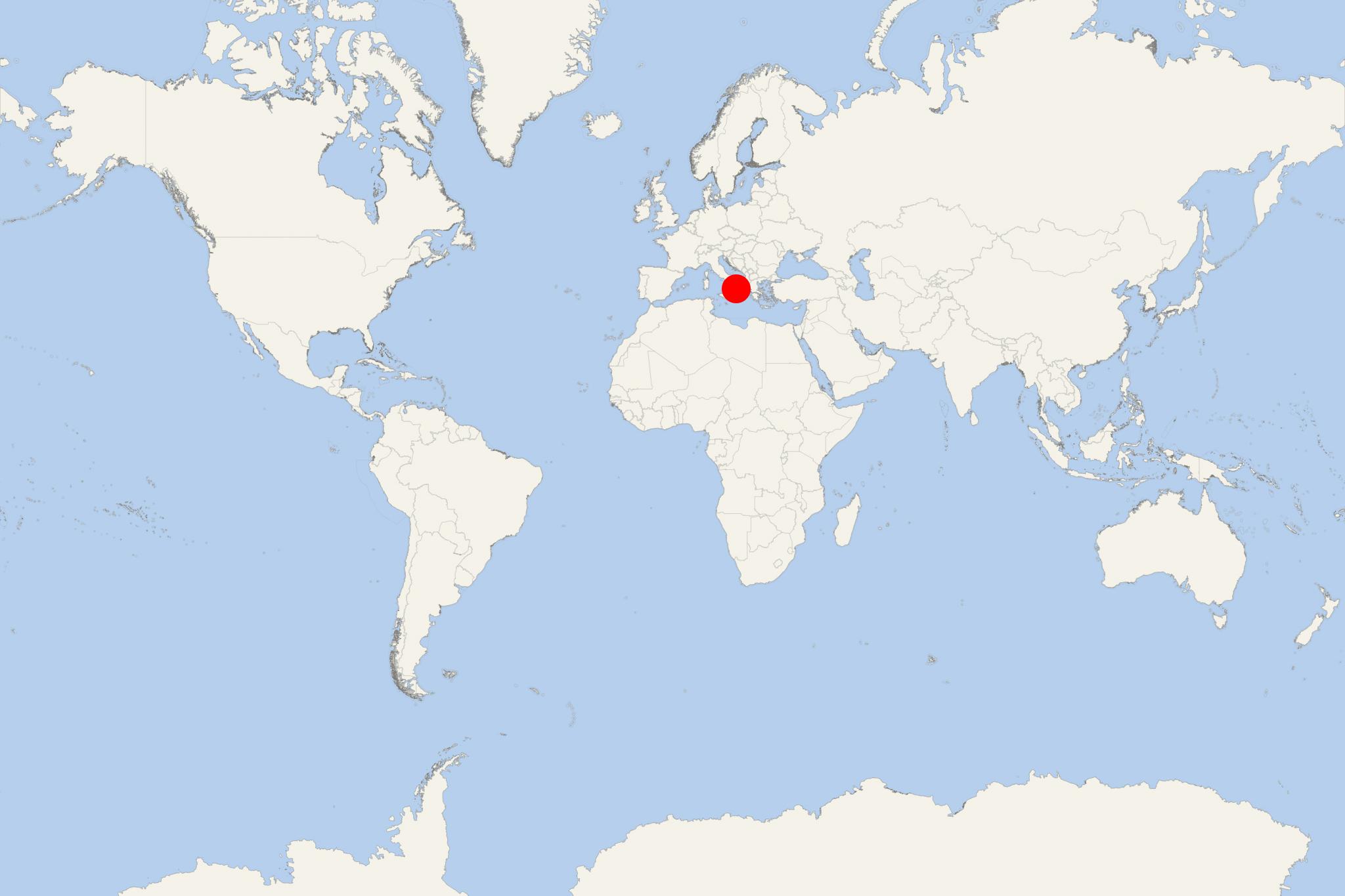
Region
Mediterranean - Black Sea
Local Time
2026-10-25 01:22
 65°F
18.4°C

 Gentle breeze
4.3 m/s
 69 °F / 21 °C
55 °F / 13 °C
Port Crotone cruise ship schedule shows timetable calendars of all arrival and departure dates by month. The port's schedule lists all ships (in links) with cruises going to or leaving from Crotone, Italy. To see the full itineraries (ports of call dates and arrival / departure times) and their lowest rates – just follow the corresponding ship-link.
| Day | Ship | Arrival | Departure |
|---|---|---|---|
| 2 June, 2028 Friday |  Viking Vela | ||
| 4 June, 2028 Sunday | Viking Lyra | ||
| 20 June, 2028 Tuesday | Viking Jupiter | ||
| 24 June, 2028 Saturday | Viking Vela |
Crotone is an Ionian Sea port and town in Italy's Calabria region (eastern coast, southern Italy) with population around 65,000. Crotone Cruise Port has a dedicated passenger terminal (on Riva Quay) where are offered a wide range of cruise tourism-related services.
Port Crotone (locode ITCRV) is also the gateway to the hilltop town Santa Severina (Norman castle) and Capo Colonna (Greek ruins site). As cruise port, Crotone is visited mainly by smaller- to mid-sized ships and superyachts. The port is often included in the schedules of luxury travel brand companies like Viking OCEAN, Seabourn, Oceania, RSSC-Regent.
In April 2022 was announced that Global Ports Holding (2004-founded, UK-based company and the world's largest cruise port operator) signed a 4-year concession agreement with the Italian Port Authority company that manages the seaports of Crotone, Gioia Tauro (Reggio Calabria), Palmi (Reggio Calabria), Corigliano Calabro (Cosenza), and Vibo Valentia. The concession for Global Ports is renewable and includes the management of Port Crotone's cruise shipping services as well as making investments in equipment, systems and technologies to improve the port's performance and ensure environmental safety and facilities' security.
Crotone-Sant'Anna Airport serves only domestic flights (by the airline Ryanair) that link to Bergamo (near Milano/Lombardy) and Bologna (Emilia-Romagna), and, during the summer season, also to Venice.
The town (under the name Kroton) was founded as one of Ancient Greece's largest colonies, and until the 20th-century (1928) was named Cotrone. Its location (between Messina Sicily and Taranto) favored its industrial development in the 1930s. An economic crisis started after the main employers, Montedison (now Edison SpA) and Pertusola Sud SpA (fka Pertusola Mining Ltd) collapsed by the late 1980s.
Best-known landmarks include Crotone Cathedral (11th-century), Castle of Charles V (16th-century, now housing the Town Museum with artifacts excavated in Kroton), National Archaeological Museum (having the Treasure of Hera found in Cape Colonna), municipal museum and art gallery, provincial (contemporary art) museum, Torre di Nao (fortification tower in Capo Colonna).
Crotone is well suited to a relaxed port day combining the old town, archaeological museum and seafront. Easy independently: the central sights are within walking distance of the cruise terminal, although the castle area involves uphill lanes. Capo Colonna requires transport and a planned return.
Getting from the Cruise Port
Cruise ships normally dock at Banchina di Riva, also called Riva Quay. Follow the designated passenger route through the terminal and security exit. The town is close, but the walk from your gangway depends on the ship’s position along the quay.
A shuttle is generally unnecessary for central sightseeing. The waterfront is mostly level; the historic streets climb towards the castle. For trips outside town, arrange a taxi or private transfer and confirm the return pickup before leaving. Ask terminal staff about current bus services rather than relying on an unverified timetable.
Best Ways to Spend Your Time
Old Town and National Archaeological Museum
Allow 2–3 hours for Piazza Pitagora, the cathedral in Piazza Duomo, the old-town lanes and the castle surroundings. Add approximately 45–60 minutes for the National Archaeological Museum on Via Risorgimento, whose collection includes the gold diadem from the sanctuary of Hera Lacinia.
This is practical independently. Expect uneven paving, inclines and occasional steps. Check museum and castle opening arrangements for your call; the castle exterior remains a useful sightseeing stop if interior access is unavailable.
Seafront Walk and City Beach
Follow Lungomare Cristoforo Colombo for sea views, a café stop or time on the city beach. Allow 1–2 hours for a leisurely promenade walk, or longer if swimming. This is the easiest option for passengers who prefer to avoid the uphill historic streets.
Choose a beach section beyond the working harbour. Beach facilities are seasonal, and swimming depends on sea conditions and local notices. The promenade has limited shade in places.
Capo Colonna Archaeological Park
Capo Colonna lies approximately 12 km (7.5 mi) southeast of Crotone. Its principal sights are the surviving column of the Temple of Hera Lacinia, the archaeological remains and the coastal setting. The nearby museum adds context to the ruins.
Allow roughly 20–30 minutes each way by road and 1–2 hours on site, making this a manageable half-day outing. Independent with some planning or transport: a prearranged return taxi or driver is practical. An organized excursion is preferable if you want guided interpretation and coordinated transport.
Check park and museum opening times separately. Wear sturdy shoes for outdoor paths and bring water and sun protection; this is an exposed archaeological visit rather than a beach outing.
Self-Guided Walking Tour
Old Town, Castle and Waterfront Loop
Start: the passenger exit from Riva Quay. Allow approximately 3 km (1.9 mi), depending on the exit and waterfront detour, with 50–65 minutes of pure walking. Plan 2–3 hours including stops, or 3–4 hours with a museum visit and refreshment break.
- Piazza Pitagora: begin at the main square where the modern town meets the historic centre.
- Piazza Duomo: continue to the cathedral; enter if open and no service is taking place.
- Historic lanes: climb through the old town towards Piazza Castello.
- Castle of Charles V: view the fortifications and visit accessible interior areas if open.
- National Archaeological Museum: stop on Via Risorgimento for the ancient Kroton and Hera Lacinia collections.
- Lungomare Cristoforo Colombo: descend to the seafront for a short promenade walk before returning towards the port entrance.
Difficulty: moderate. The route is short but includes uphill lanes, uneven surfaces and possible steps. Passengers with limited mobility may prefer Piazza Pitagora and the waterfront. Return through the authorized passenger entrance, allowing time for the checkpoint and walk back to the gangway.
Practical Tips
- Check opening times before committing to a museum or castle visit, especially on Mondays. A town and waterfront walk provides a flexible alternative.
- For Capo Colonna, agree on waiting time, pickup location and the complete return fare with your driver.
- Use the ship’s all-aboard time when planning your day. Aim to reach the port entrance at least 45–60 minutes beforehand, with additional contingency for trips outside town.
- Carry water, sun protection and shoes with good grip. The old town can feel considerably more demanding in summer heat.
Crotone hotels
- Cruise Industry
Explora Journeys unveils 2 new Journey Collections for Winter 2027–2028
Explora Journeys has announced two new Journey Collections/ship deployments for the Northern Winter 2027–2028 season. EXPLORA I is scheduled to...
September 18, 2026 - Cruise Industry
Star Clippers schedules 2026-2027 Grand Voyages
Star Clippers has released details of its 2026-2027 Grand Voyages season, offering more than 50 sailings aboard its fleet of three tall ships&mdash...
October 3, 2025 - Accidents
Celebrity Constellation ship lost power/propulsion between Ravenna and Rome
Celebrity Cruises’ Constellation encountered a loss of both hotel and propulsion power for approximately two hours on the evening of August 2...
August 3, 2025 - Cruise Industry
Windstar announces winter Mediterranean cruises for 2025-2026 season
The premium travel brand Windstar is set to offer an impressive array of winter Mediterranean voyages for the 2025-2026 season, showcasing a diverse...
May 23, 2024 - Cruise Industry
Windstar's cruise ship Star Legend to showcase new Mediterranean routes in 2025
Windstar Cruises, following its inaugural Mediterranean winter season, has revealed plans to extend Star Legend ship's presence in the region for an...
January 21, 2024 - Cruise Industry
SeaDream opens all 2024 Mediterranean cruises on both refurbished yachts SeaDream I and SeaDream II
SeaDream Yacht Club recently announced the opening of all 2024 Mediterranean voyages on its newly renovated yachts - SeaDream I and SeaDream II...
July 8, 2022 - Cruise Industry
MSC to acquire cruise port operator Global Ports Holding?
GPH-Global Ports Holding - the world's largest cruise port operator, which also manages under concession several container ship terminals, confirmed...
June 17, 2022 - Cruise Industry
Fred Olsen announces new cruises for 2022-2023
Fred Olsen Cruise Lines unveiled a new programme of cruising for 2022-2023 as the company gears up for a return to sailing, with a total of 126 new...
March 13, 2021 - Cruise Industry
Fred Olsen announces new 27-night Adriatic cruise (October 2022) on MS Braemar
Fred. Olsen Cruise Lines is setting sail to the Adriatic with a new cruise, part of the line's 2022 program. MS Braemar ship is due to depart on the...
February 12, 2021 - show more news