

Otso icebreaker
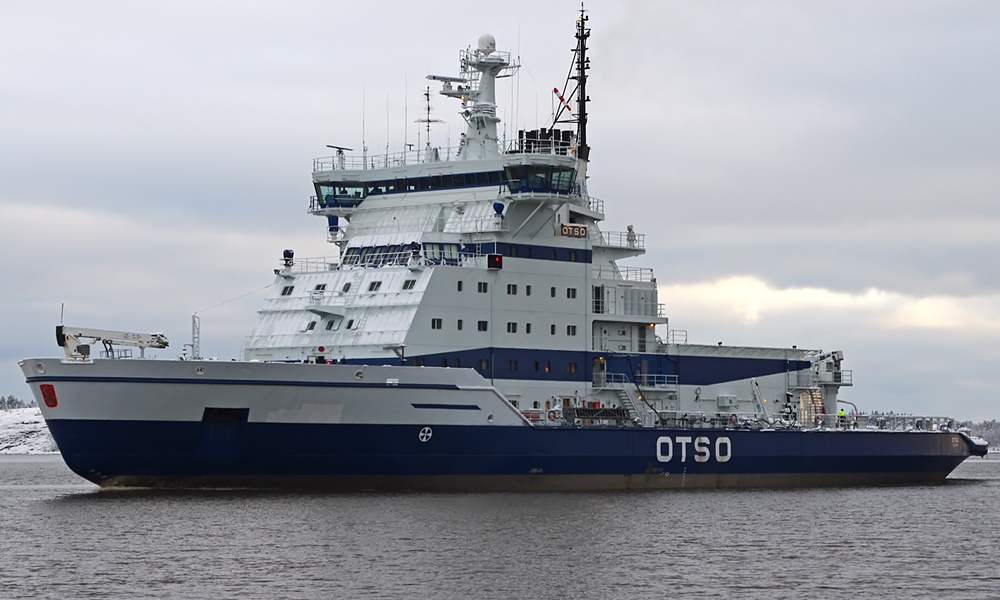
Otso icebreaker current position
The current location of Otso icebreaker is in Baltic Sea cruising en route to Helsinki. The AIS position was last reported 4 minutes ago.
Current PositionSpecifications of Otso icebreaker
| Year of build | 1986 / Age: 40 |
| Flag state | Finland |
| Builder | Wartsila Helsinki Shipyard (Helsinki, Finland) |
| Ferry route / homeports | Helsinki |
| Building cost | FIM 235 million |
| Engines (power) | Wartsila (23 MW / 30844 hp) |
| Propulsion power | 16.7 MW / 22395 hp |
| Speed | 19 kn / 35 km/h / 22 mph |
| Length (LOA) | 99 m / 325 ft |
| Beam (width) | 24 m / 79 ft |
| Gross Tonnage | 7066 gt |
| Passengers | 12 |
| Crew | 23 |
| Decks | 8 |
| Decks with cabins | 2 |
| Last Refurbishment | 2015 |
| Sister-ships | Kontio icebreaker |
| Owner | Arctia Oy |
| Operator | Arctia Icebreaking Oy |
Otso icebreaker Review
Review of Otso icebreaker
MS Otso is an icebreaking vessel currently owned by the Finnish state-owned company Arctia Oy and operated through its subsidiary Arctia Icebreaking Oy. The icebreaker was built in 1984 and has a sistership of identical design, Kontio (built in 1987). Both vessels were constructed at Wartsila Helsinki Shipyard in Helsinki, Finland.
The vessel (IMO number 8405880) is currently Finland-flagged (MMSI 230252000) and registered in Helsinki.

The shipowner Arctia Oy (founded in 2010 as Arctia Shipping Oy and renamed Arctia Oy in 2016) is a state-owned company operating Finland’s icebreaker fleet. The company’s divisions and subsidiaries include Arctia Icebreaking (operator of conventional icebreakers), Arctia Offshore (operator of multipurpose icebreakers), Arctia Karhu (port icebreaking services and towing), and Arctia Management Services.
Arctia primarily serves Vaylavirasto (FTIA – Finnish Transport Infrastructure Agency, founded in 2010), the government authority responsible for maintaining roads, railways, and waterways, during winter months. The company also provides chartered icebreaking services for private operators in offshore gas and oilfields, as well as for research and drilling companies.
The newest Arctia-owned icebreakers include Fennica (1993), Nordica (1994), and Polaris (2016). Older vessels in the fleet are Sampo (1960), Urho (1975), and Sisu (1976).
Otso vessel details and technology
MS Otso was ordered on March 19, 1984, at a shipbuilding cost of FIM 235 million. The vessel (hull/yard number 472) was launched on July 12, 1985, and delivered to the Finnish Maritime Administration on January 30, 1986.
Unlike earlier post-war (WW2/1939–45) Finnish icebreakers, Otso and Kontio do not use a quad-shaft propulsion system (two bow and two stern propellers). Instead, they are fitted with a double-shaft arrangement based on one bow thruster and two aft thrusters, all fixed and in-hull mounted, driven by electric motors.
The hull is coated with INERTA 160, a two-pack epoxy paint based on liquid epoxy resin. The bow hull plating is approximately 30 mm (1.2 in) thick. The waterline area is additionally protected by stainless steel plating (explosion-welded) to reduce ice friction and resist abrasion. An active cathodic protection system further prevents corrosion by making the hull the cathode of an electrochemical cell connected to sacrificial anodes.
Hull friction against ice is further reduced by an Air Lubrication System powered by two compressors with a combined output of 1.1 MW. Also known as an Air Bubbling System, this technology creates a layer of air bubbles along the hull’s underwater surface, resulting in lower resistance, reduced fuel consumption, and decreased CO2 emissions.
The icebreaking vessel has the following general specifications.
- Hull ice class: 1A Super (Finland), PC4 (Bureau Veritas)
- Maximum draft (scantling): 8 m / 26 ft
- Minimum draft: 7.3 m / 24 ft
- Airdraft: 37 m / 121 ft
- LWL (waterline length): 92.3 m / 303 ft
- Displacement: 9222 tons
- DWT (deadweight tonnage): 2157 tons (summer DWT: 2000 tons)
- Icebreaking capability: 1 m
- Bollard pull / emergency towing capacity: 160 tons
- Ice-heeling resistance: 1250 m3
- Aft helideck diameter: 12 m / 39 ft
- Helideck load capacity: 2.9 tons
- Fuel capacity: 2068 m3 (HFO and DO)
- Lubricating oil: 41 m3
- Freshwater capacity: 336 m3
- Water ballast capacity: 2390 m3
- Freshwater production: 9 tons per day
- Daily fuel consumption: 25 tons (13 knots), 21 tons (11 knots)
- Operational range without bunkering: 80 days (13 knots), 98 days (11 knots)
The power plant consists of four Wartsila 16V32 dual-fuel engines (5.46 MW each, total output 21.84 MW), one Wartsila generator (VASA 4R22/26, 560 kW), and one Marelli Motori generator (M7BM400/MC8, 640 kVA). An emergency diesel generator (MAN D2542-MLE) provides an additional 330 kW.
All four main engines and generators are located on the Upper Deck beneath the helideck. This uncommon engine room arrangement improves seakeeping and stability due to a higher center of gravity and simplifies maintenance, as heavy components can be handled by the forward main crane. Positioning the engine room above the waterline also allows fuel tanks to be placed amidships, reducing the risk of oil spills in the event of grounding.
The diesel-electric propulsion system comprises two ABB-built fixed stern thrusters (7.5 MW each, total 15 MW) and one ABB bow thruster (Jastram-built, fixed, variable-speed electric drive, 1.72 MW). Each thruster is equipped with a four-bladed stainless steel propeller.
Otso is also fitted with Stromberg Mete-Marine switchboards (6.3 kV, Ith 31.5 kA), two AC/DC transformers (1500 kVA each), multi-sensor radar, AIS, DF ECDIS, satellite communications, onboard TV network, GMDSS A4 radio station, VOIP telephony, and five searchlights. A Consilium fire alarm system was installed in 2017.
The vessel’s lifesaving equipment includes two lifeboats (Hatecke GSL-5.5C, 35 persons each) and four liferafts (Viking Life, 25 persons each).
Drydocks/refurbishments
During the 2015 drydock, MS Otso underwent the following upgrades:
- installation of a flume tank to reduce rolling in open seas
- hull steel renewal and ice-class upgrade to 1A Super / PC4
- new lifeboats, helideck, and infirmary
- installation of a new Mezzanine Deck above the flume tank, including a recycling station
Decks and Cabins
The aft-located helideck serves as a helicopter landing platform with a maximum load of 2.9 tons.
The aft cargo deck is equipped with a forward-mounted main crane (Bronto-built, 5-ton lifting capacity), an aft pilot crane (2-ton capacity), and an aft towing winch (Rauma-Repola TW 600 H).
Otso accommodates up to 35 persons, including 23 crew members and 12 passengers or clients. Onboard facilities include two mess rooms/day rooms (separate for crew and clients), laundry, gym, sauna, lounge, infirmary, and a kiosk.
The crew complement consists of a Master, Chief Officer, First Officer, two Second Officers, Chief Engineer, First Engineer, Second Engineer, Electrical Engineer, Electrician, Boatswain, three Able Seamen, Engine Repairman, two Motormen, Chief Steward, First Cook, and Catering Assistant.
Note: In areas with poor AIS coverage, tracking the vessel’s current position may not be possible. CruiseMapper’s complete list of icebreakers and icebreaking research vessels is available in the “itinerary” section of the Icebreakers hub.