

RRS Discovery
RRS Discovery current position
The current location of RRS Discovery is in North West Atlantic Ocean cruising en route to Halifax. The AIS position was last reported 1 minute ago.
Current PositionSpecifications of RRS Discovery
| Year of build | 2013 / Age: 13 |
| Flag state | United Kingdom |
| Builder | CNPF Freire Shipyard (Vigo, Spain) |
| Class | ice-strengthened research ship |
| Building cost | GBP 75 million (USD 122 million) |
| Speed | 15 kn / 28 km/h / 17 mph |
| Length (LOA) | 100 m / 328 ft |
| Beam (width) | 18 m / 59 ft |
| Gross Tonnage | 5952 gt |
| Passengers | 28 |
| Crew | 24 |
| Decks | 7 |
| Decks with cabins | 2 |
| Christened by | HRH Anne (The Princess Royal) |
| Owner | UK government (NERC) |
RRS Discovery Review
Review of RRS Discovery
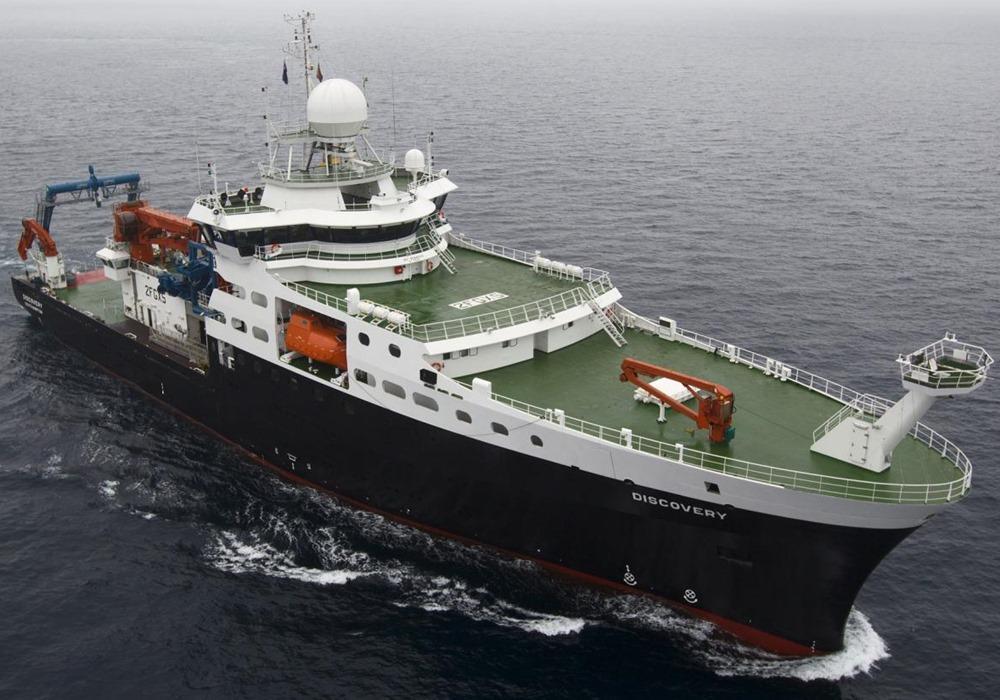
RRS Discovery is an ice-strengthened research vessel launched in 2013 and serving as an oceanographic survey ship homeported in Southampton (England UK). Her sistership (of the same design) is RRS James Cook (launched in 2007). RRS stands for "Royal Research Ship."

Royal Research Ships are UK-flagged merchant navy vessels conducting scientific research for the British Government (HMG). Organizations authorized to operate RRS vessels include NERC (Natural Environment Research Council), BAS (British Antarctic Survey), and NOC (National Oceanography Centre). A vessel must receive a warrant from the British monarch to be designated as an RRS. The UK’s current fleet of Royal Research Ships includes the following vessels (year built in brackets): RRS James Cook (2007, sistership), RRS Discovery (2013), and RRS Sir David Attenborough (2021).
This British research vessel is operated by the UK government agency NERC (Natural Environment Research Council). She is the third ship to bear the name "RRS Discovery," following vessels launched in 1901 (a wooden three-masted Antarctic research ship), 1929 (an Antarctica-based hydrographic and marine biological survey ship), and 1962 (until 2006 the UK’s largest oceanographic research ship, decommissioned in 2012). All were named after the 1901 wooden ship used during the Discovery Expedition (1901–1904) led by Robert Falcon Scott (1868–1912), a British Royal Navy officer and Antarctic explorer.
RRS Discovery vessel details
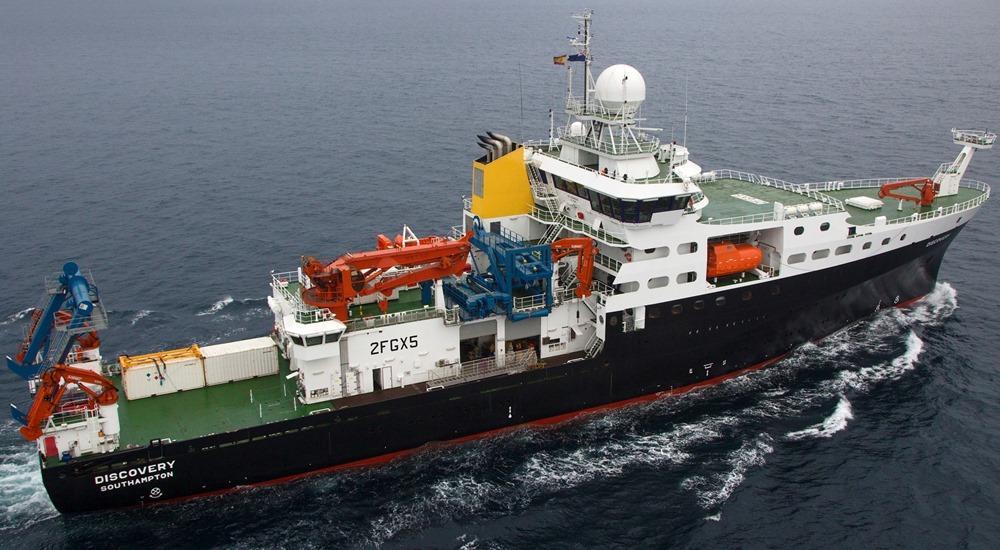
This research vessel features an ice-strengthened double hull and containerized laboratories that can be configured according to the scientific program of each voyage. She is equipped with an advanced hydroacoustic system consisting of two echo sounders and one keel-mounted hydrophone and can operate one ISIS ROV (remotely operated vehicle) with a maximum working load of 4.5 tons.
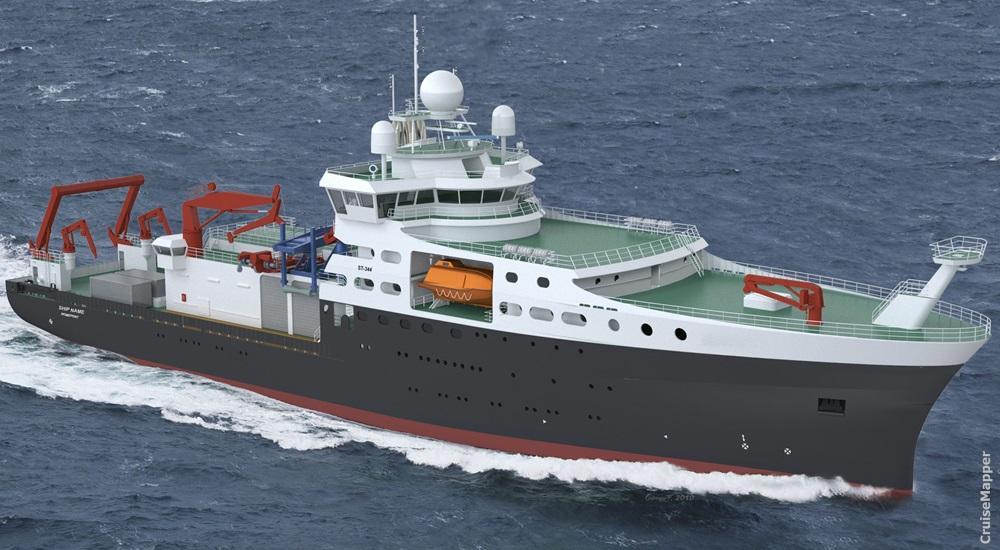
- The vessel is also equipped with a dynamic positioning system, CCTV monitoring equipment, and echosounder units supplied by the Norwegian company Kongsberg Maritime (multibeam deepwater model EM122, multibeam medium-water model EM710, single-beam model EA600), a sub-bottom profiler (Kongsberg SBP120), and a scientific echo sounder (Simrad EK60). Deck equipment includes an aft articulated crane (17 m, Ferri Serie A6 100170, single pull 10 tons, double pull 20 tons), a hydraulic winch (10-ton pull, wire length 500 m / 1,640 ft), and a forward knuckle crane (Ferri Serie A0 020120, 12 m, 2 tons). A 10-ton longitudinal transfer gantry crane lifts heavy equipment and TEU containers from the aft cargo deck into the hangar. A separate 5-ton gantry crane is used for ROV deployment.
- The ship is powered by four "Wartsila 8L20" (8-cylinder) marine diesel engines with a combined output of 7,080 kW.
- Propulsion is diesel-electric, provided by two azimuth thrusters (each fitted with five-bladed fixed-pitch propellers). One unit is retractable (forward, 1,350 kW), and the other is a Tees White Gill 360-degree bow thruster (1,700 kW).
- Displacement: 6,260 tons
- Deadweight: 2,004 tons
- Maximum draught: 6.6 m (22 ft) fully loaded
- Ice class: 1D (ice-strengthened bow)
- Endurance: up to 50 days
- Capacity: 52 persons (passengers and crew)
- The ship has no helipad and cannot accommodate helicopters.
Note: In cases of poor AIS coverage, tracking the vessel’s current location may be unavailable. You can view CruiseMapper’s list of all icebreakers and ice-strengthened research ships in the "Itinerary" section of our Icebreakers hub, where all countries and their fleets are listed.
Photos of RRS Discovery
RRS Discovery ship related cruise news
- Cruise Industry
RRS Discovery returns to the UK with vital climate change data
A team of oceanographers from SAMS (Scottish Association for Marine Science) overcame the challenge of COVID restrictions to complete a month-long...
October 27, 2020 - show more news
Other UK cruise ships
RRS Discovery Wiki
- RRS Discovery was built by the Spanish shipbuilder "Construcciones Navales Paulino Freire" (CNPF) at the Freire Shipyard in Bouzas (Vigo Spain). The company specializes in the design, construction, refit (conversion), and repair of steel-hulled vessels with a maximum LOA of 155 m (508 ft).
- The vessel's design was developed by the Alesund Norway-based company Skipsteknisk (also the designer of RRS James Cook).
- The ship was christened on October 10, 2013, by her godmother, HRH Anne Elizabeth Alice Louise (Princess Royal).
- This state-of-the-art scientific research vessel operates worldwide. She primarily conducts oceanographic research, including studies of marine ecosystems and seismic surveys (underwater earthquakes).