

Stepan Makarov icebreaker
Stepan Makarov icebreaker current position
The current location of Stepan Makarov icebreaker is in East Asia cruising en route to RU PA-A (MPQ OI). The AIS position was last reported 49 minutes ago.
Current PositionSpecifications of Stepan Makarov icebreaker
| Year of build | 2017 / Age: 9 |
| Flag state | Russia |
| Builder | Arctech Helsinki Shipyard (Helsinki, Finland) |
| Class | Arctech Icebreaking Supply Vessel |
| Ferry route / homeports | Vladivostok |
| Building cost | USD 100 million |
| Engines (power) | Wartsila (21 MW / 28161 hp) |
| Propulsion power | 15.6 MW / 20920 hp |
| Speed | 16 kn / 30 km/h / 18 mph |
| Length (LOA) | 104 m / 341 ft |
| Beam (width) | 21 m / 69 ft |
| Gross Tonnage | 8626 gt |
| Passengers | 42 |
| Crew | 28 |
| Beds | 70 |
| Cabins | 45 |
| Sister-ships | Fedor Ushakov, Gennadiy Nevelskoy, Yevgeny Primakov |
| Christened by | Ekaterina Smyaglikova |
| Owner | SCF Sovcomflot (Russia) |
| Operator | SCF Sovcomflot (Russia) |
Stepan Makarov icebreaker Review
Review of Stepan Makarov icebreaker
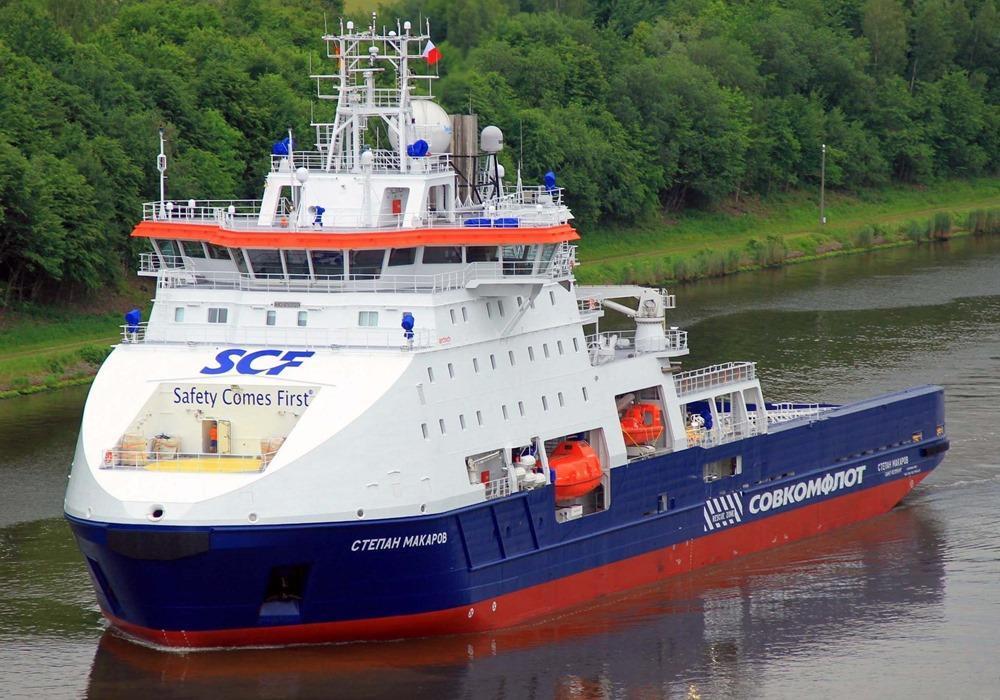
The 2017-built MS Stepan Makarov ("ледокол Степан Макаров") is an icebreaking vessel owned by SCF Sovcomflot (Совкомфлот/fleet) and operated through its subsidiary SCF Sakhalin Vessels Ltd. The shipowner is a Russian state-owned corporation specializing in petroleum and LNG shipping.
The vessel (IMO number 9753727, built at Helsinki Shipyard / hull number 512) is currently Russia-flagged (MMSI 273392530) and homeported in Vladivostok.
The icebreaker operates as a supply vessel for Russia's Sakhalin-2 oil and gas field on Sakhalin Island (Okhotsk Sea, northwestern Pacific Ocean). The ship is named after Russian Vice Admiral Stepan Osipovich Makarov (1849-1904, Imperial Russian Navy service 1863-1904), a decorated naval commander, oceanographer, naval researcher, strategist, and ship designer. During the Russo-Turkish War (1877-1878), he adopted the strategy of using small torpedo boat fleets in naval combat. He also designed two icebreaking steamships for train-ferry service across Lake Baikal.
The shipowner Sovcomflot (Совкомфлот, founded in 1988) is Russia's largest shipping company specializing in hydrocarbon transportation (HGLs - hydrocarbon gas liquids) from Arctic regions. Of its fleet of approximately 150 vessels, more than 80 are ice-classed (with icebreaking capabilities).
History and construction
This Russian icebreaker class was designed by Arctech Helsinki Shipyard (Helsinki Finland) as a supply vessel. It represents a series of four IBSBV ("icebreaking standby vessels"), with sister ships Gennadiy Nevelskoy, Fedor Ushakov, and Yevgeny Primakov.
The pair of earlier sister ships Aleksey Chirikov (2013) and Vitus Bering (2012) are based on a previous design, which is less powerful (with four diesel engines) and lacks a moon pool. All vessels were ordered in December 2010, following an agreement between shipbuilders STX Finland (now Meyer Turku) and OCK ("United Shipbuilding Corporation", Russia) to form the joint venture "Arctech Helsinki Shipyard".

Most hull blocks were assembled at the Helsinki shipyard, with the majority manufactured in Russia (by Vyborg Shipyard) and transported to Finland by cargo barge for final outfitting, painting, and assembly.
The IBSBV Stepan Makarov was the second of the four icebreakers commissioned by SCF. Compared to the original design, these standby vessels feature smaller deadweight (3824 tons), higher personnel capacity (98 people), and enhanced functionality. All were built by Arctech Helsinki and are used year-round for delivering equipment, personnel, and supplies to three offshore oil and gas platforms. They also perform standby duties, environmental protection (oil spill response), rescue operations (firefighting, helicopter support, emergency evacuation), and diving support.
- The three standby vessels were ordered in August 2014 (contract value USD 380 million), following a 20-year contract signed in May 2014 between SCF and the SEIC consortium (Sakhalin Energy, operator of the Sakhalin-2 field).
- Stepan Makarov's keel was laid on December 17, 2015. She was floated out on June 30, 2016, and delivered on March 3, 2017.
- Arctech Helsinki Shipyard specializes in Arctic icebreakers and offshore supply vessels.
- United Shipbuilding Corporation (founded in 2007) manages Russia's shipbuilding industry, employing over 80,000 people across 40+ shipyards, design offices, and repair facilities.
Other newbuild Russian icebreaking support vessels include Gazprom Neft's Alexander Sannikov and Andrey Vilkitsky. Both vessels, built in 2018, serve Gazprom's Arctic Gate (Novy Port offshore crude oil loading terminal) at the Novoportovskoye oil field.
Stepan Makarov icebreaker vessel details
The vessel is powered by six Wartsila marine diesel engines (generator sets) with a combined output of 21 MW. The propulsion system is diesel-electric, consisting of two ABB Azipods (azimuth thrusters, model VI1600, combined output 13 MW) and two bow thrusters (combined output 2.6 MW).
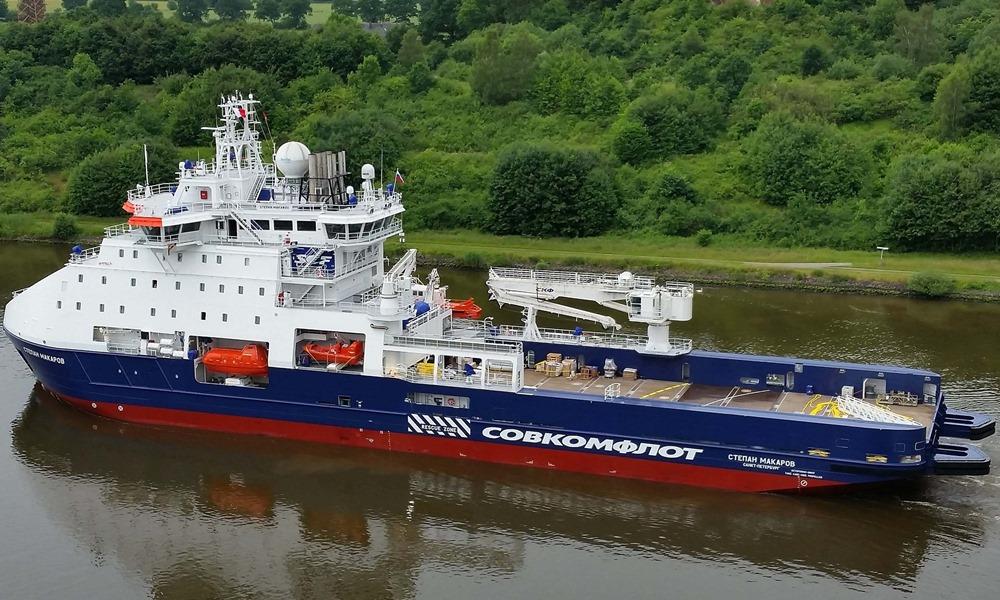
The vessel features a scientific moon pool (also known as a "wet porch"), a hull opening that provides direct access to the sea for deploying underwater equipment (ROVs, AUVs) and supporting diving operations.
- Maximum draft: 7.9 m (26 ft) when fully loaded
- Deadweight: 3670 tons
- Icebreaking capability: 1.7 m (6 ft), both ahead and astern
- Icebreaking speed: 3 knots (5.6 kph / 3.5 mph) in ice thickness of 1.5 m (5 ft)
- Endurance: 30 days
- Ice class: Icebreaker6 (RMRS / Russian Maritime Register of Shipping)
- Cargo capacity: deck area 709 m2, liquid bulk 3850 m3
- Crew and passenger capacity: 70 (28 crew + 42 additional personnel)
- Firefighting capacity: 2 monitors (1200 m3/h each), water spray capacity 1000 m3/h
- Rescue capacity: 70 people
Note: In cases of poor AIS coverage, tracking the vessel's current position may not be possible. You can view CruiseMapper's list of all icebreakers and icebreaking research vessels in the "itinerary" section of our Icebreakers hub, where fleets by country are also listed.
Photos of Stepan Makarov icebreaker