

MS Kapitan Pushkarev
Former name : XXI S’ezd KPSS
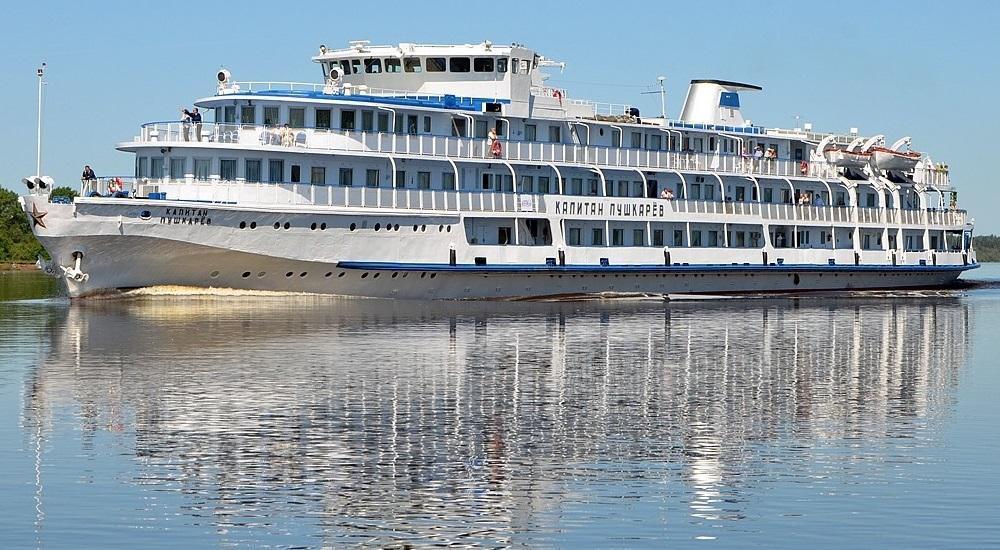
MS Kapitan Pushkarev last position
The last location of MS Kapitan Pushkarev is in Russia Inland cruising en route to Samara. The AIS position was last reported 4 days ago.
Current PositionSpecifications of MS Kapitan Pushkarev
| Year of build | 1960 / Age: 66 |
| Flag state | Russia |
| Builder | SLKB Komarno (Komarno, Slovakia) |
| Class | USSR Russian cruise ship (Project 26-37) |
| Ferry route / homeports | Nizhny Novgorod-Kazan |
| Speed | 14 kn / 26 km/h / 16 mph |
| Length (LOA) | 96 m / 315 ft |
| Beam (width) | 15 m / 49 ft |
| Passengers | 214 |
| Crew | 62 |
| Decks | 4 |
| Cabins | 99 |
| Decks with cabins | 4 |
| Last Refurbishment | 2015 |
| Sister-ships | Oktyabrskaya Revolyutsiya class |
| Former names | XXI S’ezd KPSS |
| Owner | Akademflot (Russia) |
| Operator | Infoflot (Russia) |
MS Kapitan Pushkarev Review
Review of MS Kapitan Pushkarev
MS Kapitan Pushkarev cruise ship ("теплоход Капитан Пушкарев" круизный корабль) is a traditional Russian river passenger vessel built for the USSR (Soviet Union) in Czechoslovakia (now Slovakia). MS Pushkarev operates on the Volga River, offering roundtrip cruises from Nizhny Novgorod and Kazan.
The ship is currently owned by Akadenflot (Академфлот) and chartered to the St Petersburg-based Russian company Infoflot (Инфофлот). Infoflot functions as both a tour operator and travel agency, providing Russian and international river and ocean cruise packages.

The vessel was reconstructed in 1998 in the Czech Republic. From the same “Project 26-37” series, a total of 14 ships were built between 1957 and 1962. All vessels in this class belong to the Oktyabrskaya Revolyutsiya type and were originally designed to accommodate 312 passengers and 70 crew members.
Cabins
The ship features 99 staterooms, including 2 Two-Room Suites, 2 Junior Suites, 16 Singles, 57 Doubles, 14 Triples, and 8 Quads (which can also be booked as Triples).
All staterooms offer standard amenities such as individually controlled air conditioning, refrigerator, intercom phone, radio, flat-screen TV (satellite reception), en-suite bathroom (toilet, shower, washbasin, hairdryer, towels, bath products), wardrobe, and opening windows (except Lower Deck cabins, which have portholes). Suites additionally feature a low table with pouffes, a double bed, sofa bed (for a third person), two windows, and floor lamps. Quad, Triple, and some Double cabins have upper bunk beds.
Due to the vessel’s older design, economy-class cabins do not have a full bathroom (only a washbasin, without toilet or shower). Passengers in these cabins use shared restrooms and showers located on deck.
Cabin TVs broadcast Russian channels, recorded films and cartoons, live views from a bow camera, a ship security channel (emergency instructions), and a ship channel showing the itinerary map and current position.
Shipboard dining and entertainment
Ship facilities include:
- Boat Deck – Sun Deck (aft Solarium with outdoor seating: loungers, deckchairs, tables, and folding chairs), indoor Theater (Cinema / Conference Room / Concert Hall / Disco Bar), forward Dining Room Restaurant, Shower Rooms, and a wraparound Promenade Deck with seating.
- Middle Deck – Reading Lounge (Library, fore-located), Music Salon (Main Lounge / Piano Bar, aft-located), Shower Rooms, and a wraparound Promenade Deck with seating.
- Main Deck – Bar-Restaurant (forward Dining Room with bar service and à la carte menu), Medical Room (Infirmary), Hair Salon (hairdresser and barber), Boutique (Souvenir Shop), Kids Room, Lobby (Reception / Guest Services Desk, Cruise Director’s Office, Tour Desk), Coffee Station, Ironing Room (laundry service), and Shower Rooms.
- Lower Deck – Sauna, Spa (Massage Room), and Porthole cabins (for passengers and crew).
Shipboard activities include:
- Theater – The ship’s Cinema doubles as a Conference Hall, Concert Hall, Dance Lounge, and Disco Nightclub, featuring its own Bar. The Theater Lounge also hosts enrichment programs with lectures and multimedia presentations on Russian history and culture. Port talks by professional guides provide itinerary and excursion details. Other activities include traditional tea ceremonies, Russian language lessons, music and art classes (such as matryoshka painting), blini and vodka tastings, live shows and concerts (classical and folk music), theme parties, and nightly DJ discos.
- Bar-Restaurant – A Dining Room with bar service and à la carte menu.
- Music Salon – The ship’s Main Lounge (Piano Bar) with a full-service bar, grand piano, and stage for live performances.
- Kids Room – An indoor playroom where trained staff organize supervised activities for children.
- Both restaurants serve buffet-style breakfast and waiter-served lunch and dinner featuring Russian cuisine. European dishes are offered on longer itineraries. Three meals daily are included in cruise fares. Vegetarian and dietary options are available. Complimentary beverages include a glass of champagne at breakfast and a glass of wine or vodka at dinner, as well as herbal teas and oxygen cocktails.
- The ship offers free Wi-Fi (available in the Bar-Lounge), complimentary morning exercises, yoga and pilates classes (led by a professional instructor), and access to gym equipment for sports training.
- All shore excursions are guided, and most are included in the cruise fare.
Note: You can view CruiseMapper’s full list of river cruise ships and riverboats in the "Itinerary" section of our River Cruises hub, where all cruise lines and their fleets are listed.
Other Infoflot cruise ships
MS Kapitan Pushkarev Wiki
Built as XXI S'ezd KPSS, MS Pushkarev is one of Russia's "Project 26-37" river cruise ships.
Oktyabrskaya Revolyutsiya-class Russian river ships
"Oktyabrskaya Revolyutsiya" (also known as "Project 26-37") is a series of Russian river cruise ships built in Czechoslovakia (now Slovakia) for the USSR between 1957 and 1962. The class name honors Russia's October Revolution (also called the Red October or Socialist Revolution) of 1917.
A total of 14 vessels (with a maximum of 4 built per year) were produced by "Narodny Podnik Skoda Komarno"—today the SLKB Komarno Shipyard in Komarno, Slovakia. These ships were used for combined cargo-passenger service on the Volga River, operating routes such as Nizhny Novgorod–Astrakhan and Moscow–Astrakhan. All vessels were originally operated by the "Volga Shipping Company" (Волжское пароходство). After the collapse of the USSR in 1991, the riverboats were acquired by private Russian companies.
"Project 26-37" ship technology
"Project 26-37" ships feature the following specifications:
- LOA (length overall): 96 m (316 ft)
- Beam (width): 15 m (49 ft)
- Draft: 2.4 m (8 ft)
- DWT tonnage: 1473 tons
- V-shaped hull, 4 decks (3 passenger decks)
- Originally designed for 312 passengers and 70 crew (now 110–250 passengers), featuring all-outside cabins (1-, 2-, and 4-bed), 2 restaurants (63-seat and 50-seat), 2 salon bars/lounges (18-seat Music Salon and 30-seat Café), a 25-seat Reading Room, a Hospital (first-aid room), and wraparound Promenade Decks.
- All cabins were equipped with washbasins, while only Suites had full bathrooms.
- Propulsion: three marine diesel engines (model 6L275B) with a combined output of 1.2 MW.
- Three 4-blade fixed-pitch propellers, each with a diameter of 1.7 m (5.5 ft).
- All of these traditional Russian ships were later modernized, completely refurbished, and rebuilt for both domestic and international river cruise companies. During extensive drydock reconstructions and refits, cabins were enlarged to improve comfort and safety, resulting in reduced passenger capacity.
Project 26-37 ships
The Project 26-37 series includes the following vessels:
- Oktyabrskaya Revolyutsiya (1957, Октябрьская Революция)
- Komarno (February 1959, now Volga Dream)
- Mir (July 1959, now Afanasiy Nikitin)
- Druzhba (April 1960, later Kapitan Rachkov and Sergey Abramov) – scrapped in 2012
- XXI S'ezd KPSS (July 1960, now Kapitan Pushkarev)
- Yakov Sverdlov (September 1960, now Aleksandr Benua)
- Andrey Zhdanov (November 1960, now Ivan Kulibin)
- Sergo Ordzhonikidze (March 1961, now Nikolay Nekrasov)
- Klement Gotvald (March 1961, later Professor Lukachev and Yekaterina Velikaya, now Rodnaya Rus)
- Klara Tsetkin (August 1961, Клара Цеткин) – scrapped in 1998
- Vatslav Vorovskiy (September 1961, Вацлав Воровский)
- Valeriy Chkalov (October 1961, Валерий Чкалов)
- Sergey Lazo (November 1961, now President)
- Nikolay Shchors (July 1962, now Mikhail Tanich)