

Murmansk icebreaker
Murmansk icebreaker current position
The current location of Murmansk icebreaker is in Baltic Sea cruising en route to Saint Petersburg. The AIS position was last reported 3 minutes ago.
Current PositionSpecifications of Murmansk icebreaker
| Year of build | 2015 / Age: 11 |
| Flag state | Russia |
| Builder | Arctech Helsinki Shipyard (Helsinki, Finland) |
| Class | Russian diesel icebreaker (Project 21900M) |
| Building cost | RUB 4 billion (USD 150M / EUR 110M) |
| Engines (power) | Wartsila (27 MW / 36208 hp) |
| Propulsion power | 17.4 MW / 23334 hp |
| Speed | 17 kn / 31 km/h / 20 mph |
| Length (LOA) | 120 m / 394 ft |
| Beam (width) | 28 m / 92 ft |
| Gross Tonnage | 11720 gt |
| Passengers | 58 |
| Crew | 35 |
| Decks | 7 |
| Decks with cabins | 3 |
| Sister-ships | Novorossiysk, Vladivostok |
| Owner | Russian Federation |
| Operator | Rosmorport |
Murmansk icebreaker Review
Review of Murmansk icebreaker
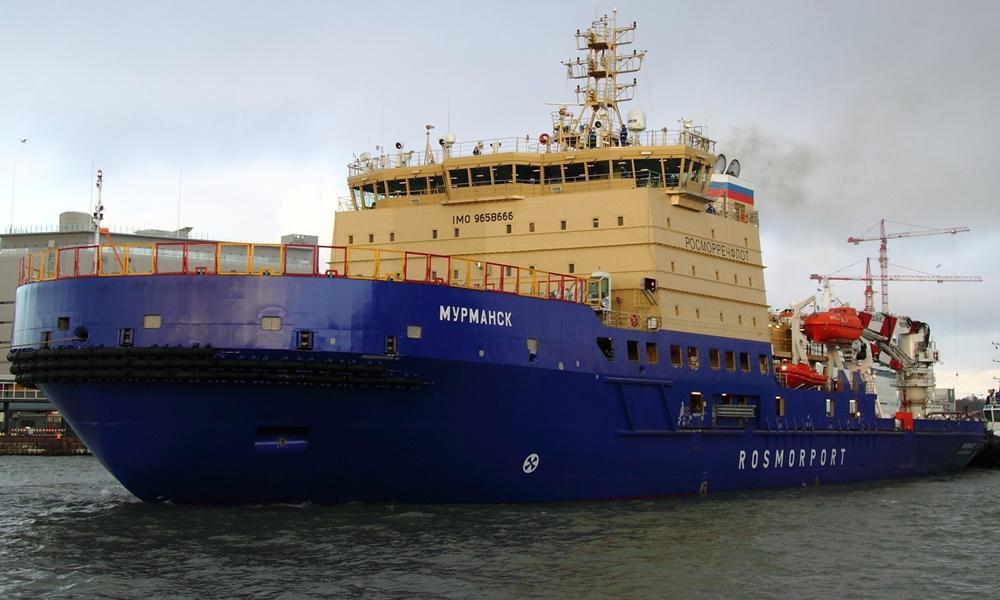
MS Murmansk ("ледокол Мурманск") is an icebreaking vessel owned and operated by Rosmorport. Rosmorport is a Russian FSUE ("Federal State Unitary Enterprise") established in 2012 by the Ministry of Transport of the Russian Federation.
The vessel (IMO number 9658666) is Russia-flagged (MMSI 273386110) and registered in Sankt-Petersburg.

Among Russia’s newest icebreakers, Murmansk is named after the port city of Murmansk, the administrative center of Murmansk Oblast. The port lies in the country’s extreme northwest, on Kola Bay (an inlet of the Barents Sea on the Kola Peninsula), near Russia’s borders with Finland and Norway.
The icebreaker was built for the Russian Ministry of Transport and launched at Arctech Helsinki Shipyard on March 25, 2015. Before launching, she was christened with the traditional champagne bottle ceremony. Designed to operate in temperatures as low as -40°C, Murmansk is one of three newbuilds ordered from Vyborg Shipyard.
Vyborg Shipyard provided the basic design, major component procurement and 40% of the hull blocks, while Arctech handled the construction, outfitting and commissioning.
On December 25, 2015, the delivery ceremony took place at Vyborg Shipyard PJSC. The vessel acceptance act was signed by the senior management of Rosmorport and Vyborg Shipyard. The icebreaker Vladivostok had been delivered earlier, in October 2015. During the ceremony, Murmansk hoisted the Russian Federation flag. Her keel-laying ceremony had been held three years earlier, on December 26, 2012.
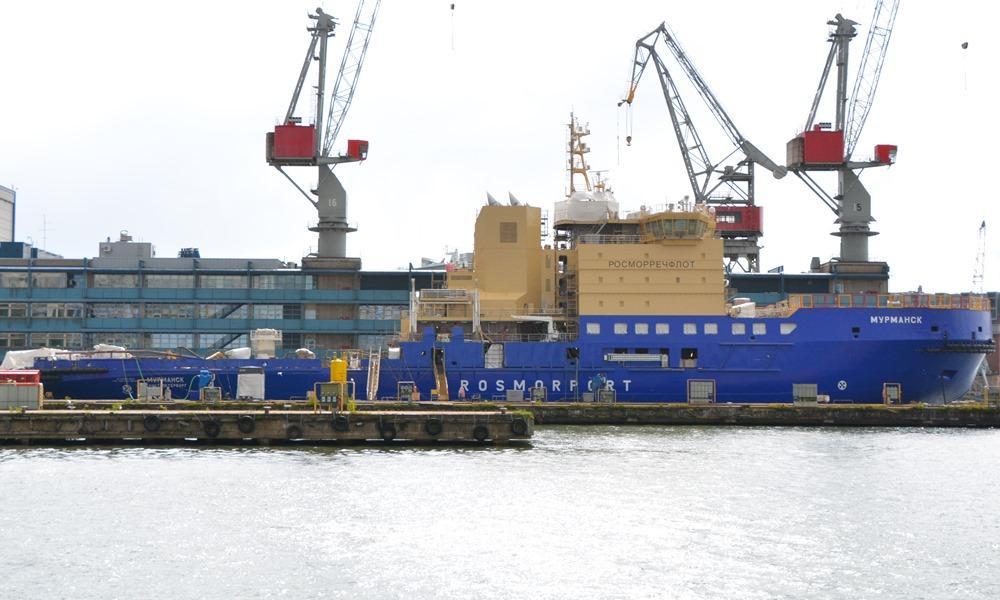
Rosmorport’s Murmansk also operates Baltic Sea and Arctic expedition cruises.
Murmansk icebreaker vessel details
Project 21900 and 21900M icebreakers (also known as LK-16) comprise a series of five Russian icebreakers. Two Project 21900 units (Sankt Peterburg and Moskva) were built at the Baltic Shipyard in St Petersburg, while three Project 21900M ships were constructed as follows: two at Vyborg Shipyard (Vyborg, Leningrad Oblast) and one at Arctech Helsinki Shipyard.
The primary purpose of these vessels is assisting heavy-tonnage ships, as well as towing floating structures both in open water and in ice.
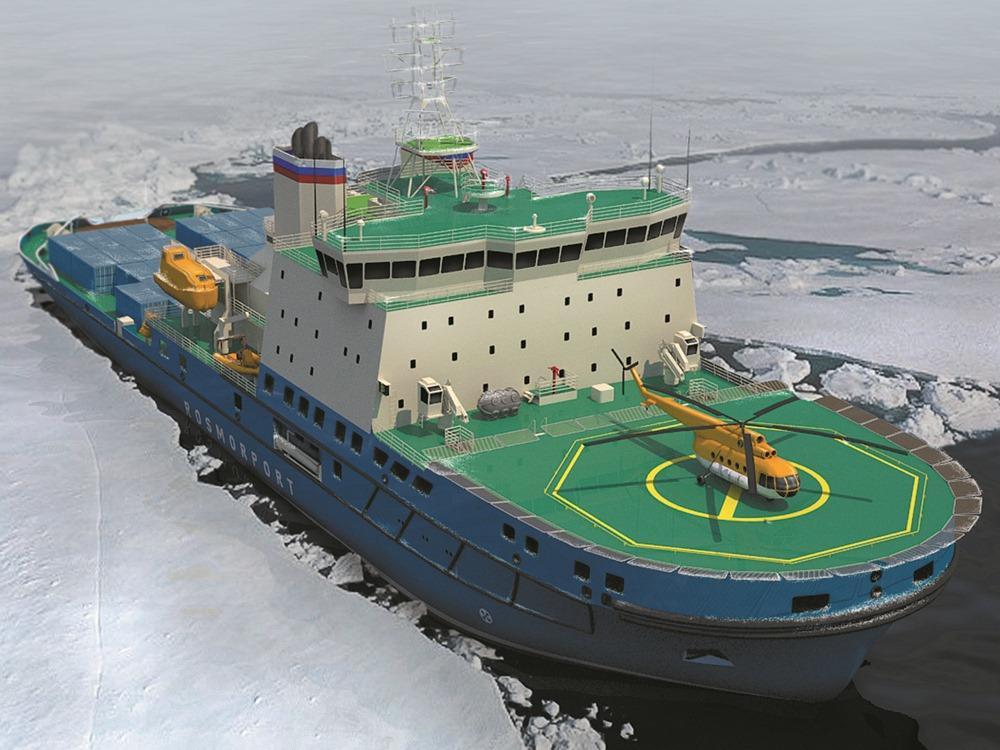
The double-deck Project 21900M icebreakers feature enhanced design and performance compared to the original 21900 class. They are equipped with a helideck and are classified by RMRS (Russian Maritime Register of Shipping) as ice-class “Icebreaker6.” These vessels are designed for operations in the Baltic Sea and along the Northern Sea Route on Russia’s Arctic coast.
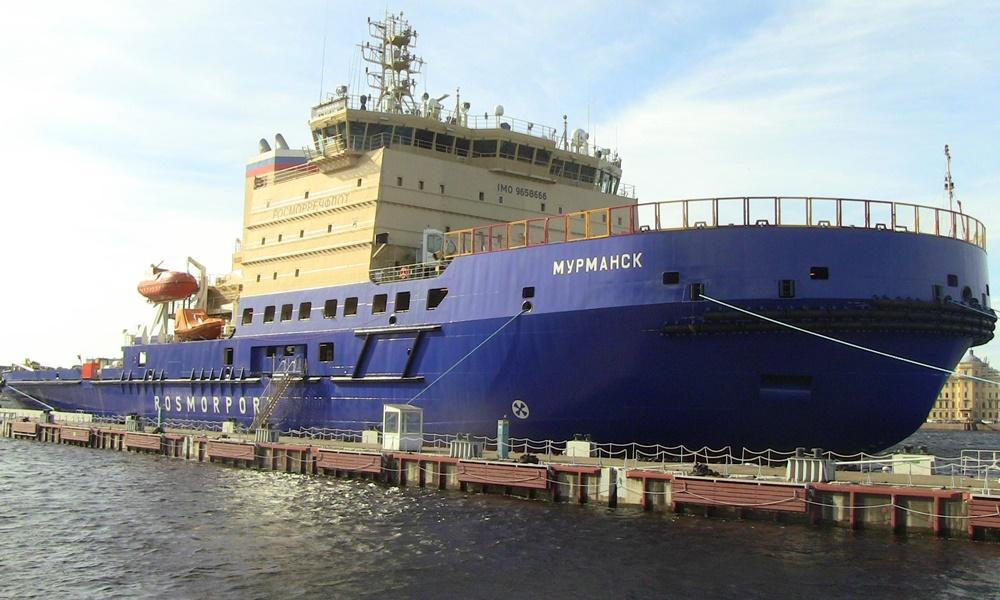
Murmansk’s sisterships in the Project 21900M class are Novorossiysk (2016) and Vladivostok (2015).
The services provided by these modern Russian icebreakers include towage, escorting heavy-tonnage vessels, salvage and assistance to distressed ships, fire-fighting on floating facilities and transportation of cargo.
The vessel’s onboard facilities include one dining room, a sauna, an indoor heated swimming pool, one elevator and a helipad.
- Max draft: 8.5 m (28 ft)
- DWT (deadweight tonnage): 5370 tons
- Displacement: 10,000 tons
- Icebreaking capacity: 1.5 m
- Cargo capacity: 33 TEUs (containers)
- Cargo deck size: 800 m2 (8600 ft2)
- Range: 20,000 km (13,000 mi)
- Powerplant: four Wartsila diesel engines (6.75 MW each, total output 27 MW)
- Propulsion: diesel-electric; two Steerprop azimuth thrusters (8.7 MW each, total output 17.4 MW)
Note: In areas with weak AIS coverage, tracking the vessel’s current position may be impossible. You can find CruiseMapper’s complete list of icebreakers and icebreaking research ships in the “itinerary” section of the Icebreakers hub. All countries and their fleets are listed there.
Photos of Murmansk icebreaker