

Polaris icebreaker
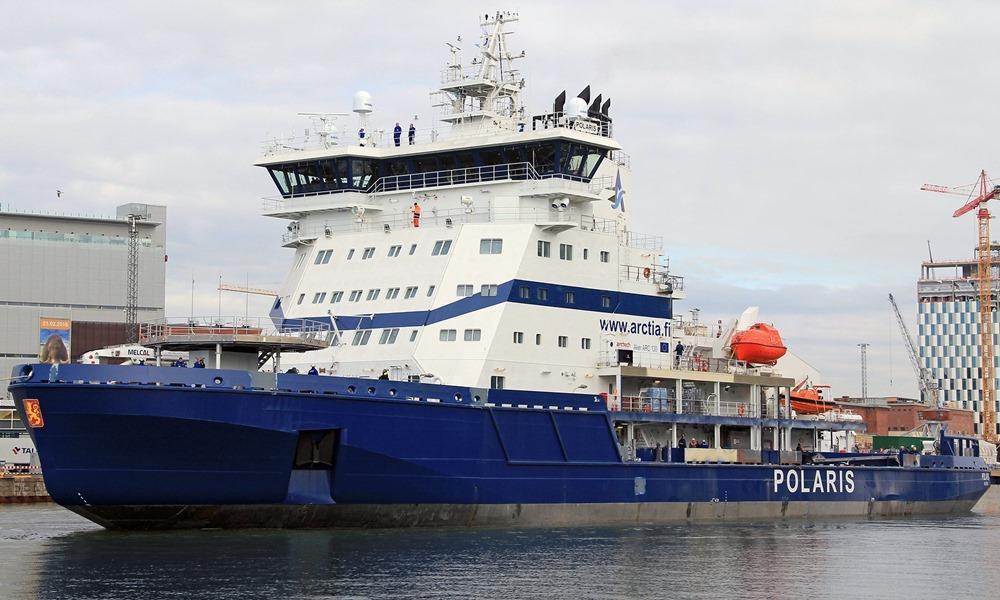
Polaris icebreaker current position
The current location of Polaris icebreaker is in Baltic Sea cruising en route to TRIAL HKI. The AIS position was last reported 3 minutes ago.
Current PositionSpecifications of Polaris icebreaker
| Year of build | 2016 / Age: 10 |
| Flag state | Finland |
| Builder | Arctech Helsinki Shipyard (Helsinki, Finland) |
| Class | Aker Arctic ARC130 (Icebreaking Support Vessel) |
| Building cost | EUR 220 million (USD 260 million) |
| Engines (power) | Wartsila (22.5 MW / 30173 hp) |
| Propulsion power | 19 MW / 25479 hp |
| Speed | 17 kn / 31 km/h / 20 mph |
| Length (LOA) | 110 m / 361 ft |
| Beam (width) | 24 m / 79 ft |
| Gross Tonnage | 10000 gt |
| Crew | 16 |
| Beds | 24 |
| Decks | 6 |
| Decks with cabins | 2 |
| Owner | Arctia Oy |
| Operator | Arctia Offshore Oy |
Polaris icebreaker Review
Review of Polaris icebreaker
Polaris is a Finnish icebreaking vessel owned and operated by Arctia Ltd (a Finnish state-owned company). One of Finland’s icebreaker ships, Polaris is the most powerful Finnish icebreaker ever constructed, as well as the world’s first LNG-powered icebreaker.
The vessel (IMO number 9734161) is currently Finland-flagged (MMSI 230661000) and registered in Helsinki.

This is the world’s first icebreaker equipped with dual-fuel engines. She operates on both LSMDO (“low-sulfur marine diesel oil”) and LNG (“liquefied natural gas”), reducing emissions and operating costs.
The vessel’s technical requirements and specifications were published in February 2013. Among these was a 16.2 MW quad-screw propulsion system, allowing navigation through compressive ridge fields at an average escort speed of 9–11 kn (17–20 kph / 10–13 mph).
The ship’s bollard pull (zero-speed pulling capability) and propulsion system are sufficient to allow year-round operation, even during winter months (ice thickness requirement up to 1.8 m / 6 ft). The specifications also included a maneuverability requirement—the ability to complete a 180-degree turn within a length of 220 m (520 ft) in just 3 minutes.
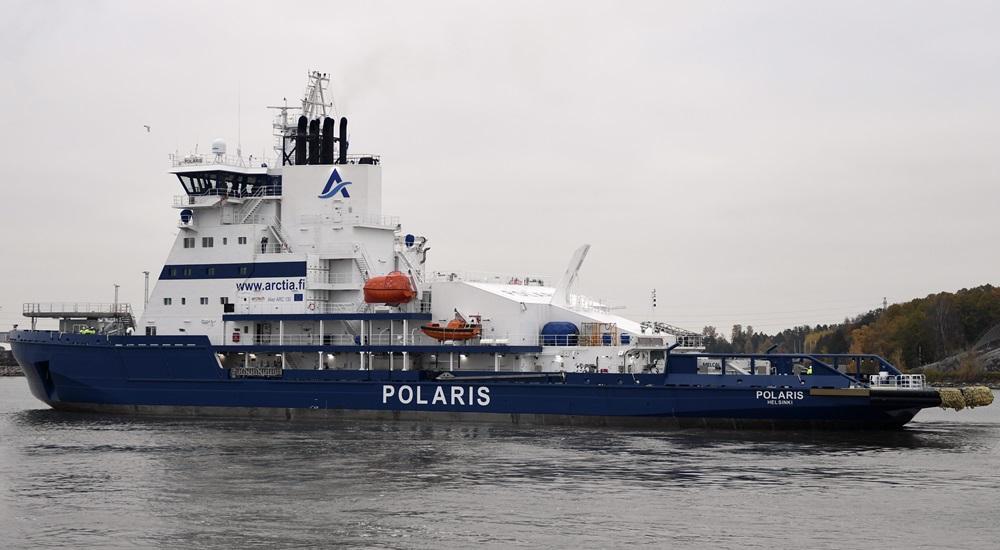
Designed primarily for Baltic Sea icebreaking and escort services, Polaris is also used for oil spill response operations due to increasing year-round oil shipping traffic in the Baltic Sea. For this secondary role, the ship is fitted with specialized equipment for operations in both ice and open water, as well as for open-sea towing in strong wind and wave conditions.
Polaris vessel details and technology
The shipbuilder Arctech Helsinki Shipyard was founded in 2011 and specializes in building icebreakers and other ice-going vessels (primarily platform supply and rescue ships). The company was a joint venture between STX Finland Cruise (now Meyer Turku Oy) and USC (United Shipbuilding Corporation, Russia). USC purchased 50% of the Hietalahti Shipyard (also known as Helsinki New Shipyard) in late 2010. In December 2014, USC acquired the remaining 50% from STX Europe (now Chantiers de l’Atlantique), becoming the sole owner of the shipyard.
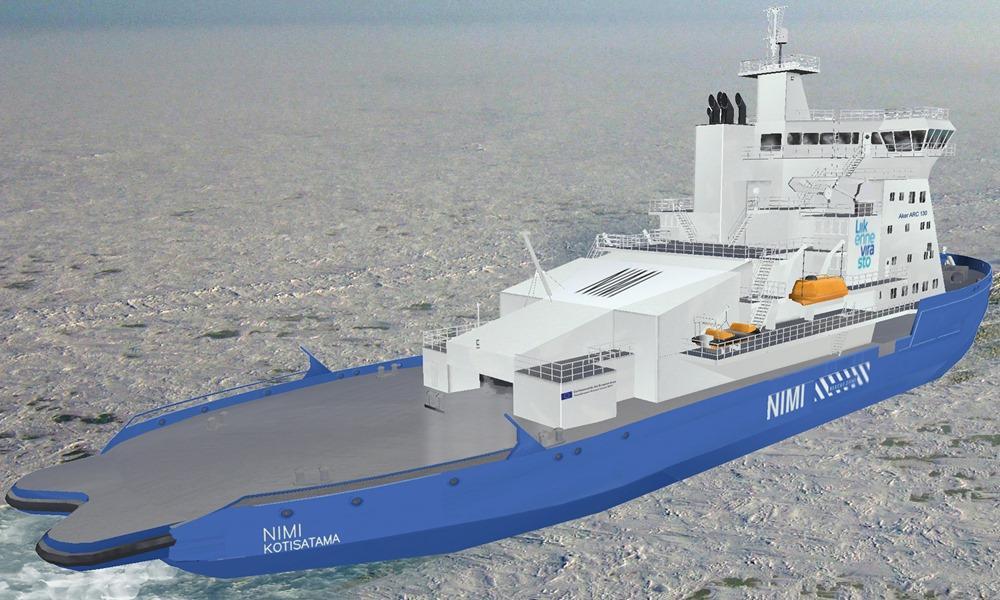
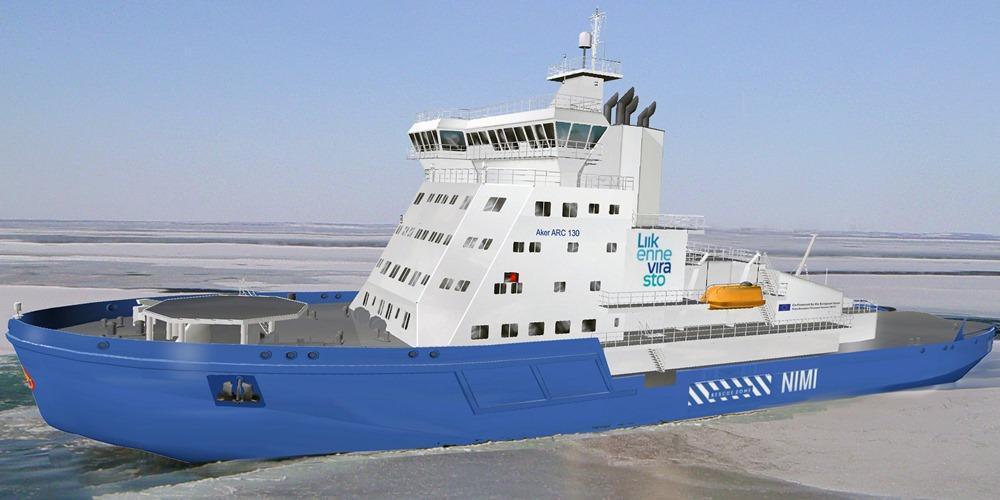
Instead of a helipad, the ship features a small bow-located winching area that can be used for helicopter landing in emergency situations.
The vessel is PC4 (Polar Class 4), intended for year-round operations in thick first-year ice. This classification also indicates that the ship can operate as an escort icebreaker in difficult ice conditions.
The hull incorporates structural strengthening in several critical areas.
As an oil spill response vessel, Polaris is equipped with an advancing system, stern-mounted brush skimmers, and recovery tanks with a total capacity of 1,300 m3 (46,000 ft3).
The powerplant is located midship (main deck level) and consists of four Wärtsilä four-stroke dual-fuel generator sets (two pairs of medium-speed engines) fitted with exhaust gas economizers. An auxiliary engine is used to generate electricity while the vessel is in port. The combined electrical power output is 22.5 MW. The ship is also equipped with an emergency diesel generator.
Polaris is capable of opening a uniform ice-free channel 25 m (82 ft) wide through ice fields with a thickness of 1.8 m (6 ft) at a speed of 4 kn (7.4 kph / 4.6 mph). She can also maintain a speed of 9.2 kn (17 kph / 11 mph) in unbroken ice with a thickness of 0.9 m (3 ft). These capabilities enable high escort speeds in winter ice conditions.
The projected service life of the Polaris icebreaker is 50 years.
Other Finnish icebreakers include (year built in brackets): MSV Fennica (1993), MSV Nordica (1994), Kontio (1987), Otso (1986), Sampo (1960), Sisu (1976), and Urho (1975).
In late November 2014, Finland’s Cabinet Committee on Economic Policy released an official statement regarding the country’s aging icebreaker fleet. According to the statement, Arctia Shipping’s older fleet would be fully replaced with new icebreakers by 2029. The project’s overall cost is estimated at approximately EUR 1 billion. The new vessels, including Polaris, are required to be multipurpose icebreakers (also suitable for Arctic oil exploration support).
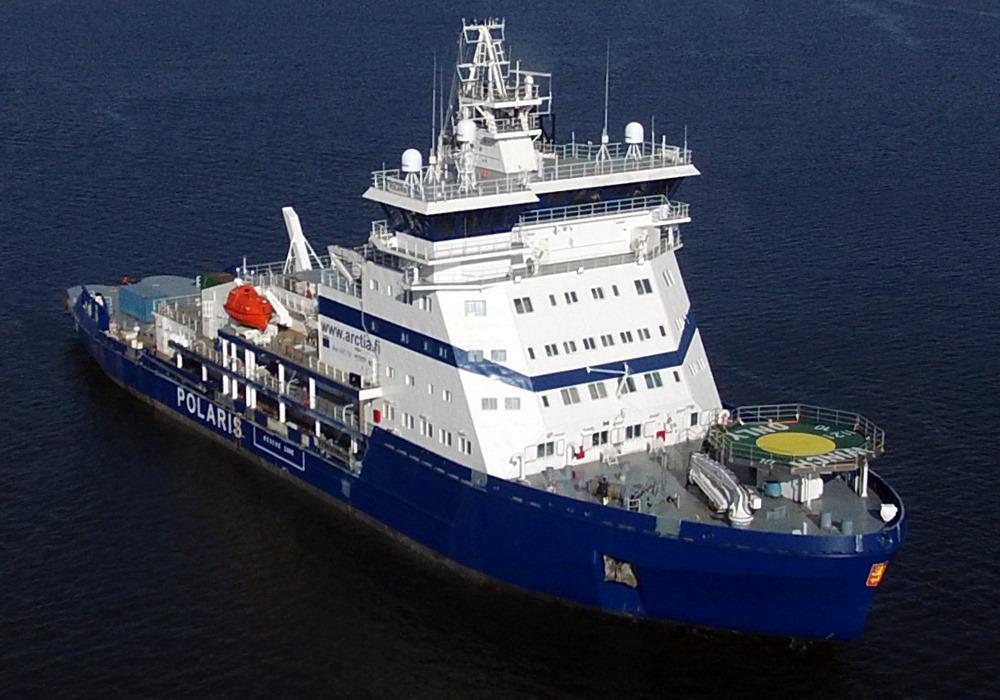
- The vessel has one dining room and a sauna; she has no swimming pool, elevator, or helipad.
- Max draught: 9 m (30 ft)
- Deadweight tonnage (DWT): 3,000 tons
- Displacement tonnage: 5,880 tons
- Bollard pull (emergency towing capacity): 193 tons
- Icebreaking capacity: 1.2 m (4 ft) at 6 kn (7 mph / 11 kph)
- Icebreaking capacity: 1.8 m (6 ft) at 3.5 kn (4 mph / 6.5 kph)
- Endurance: 10 days (LNG), 20 days (LSMDO)
- Powerplant: 2x Wärtsilä 9L34DF diesel engines (each 4.5 MW), 2x Wärtsilä 12V34DF diesel engines (each 6 MW), 1x Wärtsilä 8L20DF auxiliary engine (1.4 MW)
- Propulsion: diesel-electric, 3x azimuth thrusters (ABB Azipod motors)—1x bow (6 MW), 2x stern (each 6.5 MW); no controllable-pitch propellers. Total propulsion output: 19 MW (25,000 hp).
- The vessel’s construction cost is approximately USD 260 million. For comparison, Canadian and US Coast Guard icebreakers cost around USD 1.2 billion per vessel.
Note: In cases of poor AIS coverage, tracking the vessel’s current position may not be possible. CruiseMapper’s complete list of icebreakers and icebreaking research ships can be found in the “itinerary” section of our Icebreakers hub, where all countries and their fleets are listed.
Photos of Polaris icebreaker
Polaris icebreaker ship related cruise news
- Accidents
Finnish icebreakers aid Hanseatic Spirit through frozen Bothnian Bay
The expedition cruise vessel Hanseatic Spirit, operated by Hapag-Lloyd Cruises, encountered heavy sea ice while navigating off the coast of Kemi...
April 2, 2025 - show more news
Polaris icebreaker Wiki
On February 4, 2019, the icebreaker Polaris completed her first LNG bunkering at the Tornio Manga LNG terminal in Tornio (Finland). The vessel is the most powerful Finland-flagged icebreaker and the world’s first icebreaker equipped with dual-fuel engines capable of operating on both ULSD and LNG (ultra-low-sulfur marine diesel and liquefied natural gas).
The icebreaker’s namesakes are the riverboat Travelmarvel Polaris (2021), the cruiseferry Havila Polaris (2022), and the expedition ship Viking Polaris (2022).
The shipowner Arctia Oy is a state-owned company operating Finland’s icebreaker fleet. The company was established in 2010 as “Arctia Shipping Oy” and was renamed “Arctia Oy” in 2016. Arctia Ltd serves Liikennevirasto (“Finnish Transport Agency”, abbrev FTA) during the winter months. This Finnish government agency (annual budget EUR 1.6 billion) is responsible for maintaining Finland’s roads, railways, and waterways.
Arctia Ltd also charters its icebreaking vessels to private companies involved in the development of offshore oil and gas fields and wind farms.
Arctia Ltd has the following subsidiaries:
- Arctia Icebreaking (manages the conventional/older icebreakers Voima, Sisu, and Urho)
- Arctia Offshore (manages the multipurpose icebreakers Nordica, Fennica, Otso, and the newest LNG-powered Polaris)
- Arctia Karhu (manages port icebreaking, harbor assistance, and towing services in the Gulf of Bothnia with the vessel Ahto)
- Arctia Management Services (manages the oil-recovery icebreaker Kontio)
- If required, all Arctia icebreakers can be equipped with oil spill response equipment
The company’s icebreaker base is located at Katajanokka (Helsinki, Finland).
An upgraded (enlarged and more powerful) version of the Aker ARC130 design is ARC130A. Two such icebreakers (Alexander Sannikov and Andrey Vilkitsky) were delivered to Gazprom Neft (Russia) in 2018 to serve Gazprom’s Arctic Gate (Novy Port offshore crude oil loading terminal) at the Novoportovskoye oil field.