

Sevmorput icebreaker
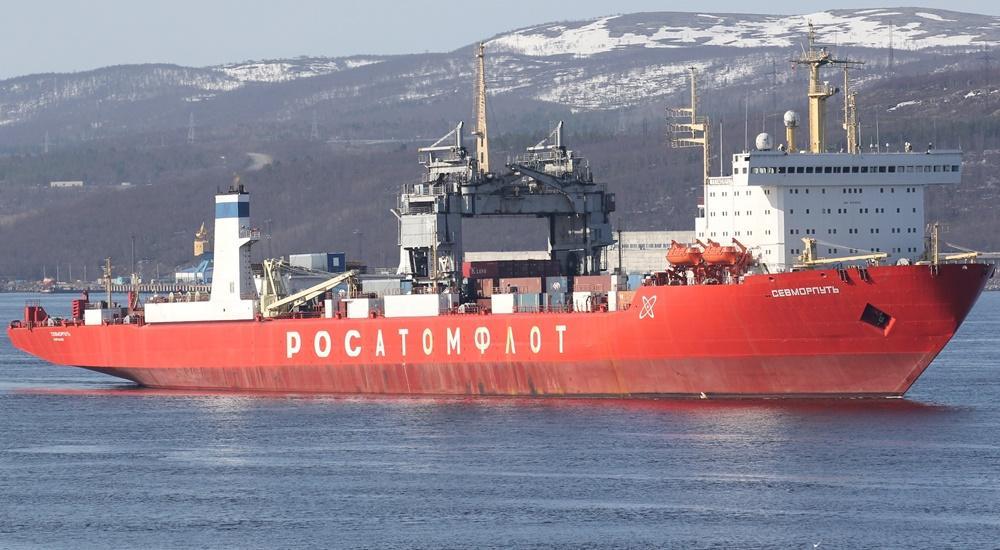
Sevmorput icebreaker last position
The last location of Sevmorput icebreaker is in Baltic Sea cruising at speed of 14.1 kn (26 km/h | 16 mph) en route to Murmansk. The AIS position was last reported 8 months ago.
Current PositionSpecifications of Sevmorput icebreaker
| Year of build | 1988 / Age: 38 |
| Flag state | Russia |
| Builder | Zaliv Shipyard (Kerch, Ukraine) |
| Class | Russian nuclear icebreaker (container cargo ship) |
| Engines (power) | KLT-40 nuclear reactor (135 MW / 181038 hp) |
| Propulsion power | 29.4 MW / 39426 hp |
| Speed | 21 kn / 39 km/h / 24 mph |
| Length (LOA) | 260 m / 853 ft |
| Beam (width) | 32 m / 105 ft |
| Gross Tonnage | 38226 gt |
| Decks | 5 |
| Owner | Russian Federation |
| Operator | Atomflot (Rosmorport) |
Sevmorput icebreaker Review
Review of Sevmorput icebreaker
NS Sevmorput ("атомный ледокол Севморпуть") is a Russian nuclear icebreaker. "NS" stands for "nuclear ship". The vessel is state-owned by the Russian Federation and operated by Atomflot. The Atomflot company provides maintenance and technological services for all Russian nuclear icebreakers and also services the country's fleet of special-purpose vessels.
The vessel (IMO number 8729810) is Russia-flagged (MMSI 273137100) and registered in Murmansk.
Besides the container carrier Sevmorput, other active Russian nuclear icebreaker ships include Taymyr (1989), Vaygach (1990), Yamal (1992), 50 Let Pobedy (2007), Arktika (2020), Sibir (2021), Ural (2022), Yakutia (2024), Chukotka (2026), and Rossiya (2027 / Project Leader).

One of the largest Russian icebreaker ships, Sevmorput is a nuclear-powered LASH (lighter aboard ship) cargo carrier and container ship. The vessel's building cost was nearly USD 265 million. Sevmorput is named after the Northern Sea Route ("Северный Морской Путь"), on which the ship operates year-round.
In October 2012 it was announced that the nuclear cargo ship would be decommissioned and scrapped. The decision was reversed in December 2013. However, by 2015 the vessel had been laid up at the Atomflot base near Murmansk (Kola Peninsula, Barents Sea). She returned to service in February 2016.
Immediately after its launch, the icebreaker was denied entry to major seaports in the USSR Far East. Port authorities in Vostochny, Nakhodka, Vladivostok, and Magadan refused to accept the two-month-old vessel. The reason was public concern about the safety of its nuclear power plant, as the Chernobyl disaster had occurred only two years earlier (April 26, 1986). Finally, on March 13, 1989, Sevmorput was allowed to dock at Vladivostok.
The ship was used mainly on the cargo shipping route between Murmansk and Dudinka, but she also completed several voyages to Vietnam. Since 2016, Sevmorput has also served as a floating laboratory and resource support vessel for Arctic operations.
Russia's fleet of nuclear-powered icebreakers is used primarily in the Arctic Ocean for escorting merchant ships and supporting research stations operating in ice-covered waters north of Siberia. These vessels are also used for scientific missions and Arctic expedition cruises. Russian nuclear icebreakers must operate in ice-cold waters to effectively cool their reactors.
NS Sevmorput container ship details
In terms of cargo capacity, Sevmorput can carry 74 lighters (flat-bottom barges), each with a cargo capacity of 300 tons, stored in six cargo holds and in two layers on the stern deck. The lighters are loaded and unloaded via a large gantry crane (manufactured by KONECRANES) with a lifting capacity of 500 tons.
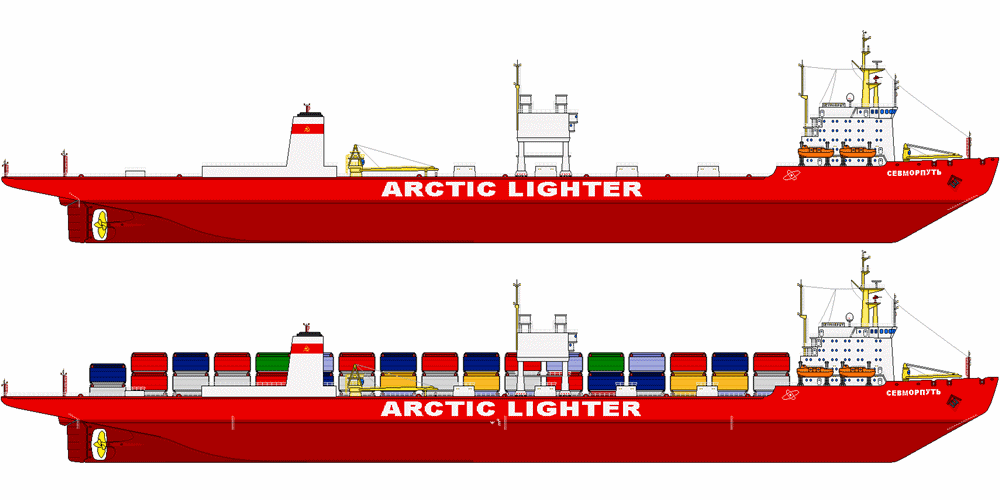
The vessel also has two 3-ton auxiliary cranes. When not carrying lighters, NS Sevmorput can transport 20- and 40-foot containers (up to 20.3 and 30.5 tons) stacked in three layers. The total container capacity is 1328 TEUs (twenty-foot equivalent units).
This is one of only four nuclear-powered merchant ships ever constructed - together with NS Mutsu (Japan, launched in 1970, decommissioned in 1992), NS Savannah (USA, launched in 1962, decommissioned in 1972, now a museum ship), and NS Otto Hahn (Germany, launched in 1968, scrapped in 2009).
The vessel has one dining room, sauna, library, auditorium, passenger lounge, gymnasium, one indoor heated swimming pool, infirmary, and one elevator, but no helipad (helicopter deck).
- Max Draft: 11 m (36 ft)
- DWT Deadweight tonnage: 26480 tons (Arctic)
- Displacement tonnage: 61800 tons
- Icebreaking capacity: 1.8 m (6 ft)
- Range: unlimited
- Powerplant: KLT-40 nuclear reactor (135 MW power output), 3x turbo-diesel generators (1.7 MW each)
- Propulsion: Single shaft; steam turbine (29.42 MW output); 1x 4-blade ducted propeller
Note: In cases of poor AIS coverage, tracking the vessel's current location may be impossible. You can see CruiseMapper's list of all icebreakers and icebreaking research ships in the "itinerary" section of our Icebreakers hub. All states and their fleets are listed there.
Photos of Sevmorput icebreaker
Other Rosatom-Rosmorport Russia cruise ships
Sevmorput icebreaker Wiki
The vessel was laid down on November 2, 1984. She was launched (floated out from drydock) on February 20, 1986, and inaugurated (entered service) on December 31, 1988. The ship's characteristics include a nuclear power plant (total output 29 MW), DWT (deadweight tonnage) of 61,880 tons (SLL / summer load line), SLL deadweight of 33,980 tons, and cargo capacity of 1320 (20-ft) plus 428 (40-ft) containers.