

NS Yakutia icebreaker
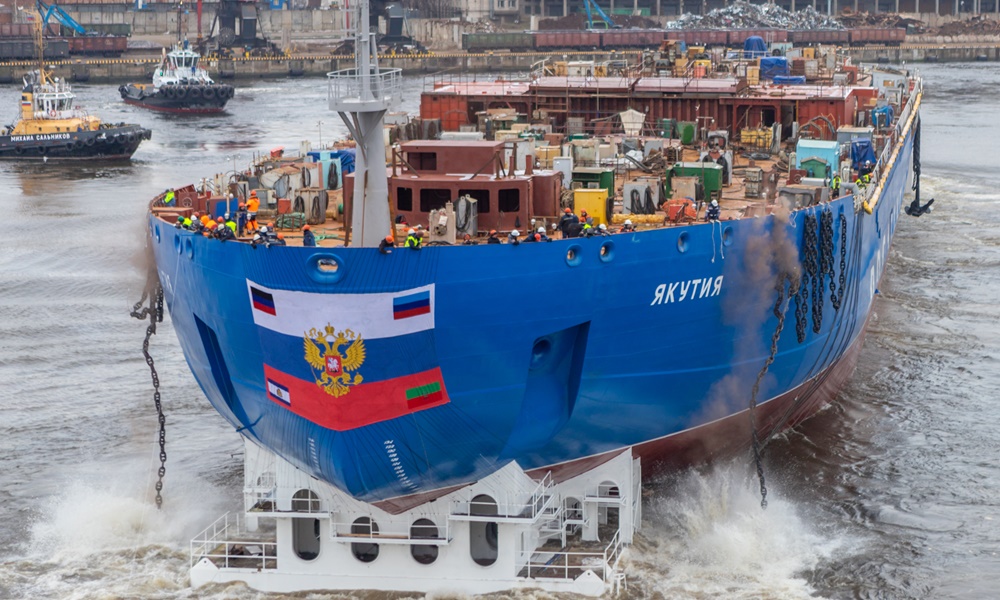
NS Yakutia icebreaker last position
The last location of NS Yakutia icebreaker is in North Russia cruising en route to Murmansk. The AIS position was last reported 3 weeks ago.
Current PositionSpecifications of NS Yakutia icebreaker
| Year of build | 2024 / Age: 2 |
| Flag state | Russia |
| Builder | Baltiysky Zavod/Baltic Shipyard (St Petersburg, Russia) |
| Class | Russian nuclear icebreaker (LC-60YA-class, Project 22220) |
| Building cost | RUB 50 billion (USD 720M / EUR 640M) |
| Engines (power) | RITM-200 nuclear reactors (350 MW / 469358 hp) |
| Propulsion power | 110 MW / 147512 hp |
| Speed | 22 kn / 41 km/h / 25 mph |
| Length (LOA) | 173 m / 568 ft |
| Beam (width) | 34 m / 112 ft |
| Gross Tonnage | 33540 gt |
| Passengers | 64 - 128 |
| Crew | 75 |
| Decks | 8 |
| Cabins | 64 |
| Decks with cabins | 5 |
| Sister-ships | NS Arktika (2020), NS Sibir (2021), NS Ural (2022), NS Chukotka (2026), NS Leningrad (2028), NS Stalingrad (2030) |
| Christened by | Victoria Valeriyevna Abramchenko |
| Owner | Russian Federation (via FSUE Atomflot) |
| Operator | Rosatom (Rosmorport) |
NS Yakutia icebreaker Review
Review of NS Yakutia icebreaker
NS Yakutia ("атомный ледокол Якутия") is a new-design (world’s largest) Russian nuclear icebreaker. “NS” stands for “nuclear ship.” The vessel is state-owned by the Russian Federation (via FSUE Atomflot) and operated by Rosatom. Atomflot provides maintenance and technological services for all Russian nuclear icebreakers and also serves the country’s special-purpose vessel fleet.
NS Yakutia is currently scheduled for delivery to FSUE Atomflot and commissioning in December 2024.
The vessel (IMO number 9911202) is Russia-flagged (MMSI 273654582) and registered in Murmansk.
Besides NS Yakutia, other active Russian nuclear icebreakers include Rossiya (2027/Project Leader), Sibir (2021/sistership), Ural (2022/sistership), Arktika (2020/sistership), Chukotka (2026/sistership), Leningrad (2028/sistership), Stalingrad (2030/sistership), and 50 Let Pobedy (2007).
Among the newest and largest Russian icebreakers, Yakutia is the fifth of the “Project 22220” ships (also known as LK-60Ya). This class comprises seven nuclear-powered icebreakers designed and built in Russia.
As the fifth unit in the series, Yakutia’s construction officially started with the keel-laying ceremony on May 26, 2020. The vessel (hull/yard number 05709) was launched (floated out from drydock) on November 22, 2022, and is currently planned for delivery and commissioning in December 2024.
These sisterships are currently the world’s largest and most powerful icebreakers ever built, surpassing the nuclear-powered icebreaker 50 Let Pobedy (50 Years of Victory) by 14 m in length and 4 m in beam.

Negotiations between the Russian companies Atomflot and USC (United Shipbuilding Corporation) were lengthy. In early 2013, the federal government allocated RUB 86.1 billion (~USD 1.3 billion) for the project. Rosatom (also a state-owned corporation) insisted that the two icebreaking ships should have a total construction cost of RUB 77.5 billion (~USD 1.2 billion). This proposal was declined by the shipbuilder Baltic Shipyard (also known as Baltiysky Zavod). A second tender, with an adjusted shipbuilding price of RUB 84.4 billion, was announced in December 2013.
Due to the vessel’s dual draught (8.7 m / 10.5 m), Yakutia’s operational program is focused on Northern Sea Route shipping assistance and includes Arctic sea navigation as well as polar river services. Her operating areas in the Arctic Ocean include the Barents Sea, Kara Sea, Pechora River, Yenisei River estuary, and the Ob River (Gulf of Ob).
Russia’s nuclear icebreaker fleet is used exclusively in the Arctic Ocean to escort merchant vessels and support research stations operating in ice-covered waters north of Siberia. These ships are also employed for scientific missions and Arctic cruise expeditions. Russian nuclear icebreakers must operate in ice-cold waters to ensure effective cooling of their reactors.
NS Yakutia vessel details
Project 22220 class Russian nuclear ships have a minimum draught of 8.6 m (28 ft) and a maximum draught of 10.5 m (34 ft). The dual-draught design allows these vessels to operate both in the Arctic Ocean and in ice-covered rivers.
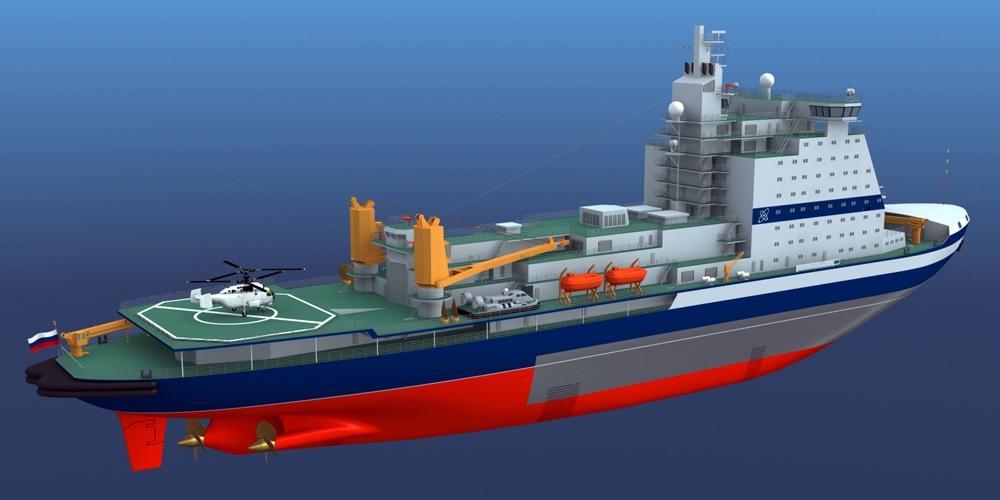
Project 22220 icebreakers are equipped with two RITM-200 nuclear reactors with a combined thermal capacity of 350 MW. Propulsion power output is 110 MW. The previous design delivered 60 MW, which is why this class is also known as “LK-60.” The RITM-200 is a pressurized water reactor developed by OKBM Afrikantov and designed to produce 55 MWe (megawatts electrical). It uses up to 20% enriched uranium-235, is refueled every seven years, and has a planned service life of 40 years. The RITM-200 is also intended for use on Russia’s newest aircraft carrier designs (Project 23000E).
Yakutia’s maximum icebreaking capability is 2.8 m (9 ft) at a cruising speed of 1.5–2 knots (2.8 kph / 1.7 mph).
In May 2015, it was reported that Russia decided to develop a new generation of nuclear-powered icebreakers capable of operating in Arctic ice up to 4.5 m (15 ft) thick. These future icebreakers are planned with propulsion power of 110 MW and will be nearly twice as powerful as Project 22220 nuclear ships.
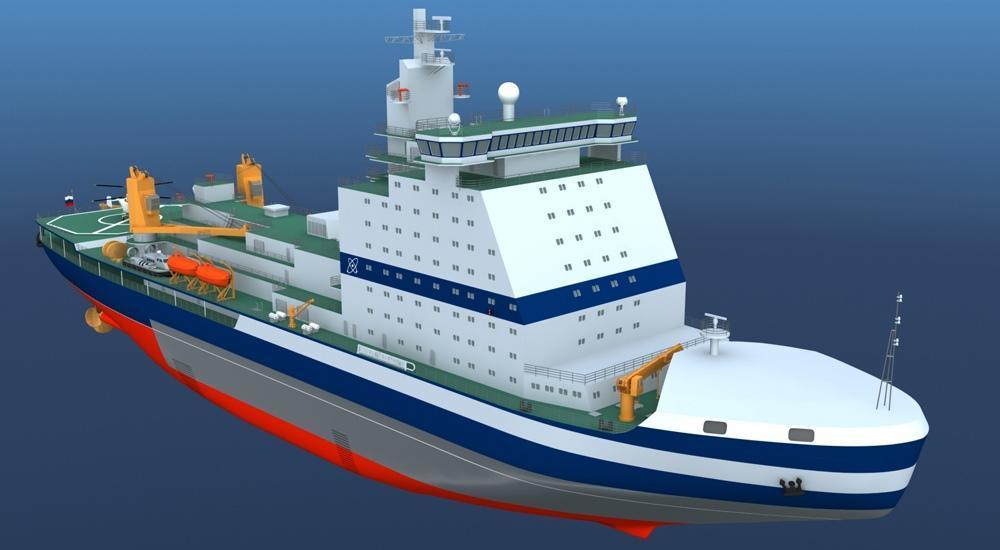
The steel used for Yakutia (thick plate “Mill 5000”) was supplied by MMK (Magnitogorsk Iron and Steel Works), one of the world’s largest steel producers, supplying over 50% of Russia’s shipbuilding steel. “Mill 5000” steel plate is used in the construction of Russia’s naval fleet, as well as tankers and ice-class vessels, and is internationally certified, including by Lloyd’s Register and Bureau Veritas.
NS Yakutia features one dining room, sauna, library, auditorium, passenger lounge, volleyball court, gymnasium, one indoor heated swimming pool, infirmary, one elevator, and a helipad accommodating a Mi-2 transport helicopter.
- DWT (deadweight tonnage): 9,000 tons
- Displacement: 33,540 tons
- Clear path width: 50 m (164 ft)
- Draught: 8.6 m (28 ft min), 10.5 m (35 ft max)
- Height: 52 m (171 ft)
- Icebreaking capability: 2.8 m (9 ft)
- Ice class: 9 (highest)
- Design service life: 40 years
- Range: unlimited
- Powerplant: 2x RITM-200 nuclear reactors (175 MW each / 350 MW total)
- Propulsion: three shafts (combined output 110 MW)
Project 22220 ships have an endurance of up to six months for provisions and up to seven years for nuclear reactor fuel.
Note: In areas with poor AIS coverage, tracking the vessel’s current position may be unavailable.
You can find CruiseMapper’s list of all icebreakers and icebreaking research ships in the “itinerary” section of our Icebreakers hub, where fleets of all operating states are listed.
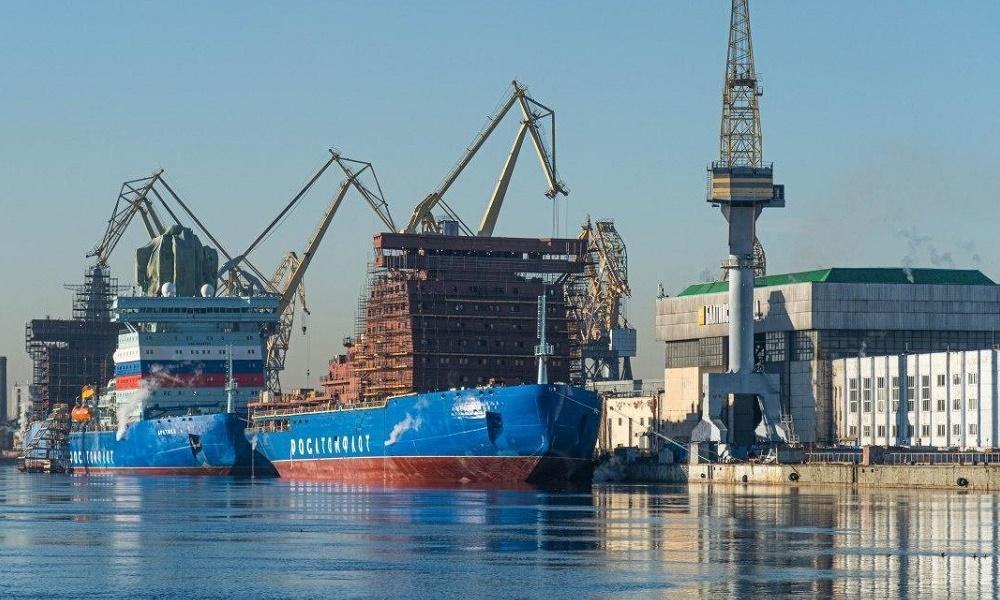
Photos of NS Yakutia icebreaker
Other Rosatom-Rosmorport Russia cruise ships
NS Yakutia icebreaker Wiki
One of the world’s largest icebreaking vessels, Yakutia was launched (floated out from drydock) on November 22, 2022 (postponed from Q2 2021 due to the COVID crisis) at the Baltic Shipyard in Sankt Petersburg. The launch ceremony was led by the ship’s godmother, Victoria Valeriyevna Abramchenko (Виктория Абрамченко, born 1975), a Russian politician and economist appointed in 2021 as the Russian Federation’s Deputy Prime Minister responsible for the agro-industrial complex, natural resources, and ecology.
The vessel’s construction officially started with the keel-laying ceremony on May 26, 2020. The event was attended by Denis Manturov (Russian Federation’s Minister of Industry and Trade), Vyacheslav Ruksha (ROSATOM’s Deputy Director-General), and Alexei Kadilov (Baltic Shipyard’s Director-General).
The ship is powered by two nuclear reactors (RITM-200 steam generator/power plants), each with a thermal capacity of 175 MW (350 MW combined output).
The shipbuilding contract for two additional “Project 22220” units (Yakutia and Chukotka, bringing the total to five icebreakers) was signed in August 2019. Under the contract terms, the shipbuilding cost per unit was RUB 50 billion (~USD 720 million / ~EUR 640 million).
The icebreaker is named after Yakutia (Sakha Republic), one of the Russian Federation’s republics with a population of around 1 million. By land area (approximately 3.084 million km2 / 1.191 million mi2), Yakutia is currently the world’s largest subnational governing entity. The republic’s capital is Yakutsk (population around 320,000), which is also a major cargo port on the Lena River. Yakutia has recorded the Northern Hemisphere’s lowest temperatures (-89.2 C / -128.6 F). Via satellite observations, even lower temperatures have been recorded only in Antarctica (-93.2 C / -135.8 F).
On September 5, 2021, ROSATOM’s Deputy Director Maxim Kulinko stated that year-round service on the Northern Sea Route (NSR) requires two additional Project 22220 ships (the 6th and 7th units). In April 2022, it was announced that the Russian Federation plans to allocate RUB 118 billion (~USD 1.7 billion / EUR 1.6 billion) from the federal budget for these two icebreakers (cost per unit RUB 59 billion / USD 851 million / EUR 807 million), with scheduled deliveries in 2028 (Leningrad) and 2030 (Stalingrad).
As Project 22220 vessels can operate in both deep (sea) and shallow waters (river estuaries), ROSATOM effectively received two types of icebreaking capability for the price of one, resulting in savings of hundreds of millions of USD.
NS Yakutia and her sisterships are of strategic importance for Russia’s plans to open the Northern Sea Route (NSR) for year-round commercial and military operations. By 2030, the NSR is expected to serve vessels carrying more than 150 million tonnes of cargo annually. The Russian Government has assigned ROSATOM the lead role in the route’s six-year infrastructure development project, with total funding of RUB 734.9 billion (USD 11.37 billion / EUR 10.17 billion). Of this amount, RUB 274 billion is provided by the Government, while over RUB 460 billion comes from investors, the largest of which are ROSATOM, ROSNEFT, and NOVATEK.
ROSATOM (founded in 2007) is a state-owned nuclear energy corporation headquartered in Moscow. It comprises over 360 companies and organizations and specializes in scientific research, nuclear weapons, and nuclear power, as well as operating the world’s only fleet of nuclear icebreakers. In 2017, ROSATOM produced 202.868 billion kWh of electricity, accounting for 18.9% of Russia’s total electricity generation. The corporation’s construction portfolio includes 33 nuclear power plant units installed and maintained in 12 countries. It also manufactures related equipment, produces isotopes for nuclear medicine, conducts research and studies, develops supercomputers and software, and advances renewable energy technologies (including wind turbines). ROSATOM holds approximately 17.7% of the global nuclear fuel market and around 35% of the world market for uranium enrichment services.
ROSNEFT (founded in 1993) is a state-controlled oil and gas corporation headquartered in Moscow. The company specializes in the exploration, extraction, production, refining, and transportation of natural gas and petroleum. ROSNEFT is ranked as Russia’s third-largest company, the country’s second-largest state-controlled enterprise (after Gazprom), and the world’s 24th-largest oil company by revenue (FY2017 – USD 103 billion / EUR 92.09 billion).
NOVATEK (founded in 1994) is Russia’s second-largest natural gas producer and the world’s seventh-largest publicly listed company by annual natural gas production volume. The company is listed on the London (LSE) and Moscow (MCX) stock exchanges. Major shareholders include Leonid Michelson (CEO, ~28%), Volga Group (23%), Total SA (~16%), and Gazprom (9.4%).