

NS Rossiya icebreaker
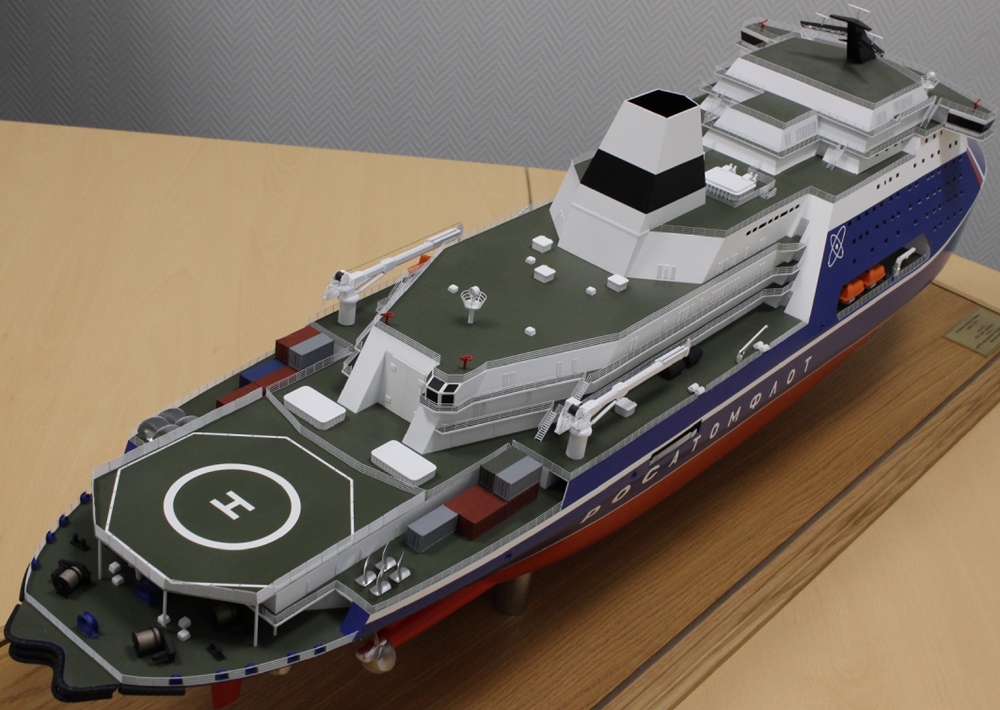
Specifications of NS Rossiya icebreaker
| Year of build | 2027 new ship |
| Builder | SKK Zvezda Shipbuilding Complex (Bolshoy Kamen, Russia). |
| Class | Russian nuclear icebreaker (Leader-class, Project 10510) |
| Building cost | RUB 127,5 billion (USD 1,99B / EUR 1,56B) |
| Speed | 23 kn / 43 km/h / 26 mph |
| Length (LOA) | 209 m / 686 ft |
| Beam (width) | 48 m / 157 ft |
| Passengers | 12 |
| Crew | 127 |
| Decks | 7 |
| Decks with cabins | 3 |
| Christened by | tba |
| Owner | Russian Federation (via FSUE Atomflot) |
| Operator | Atomflot (Rosmorport) |
NS Rossiya icebreaker Review
Review of NS Rossiya icebreaker
NS Rossiya (“атомный ледокол Россия”) is the first in a 3-unit series of “Project 10510” (also known as Project Lider/Leader or LK-120Ya) Russian nuclear icebreakers. “NS” stands for “nuclear ship.” The vessel is state-owned (by the Russian Federation via FSUE Atomflot) and operated by Rosatom. Atomflot provides maintenance and technological services for all Russian nuclear icebreakers and also manages the country’s special-purpose vessel fleet.
The vessel (IMO number 9911238) is Russia-flagged (MMSI tba) and registered in Murmansk.
NS Rossiya is scheduled for completion and commissioning in December 2027. Construction of the other two Project 10510 sisterships is planned to begin in 2023 (tbn2 / IMO 9945930 / expected completion 2030) and in 2025 (tbn3 / IMO 9945942 / expected completion 2032).
Other active Russian nuclear icebreakers include 50 Let Pobedy (2007), Arktika (2020), Sibir (2021), Ural (2022), Yakutia (2024), Chukotka (2026), Leningrad (2028), Stalingrad (2030), and Sevmorput (1988/cargo ship).
Project 10510 icebreakers – history and construction
The design and construction plans for a new generation of 110-MW nuclear icebreakers were first announced in September 2011. Development began shortly afterward, led by the state-owned Krylov State Research Center (Крыловский государственный научный центр) in cooperation with CDB Iceberg (ЦКБ Айсберг/Central Design Bureau Iceberg), a subsidiary of USC-United Shipbuilding Corporation (also the owner of Arctech Helsinki Shipyard).
Project 10510 nuclear icebreakers are intended for escort operations along the Northern Sea Route (Северный морской путь), which runs along Russia’s Arctic coastline from the Kara Sea to the Bering Strait. The icebreakers are capable of escorting cargo ships, LNG carriers, and oil tankers with a maximum width of 50 m (160 ft) and deadweight up to 100,000 tonnes.
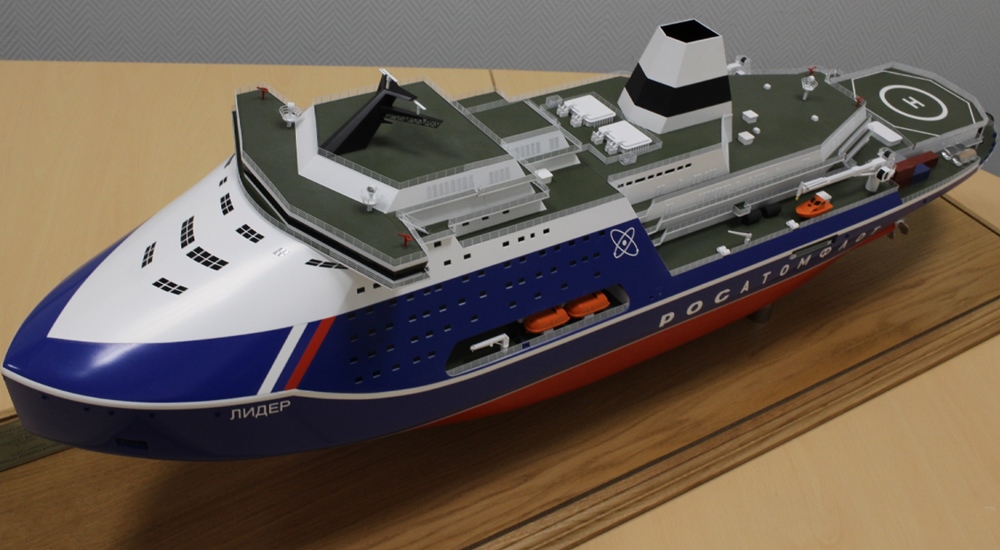
In February 2019, it was officially confirmed that all three Project 10510 vessels would be built by Zvezda Shipbuilding Complex (Судостроительный комплекс Звезда), established in 2015 and operating Russia’s largest shipyard, located in Bolshoy Kamen, Primorsky Krai.
On January 15, 2020, Russia’s Prime Minister authorized the allocation of RUB 125.57 billion (USD 1.959B / EUR 1.77B) from the federal budget for the construction of the lead ship. On April 23, 2020, Atomflot signed the contract with SKK-Zvezda for the construction of NS Rossiya.

Construction officially started on July 6, 2020 (steel-cutting ceremony, hull/yard number 056). The keel-laying ceremony took place on July 5, 2021. Launch/float-out from drydock is currently planned for 2025.
NS Rossiya vessel details
Project Leader icebreakers are designed for a 40-year service life.
- Min draft: 11.5 m (38 ft)
- Max draft: 13 m (43 ft)
- DWT (Deadweight): 100,000 tonnes
- Displacement: 50,398 tonnes (standard), 70,674 tonnes (full load)
- Icebreaking capacity: 4.3 m (14 ft) at 2 kn / 3.7 km/h / 2.3 mph
- Max icebreaking capability: 5 m (16 ft)
- Range: unlimited (8-month endurance without refueling)
- Powerplant: 2 × RITM-400 nuclear reactors (315 MW each; 630 MW combined thermal output)
- Propulsion: turbo-electric, 4 shafts, 4 electric motors (30 MW each; 120 MW combined), 4 × FPPs (fixed-pitch propellers with 4 removable blades each)
- Aft helideck
The RITM-400 reactor is a larger, more powerful version of the RITM-200 used on Project 22220 ships. It is developed by OKBM Afrikantov (Нижний Новгород), a Rosatom subsidiary. RITM-200 derives from the earlier KLT-40 reactors, which themselves evolved from the OK-150 and OK-900 marine reactors. All of these powerplants have a 60-year lifespan, a 6-year fuel cycle (refueling every 10 years), and operate on up to 20% enriched uranium-235.
The vessel’s speed varies by conditions: 23 knots in clean water, 15 knots in 2-m (7-ft) ice, and 2 knots in 4.3-m (14-ft) ice.
For information on the old Rossiya icebreaker (1985-built / 2013-decommissioned), see the vessel’s dedicated Wiki page.
Note: In areas with poor AIS coverage, tracking the vessel’s current position may be impossible.
You can find CruiseMapper’s complete list of all icebreakers and icebreaking research vessels in the “itinerary” section of our Icebreakers hub.
Photos of NS Rossiya icebreaker
Other Rosatom-Rosmorport Russia cruise ships
NS Rossiya icebreaker Wiki
ROSATOM (founded 2007) is a state-owned nuclear energy corporation headquartered in Moscow. It comprises more than 360 companies and organizations involved in scientific research, nuclear weapons development, and the operation of the world’s only fleet of nuclear icebreakers. In 2017, ROSATOM generated 202,868 billion kWh of electricity, accounting for 18.9% of Russia’s total output. The corporation’s construction portfolio includes 33 nuclear power plant units installed and maintained in 12 countries. ROSATOM also manufactures related equipment, produces isotopes for nuclear medicine, conducts scientific research, develops supercomputers and software, and invests in renewable energy technologies (including wind turbines). The corporation holds 17.7% of the global nuclear fuel market and approximately 35% of the world’s uranium enrichment services.
The old Rossiya icebreaker
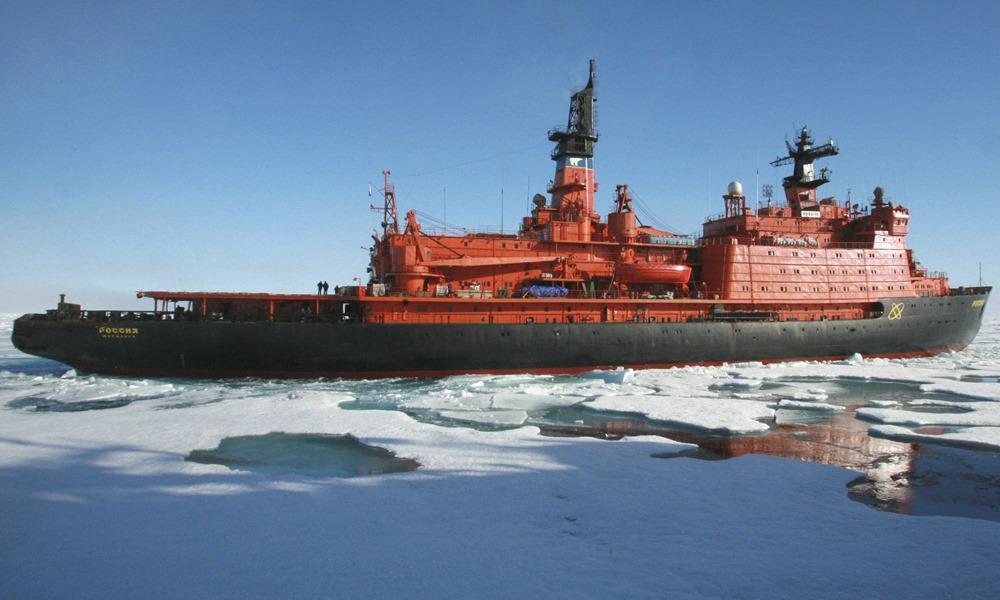
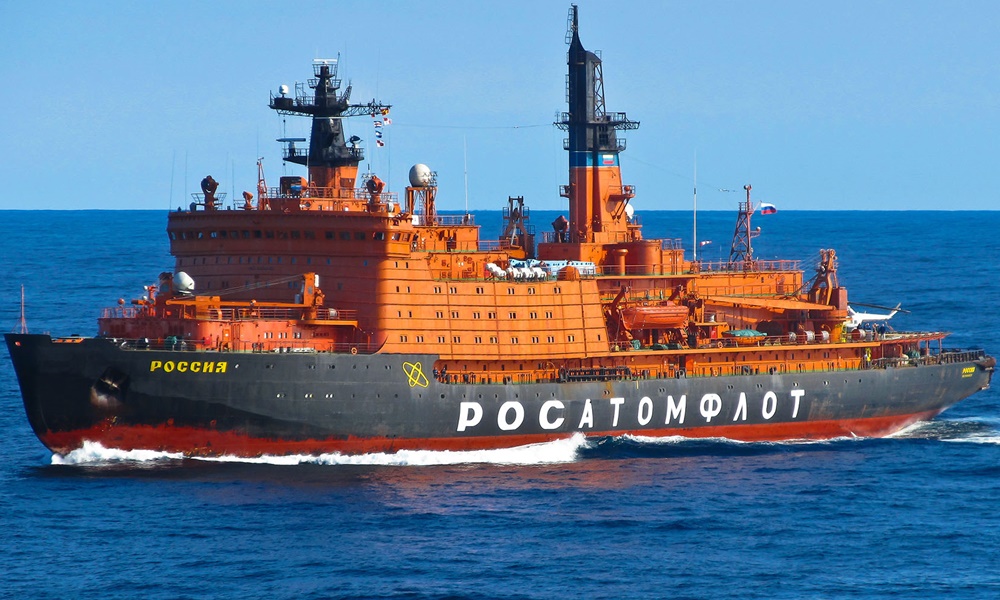
The old vessel (IMO number 8424240) was Russia-flagged (MMSI 273133400) and registered in Murmansk. It was officially decommissioned in 2013 (following the winter 2012–13 deployment in the Gulf of Finland) and remains laid up, still not scrapped.
One of Russia’s largest icebreakers, Rossiya is a nuclear-powered vessel of the Arktika-class. Construction (hull/yard number 702) began on February 20, 1981. The ship was launched on November 2, 1983, and delivered/commissioned on December 20, 1985.
In the summer of 1990, Rossiya transported an expedition of 40 West Germans to the North Pole—marking the first non-communist charter of a nuclear icebreaker. The ship also served in the Gulf of Finland during the winter of 2012–13.
Rossiya’s itinerary program included North Pole expeditions and extended voyages along the Northern Sea Route. Russia’s nuclear icebreaking fleet is used exclusively in the Arctic Ocean for escorting merchant vessels and supporting research stations in ice-covered waters north of Siberia. These ships are also used for scientific and Arctic cruise expeditions. Nuclear icebreakers must operate in cold waters to maintain proper reactor cooling.
NS Rossiya is part of the Arktika-class (Project 10520) nuclear icebreakers—until 2017 the world’s largest and most powerful ships of their type. The class consists of six vessels: the old Sibir (1977–1992), the old Arktika (1975–2008), Sovetskiy Soyuz (1990), Yamal (1992), 50 Let Pobedy (2007), and Rossiya.
All units were constructed at Baltiysky Zavod/Baltic Shipyard (Sankt-Petersburg).
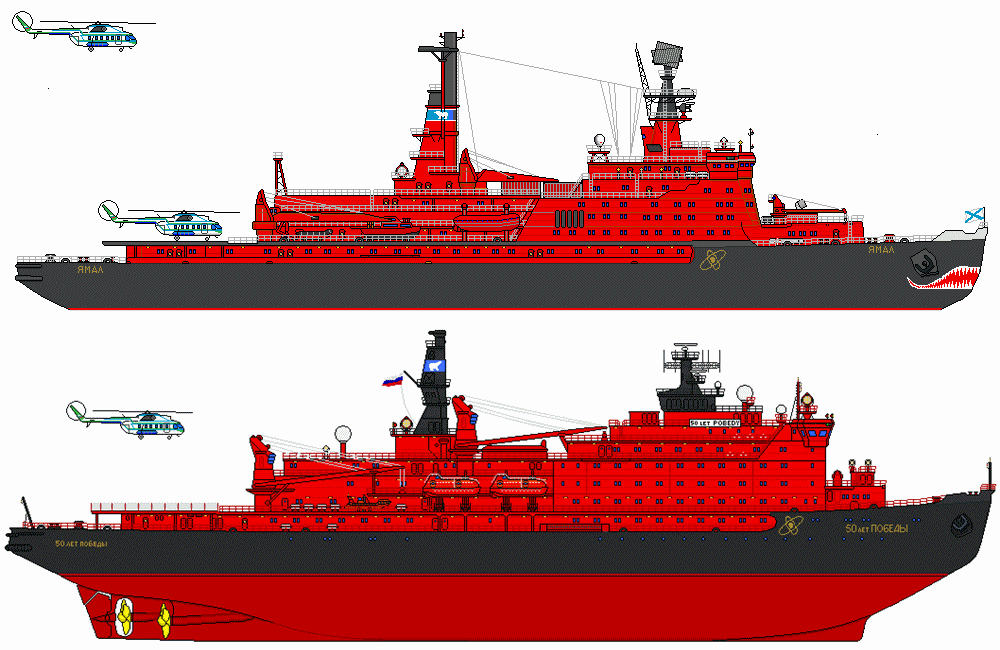
The vessel is equipped with 1 dining room, sauna, library, auditorium, passenger lounge, gymnasium, 1 indoor heated swimming pool, infirmary, 1 elevator, and 1 helipad with 2 helicopters.
- LOA (Length): 150 m / 492 ft
- Beam: 30 m / 98 ft
- GT tonnage: 20,680 tons
- Decks: 5 (2 with cabins)
- Crew: 140
- Passengers: 100
- Max speed: 21 knots / 39 km/h / 24 mph
- Max draught: 11 m / 36 ft
- DWT (Deadweight): 2,713 tons
- Displacement: 23,630 tons
- Icebreaking capability: 2.8 m / 9 ft
- Range: unlimited (4 years endurance)
- Powerplant: 2 × OK-900A nuclear reactors (171 MW each; 342 MW combined thermal output)
- Propulsion: turbo-electric, 3 shafts, 3 electric motors (17.6 MW each; 52.8 MW combined output)