

Vitus Bering icebreaker
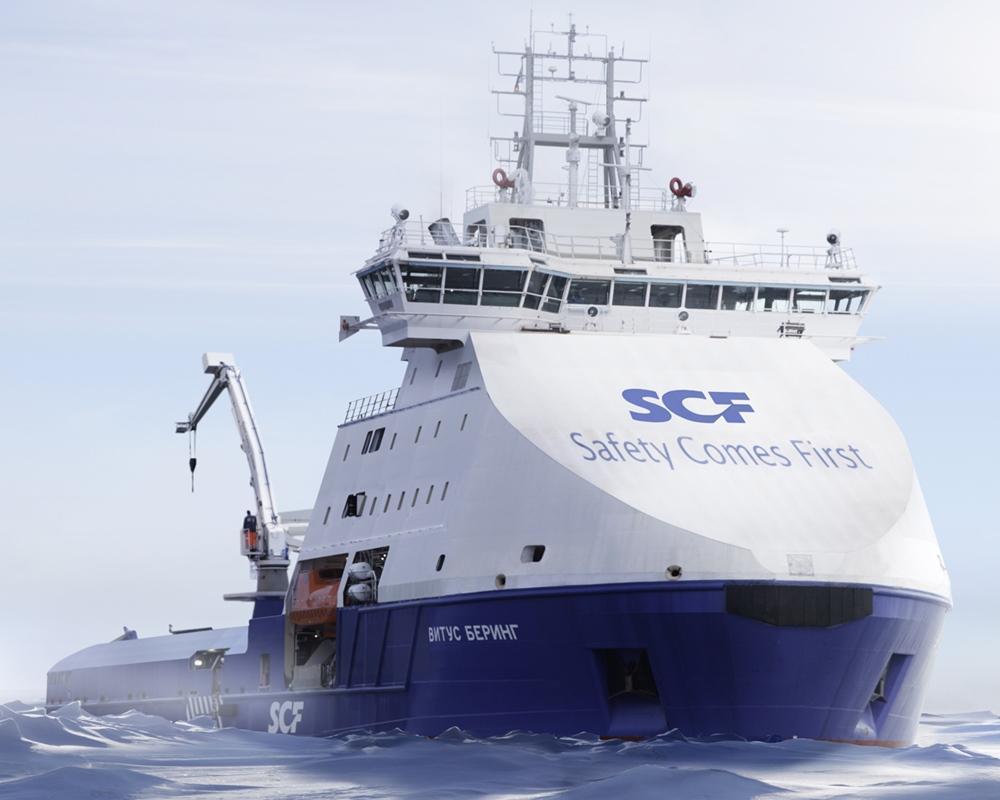
Vitus Bering icebreaker last position
The last location of Vitus Bering icebreaker is in East Asia cruising en route to NAKHODKA. The AIS position was last reported 2 weeks ago.
Current PositionSpecifications of Vitus Bering icebreaker
| Year of build | 2012 / Age: 14 |
| Flag state | Russia |
| Builder | Arctech Helsinki Shipyard (Helsinki, Finland) |
| Class | Icebreaking Supply Vessel |
| Ferry route / homeports | Vladivostok |
| Building cost | USD 100 million |
| Engines (power) | Wartsila (18 MW / 24138 hp) |
| Propulsion power | 15.6 MW / 20920 hp |
| Speed | 16 kn / 30 km/h / 18 mph |
| Length (LOA) | 100 m / 328 ft |
| Beam (width) | 22 m / 72 ft |
| Gross Tonnage | 7487 gt |
| Passengers | 28 |
| Crew | 22 |
| Cabins | 25 |
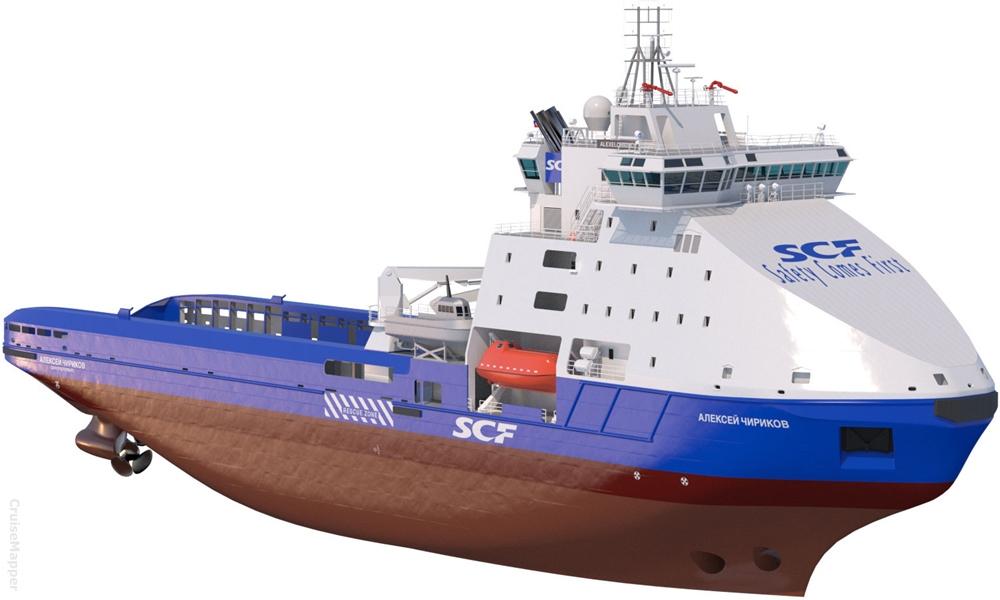
| Sister-ships | Aleksey Chirikov |
| Owner | SCF Sovcomflot (Russia) |
| Operator | SCF Sakhalin Vessels Ltd (Russia) |
Vitus Bering icebreaker Review
Review of Vitus Bering icebreaker
The 2012-built MS Vitus Bering ("ледокол Витус Беринг") is an icebreaking vessel owned by SCF Sovcomflot (Совкомфлот/fleet) and operated via the subsidiary company SCF Sakhalin Vessels Ltd. The shipowner is a Russian state-owned corporation specializing in petroleum and LNG shipping.
The vessel (IMO number 9613549, Helsinki Shipyard/hull number 506) is currently Russia-flagged (MMSI 273358680) and homeported in Vladivostok.
The icebreaker is operated as a supply vessel for Russia's Arkutun-Dagi Oil and Gas Field (Sakhalin 1 oil field) in the Sea of Okhotsk, northwestern Pacific Ocean. The ship is named after Vitus Bering (aka Ivan Ivanovich Bering, 1681-1741), a Danish-born Russian Navy officer and cartographer. Bering, together with Aleksei Ilyich Chirikov (1703-1748), were the first Russians to reach North America during the Great Northern Expedition (aka Second Kamchatka Expedition, 1733-1743). During the expedition, most of Siberia's Arctic coast and parts of North America's coastline and islands were mapped.
History and construction
This Russian icebreaker class was designed by Arctech Helsinki Shipyard (Helsinki Finland) as a supply vessel, with sistership Aleksey Chirikov (built in 2013). Both ships were ordered on December 16, 2010, following the agreement signed on December 10 between shipbuilders STX Finland (currently Meyer Turku) and OCK ("United Shipbuilding Corporation", Russia) to form the joint venture company Arctech Helsinki Shipyard.

The shipowner Sovcomflot ("Совкомфлот"/founded in 1988) is Russia's largest shipping company specializing in hydrocarbon transportation (of HGLs-Hydrocarbon gas liquids) from the Russian Arctic regions. Of the fleet's ~150 vessels, 80+ are ice-classed (with icebreaking capabilities).
Sovcomflot's shipbuilding contract value for both icebreakers was USD 200 million. Initially, both units were scheduled for delivery in April 2013, but Vitus Bering was delivered in December 2012 (4 months ahead of schedule). This series is an upgraded version of the 2005-built SCF Sakhalin.
Most hull blocks were assembled at the Arctech shipyard, and the majority were manufactured in Russia (by Vyborg Shipyard). Only 5 of the 42 hull blocks for both ships were manufactured in Finland. From Vyborg, the Russia-made hull blocks were delivered by cargo barge to the Arctech shipyard for outfitting, painting, and assembly.
The Vitus Bering ship's steel-cutting ceremony was held on July 6, 2011, at the Vyborg shipyard, officially starting the vessel's construction. Assembly began in August 2011 in Helsinki. The ship's keel-laying ceremony was held on January 19, 2012, in Helsinki. During the ceremony, the first block (353-ton midship section) was lowered into the covered drydock.
The icebreaker Vitus Bering was floated out on June 30, 2012. Aleksey Chirikov's hull assembly started in July 2012, and she was floated out on November 23, 2012. The ship was delivered on December 21, 2012 (4 months ahead of schedule). From Helsinki, the icebreaker left for Sankt-Petersburg Russia, where on January 10, 2013, she was boarded by Russian Federation's President Vladimir Putin.
Vitus Bering icebreaker vessel details
The vessel is powered by four Wartsila marine diesel engines (generator sets), of which two are 12-cylinder units (model 12V32, combined power 12 MW) and two are 6-cylinder units (model 6L32, combined power 6 MW). The ship's power plant generates a combined power output of 18 MW (24,000 hp). This provides electricity for all onboard systems.
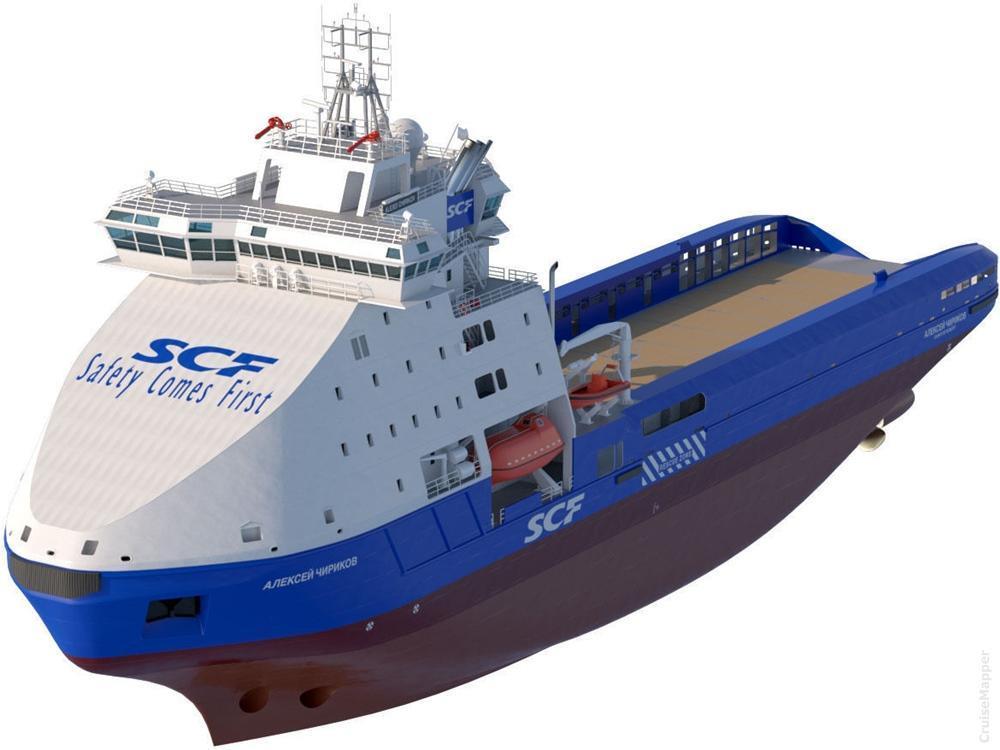
The ship's propulsion is diesel-electric, consisting of two ABB Azipods (azimuth thrusters, model VI1600, combined power output 13 MW) plus 2 bow thrusters (combined power 2.6 MW).
- Draught: 8 m (26 ft) when fully loaded
- Deadweight: 4158 tons
- Ice-breaking capacity: 1.7 m (6 ft) - both ahead and astern ice-breaking capability
- Ice-breaking speed: 3 kN (5.6 kph / 3.5 mph) in ice 1.5 m (5 ft) thick
- Endurance: 30 days
- Ice class: Icebreaker6 (RMRS / "Russian Maritime Register of Shipping")
- Cargo capacity: cargo deck (709 m2), liquids-bulk (3850 m3)
- Crew and passenger capacity: 50 (22+28)
- Firefighting capacity: 2 monitors (1200 m3 per hour each), water spraying capacity 1000 m3 per hour
- Rescue capacity: 195 people
Similarly designed, but with increased power (6 engines / 21 MW), larger capacity (70 people), and a moon pool (for diving support), are SCF's icebreaking supply vessels Gennadiy Nevelskoy, Fedor Ushakov, and Stepan Makarov.
Note: In cases of poor AIS coverage, tracking the vessel's current location will be impossible. You can see CruiseMapper's list of all icebreakers and icebreaking research ships in the "Itinerary" section of our Icebreakers hub. All states and their fleets are listed there.
Photos of Vitus Bering icebreaker
Other SCF Sovcomflot Russia cruise ships
Vitus Bering icebreaker Wiki
Other Russian newbuild icebreaking support vessels include Gazprom Neft's Alexander Sannikov (2018) and Andrey Vilkitsky (2018). Both serve Gazprom's Arctic Gate (Novy Port offshore crude-oil loading terminal) at the Novoportovskoye oil field.