

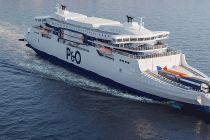
PO Liberte ferry
Former name : GUANGZHOU 19121008
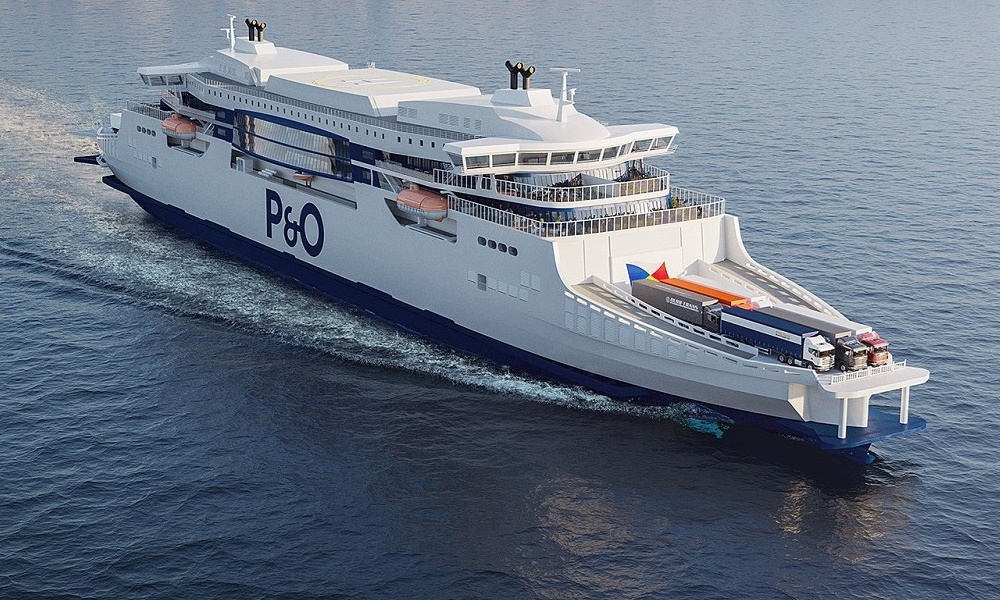
PO Liberte ferry current position
The current location of PO Liberte ferry is in North Sea cruising at speed of 18 kn (33 km/h | 21 mph) en route to CALAIS>DOVER
Specifications of PO Liberte ferry
| Year of build | 2023 / Age: 3 |
| Flag state | Cyprus |
| Builder | COMEC Guangzhou Shipyard (Nansha-Guangzhou, China) |
| Class | double-ended ferry/Ro-Pax ship |
| Ferry route / homeports | Dover-Calais |
| Building cost | EUR 130 million / USD 145 M / GBP 110 M |
| Engines (power) | Wartsila (39.2 MW / 52568 hp) |
| Propulsion power | 30 MW / 40231 hp |
| Speed | 21 kn / 39 km/h / 24 mph |
| Length (LOA) | 229 m / 751 ft |
| Beam (width) | 30 m / 98 ft |
| Gross Tonnage | 47653 gt |
| Passengers | 1500 |
| Crew | 80 |
| Cars | 200 |
| Freight vehicles | 175 |
| Decks | 7 |
| Sister-ships | P&O Pioneer |
| Former names | GUANGZHOU 19121008 |
| Christened by | tba |
| Owner | P&O Ferries Cyprus Ltd |
| Operator | P&O FERRIES UK |
PO Liberte ferry Review
Review of PO Liberte ferry
MS P&O Liberte ferry is a Ro-Ro passenger vessel owned and operated by the UK company P&O FERRIES. The ship has a maximum capacity of 1,500 passengers, 200 cars, and 175 lorries/semi-trailer trucks. The vessel was launched in 2023 (delivered in November and inaugurated in April 2024) and operates on the UK–France/English Channel route Dover–Calais (crossing time approx. 1.5 hours) together with her sistership P&O Pioneer.
The vessel (IMO number 9895173) is currently Cyprus-flagged (MMSI 210384000) and registered in Limassol.
Cabins
The ferry P&O Liberte has no cabins (passenger staterooms) due to the route’s short crossing distance. Instead, the ship offers a Reserved Seating Lounge (a luxury Club-class bar lounge furnished with comfortable leather couches).
Reserved seats are available for pre-booking. These packages include complimentary beverages (champagne, tea, coffee, soft drinks) and newspapers.
Shipboard facilities and amenities
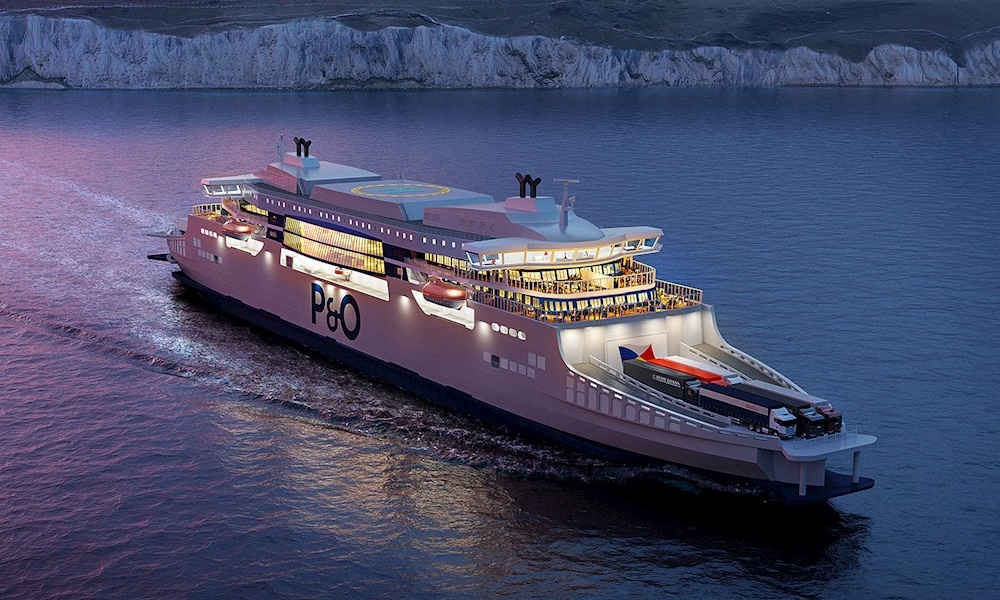
The ship’s design features two large glass walls (portside and starboard, each two decks high and spanning decks 8–9) that allow natural light into the public areas and provide unobstructed outside views. Each vessel also has approximately 1,500 m2 (16,145 ft2) of outdoor deck space for panoramic sea views.
P&O Liberte’s main passenger-accessible facilities include The Food Court (buffet-style restaurant), Brasserie (French restaurant serving gourmet cuisine and fine wines), patisseries (coffee shops offering light snacks, pastries, and hot and cold beverages), retail shops, and a Starbucks Coffee Bar.
Liberte Lounge is the main bar lounge, offering comfortable seating and served by its own bar (light snacks and drinks, including tea, coffee, and soft drinks).
Shipboard shopping offers a wide selection of branded products at discounted prices compared to UK high street rates. Discounts of up to 40% are available on luxury brand perfumes, skincare, and cosmetics, while alcohol (spirits, wines, beers) is discounted by up to 30%. The shops also sell bestseller books, newspapers, magazines, toys, games, and electronics.
The ship is entirely non-smoking, and smoking is not permitted even in the outdoor deck areas.
The ferry has no dedicated children’s staff or facilities (such as arcades or playrooms) and does not provide organized kids’ entertainment or supervised activities.
The top deck houses the helideck (a midship helicopter landing area used in emergency situations) as well as the ship’s communication equipment (radars and antennas).
Six lifts (passenger elevators) and indoor staircases connect all passenger decks with the vehicle and cargo decks.
Ship technology
Currently the world’s largest and longest double-ended ferries, each vessel is equipped with two wheelhouses/navigation bridges (one at each end). P&O selected the double-ended hull design to save approximately 10 minutes of in-port docking and undocking time, as no maneuvering is required when berthing or departing. The four Azipods are in-hull mounted (two forward and two aft) and can rotate 360 degrees, providing excellent maneuverability.
The double-ended ferry design allows vehicles to be loaded and unloaded from both ends (bow and stern). Such ferries are mainly used on short routes (including river crossings) as they reduce maneuvering time, fuel consumption, and operational risks before docking. A distinctive feature of these vessels is the duplicated propulsion system, with identical units installed at each end, resulting in improved stopping power and greater maneuverability compared to conventional ferries.
The WHRS (waste heat recovery system) provides heating for fuel tanks, fuel heaters, fuel purifier heaters, and the HVAC system (heating, ventilation, and air conditioning), producing hot water and heating machinery spaces and all areas below Deck 8. A computer-based power management system allows additional energy and fuel savings by switching off lighting and ventilation in unused areas and optimizing the powerplant, battery, and waste heat recovery systems. Further energy savings are achieved as up to two-thirds of the vessel can be closed during off-peak crossings.
The ship’s batteries are supplied by XALT Energy (a Midland, Michigan, USA-based company specializing in lithium-ion cells, battery packs, and system development). The batteries have sufficient capacity to allow departure from homeports without running the diesel generators. Designed to be plug-in ready, the vessel’s propulsion system can be converted from diesel-electric to battery-electric operation in the near future. Currently, the batteries are charged using surplus energy from the diesel engines and discharged when peak power demand is required.

Car decks
The ferry has three vehicle decks/garages, including two for trucks (Lower and Main decks) and one for cars and vans (Upper deck).
- All onboard emergency instructions are displayed in public areas, on TV screens, and at the ship’s assembly (muster) stations. Life jackets are issued at the assembly stations. In an emergency, the use of elevators/passenger lifts is prohibited.
- Passengers with disabilities or those requiring special assistance should visit the ship’s Information Desk (open 24 hours).
- Apply the handbrake and place the vehicle in park or first gear. Switch off the ignition, alarm, electrical equipment, and headlights. Gas cylinders, if any, must be turned off. Lock the vehicle.
- Take only valuables and essential hand baggage from your vehicle.
- Make a note of your vehicle’s location and the garage deck number/stairway before leaving the car deck.
- Access to the ship’s vehicle (cargo) decks during the voyage is prohibited.
- Smoking on vehicle decks, as well as in passenger lounges, is forbidden.
- Wait for the onboard announcement before returning to your vehicle.
To avoid air pollution, do not start the engine until instructed.
The shipowner P&O Ferries (fleet, founded in 2002, headquartered in Dover, England) is a UK ferry company operating routes between the UK and France, UK and Ireland, UK and the Netherlands (mini-cruises), UK and Belgium (mini-cruises), and Scotland and Northern Ireland.
Photos of PO Liberte ferry
PO Liberte ferry ship related cruise news
- Cruise Industry
Wartsila secures lifecycle agreement with P&O Ferries UK for hybrid ships
Finnish technology conglomerate Wartsila has recently inked a lifecycle agreement with the UK-based passenger and cargo shipping company P&O...
March 18, 2024 - Cruise Industry
P&O Pioneer ferry to debut with freight-only sailing Dover-Calais
According to the timetables of P&O Ferries, the company's newest ship in the Dover Strait - P&O Pioneer, will soon start revenue operations...
June 12, 2023 - Cruise Industry
P&O Ferries takes delivery of the first of 2 new “fusion class” ferries for its Dover-Calais route
Dover-based ferry company P&O Ferries took delivery of the first of 2 new “fusion class” ships for its Dover (England UK)-Calais...
March 2, 2023 - Cruise Industry
P&O Ferries' new hybrid ships cannot charge at Dover/Calais docks
P&O Ferries UK came under criticism for its purchase of 2 new hybrid electric cruiseferries despite a lack of suitable shore-power/in-port...
March 1, 2023 - show more news
Other P&O FERRIES cruise ships
PO Liberte ferry Wiki
The vessel (Guangzhou yard/hull number 19121008) has a volume of 47,653 GT, deadweight tonnage (DWT) of 8,850 tons, and a maximum draught of 5.6 m. The powerplant is based on four Wartsila marine diesel engines (model 16V31) with a combined output of 39.2 MW (52,570 hp). The propulsion system consists of four Azipod thrusters (model ABB DO1600) with a combined output of 30 MW (40,230 hp). The registered shipowner is DUBRIS LEASING 2 SNC, while the registered manager is P&O FERRIES LTD.
P&O FERRIES signed the shipbuilding contract (for two vessels, total cost EUR 260 million / GBP 220 million) with GSI-Guangzhou Shipyard International (COMEC) on September 26, 2019. The project is based on a design developed by OSK-ShipTeck AS (Copenhagen Denmark-based maritime consultancy and design company) and Guangzhou SinoDane Ship Design Co Ltd. The double-ended RoPax hull design is for a maximum passenger capacity of 1,500 and cargo capacity of 3,600 lane meters (2,800 lm for wheeled cargo/trucks and 800 lm for passenger vehicles/cars and vans). The first unit (P&O Pioneer) was scheduled for delivery in Q2 2023, and the second unit (P&O Liberte) in Q1 2024.
Both ferries were intended for P&O’s Dover–Calais service (to replace the 1991-built sisterships Pride of Kent and Pride of Canterbury), making them the largest-ever vessels (by both length and capacity) deployed on this route. The hybrid diesel-electric propulsion system reduces fuel consumption by approximately 1 ton of diesel per English Channel crossing. The system is based on four Wartsila 31 engines (16V31 diesels) that generate electricity to power the four Azipods (azimuth thrusters combining an electric motor and steerable pod with a fixed propeller). In addition to the diesel engines, each ferry is fitted with a battery pack (capacity 8.8 MWh), plug-in ready by design, and a WHRS (Waste Heat Recovery System) that utilizes waste heat from the engines to generate electricity. Together, these technologies allow for up to 40% lower fuel consumption compared to the older, smaller Pride of Kent and Pride of Canterbury.
The shipbuilder GSI (founded in 1954, now COMEC/CSSC Offshore and Marine Engineering Co Ltd) is part of CSSC-China State Shipbuilding Corporation (founded in 1982, one of China’s top 10 defense groups).
The ship’s four Wartsila 31 diesel engines are four-stroke, 16-cylinder units (running on ULSFO-ultra-low sulfur fuel oil) with a total power output of 39.2 MW (4 x 9.8 MW). ABB’s Azipods are model DO1600, with a combined power output of 30 MW (4 x 7.5 MW).
- ABB Ltd (founded in 1988, Swedish-Swiss corporation headquartered in Zurich) was contracted by GSI Shipyard in September 2020. The order included ABB Ability Marine Pilot Control (bridge-control automation system), ABB Power2 (turbocharging system improving power efficiency, delivering up to 5% fuel savings and around 60% lower NOx emissions), ABB PEMS (Power and Energy Management System), and ABB Azipods (first introduced in 1990).
- Wartsila Oyj Abp (founded in 1834, Finnish corporation) was contracted by GSI Shipyard in October 2020 to deliver the engines for both new ferries.
- Light Structures AS (founded in 2001, supplier of fiber-optic monitoring systems based on Fiber Bragg Grating technology) was contracted by GSI Shipyard in July 2022 to provide the SENSFIBTM Global+ Hull Stress Monitoring System for both vessels. The system monitors hull stress loading in real time, optimizing drydock inspection and maintenance scheduling.
P&O Liberte left China in September 2023 and arrived in the UK in October, transiting the Suez Canal and making bunkering stops for provisioning and fueling in Singapore and Gibraltar.
Formalized in January and officially signed in March 2024, P&O Ferries entered into a lifecycle ship maintenance agreement with Wartsila covering the China-built sisterships MV Pioneer and MV Liberte. The agreement includes spare parts supply and scheduled maintenance services, maintenance planning, real-time operational support, and Wartsila’s Expert Insight (predictive maintenance) service. As part of Wartsila’s Lifecycle Agreements, Expert Insight uses artificial intelligence and advanced engine diagnostics to help shipowners improve asset efficiency and reduce operating costs and greenhouse gas (GHG) emissions. With real-time assistance from a Wartsila expert, the service identifies anomalous behavior and addresses machinery or system issues before they can develop into major technical problems.