

NS Sibir icebreaker
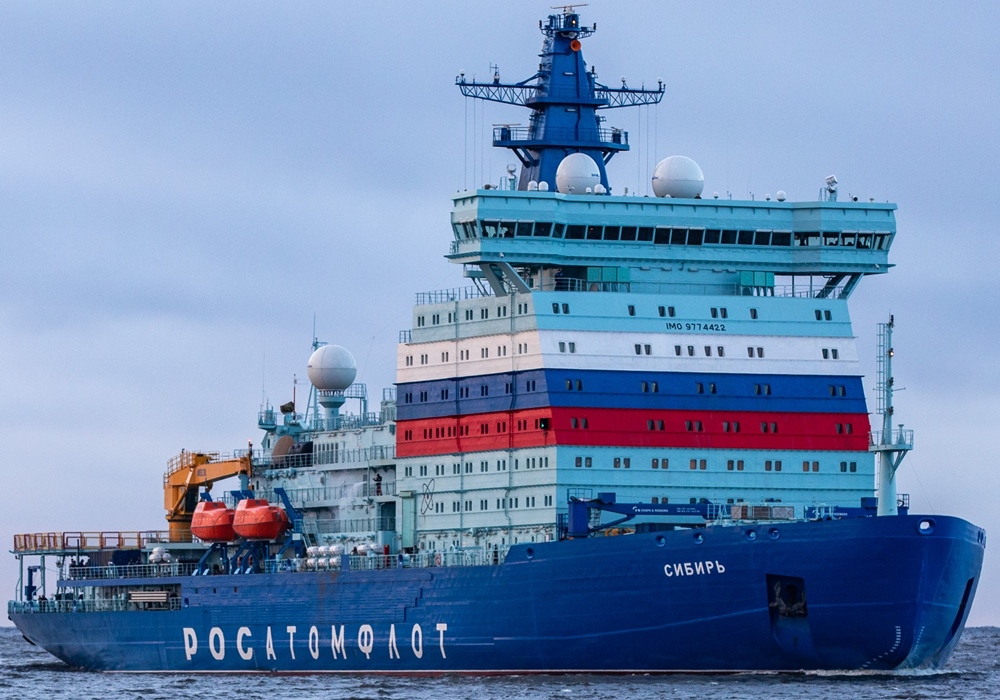
NS Sibir icebreaker current position
The current location of NS Sibir icebreaker is in North Russia cruising en route to MMK. The AIS position was last reported 6 minutes ago.
Current PositionSpecifications of NS Sibir icebreaker
| Year of build | 2021 / Age: 5 |
| Flag state | Russia |
| Builder | Baltiysky Zavod/Baltic Shipyard (St Petersburg, Russia) |
| Class | Russian nuclear icebreaker (LC-60YA-class, Project 22220) |
| Building cost | RUB 50 billion (USD 720M / EUR 640M) |
| Engines (power) | RITM-200 nuclear reactors (350 MW / 469358 hp) |
| Propulsion power | 110 MW / 147512 hp |
| Speed | 22 kn / 41 km/h / 25 mph |
| Length (LOA) | 173 m / 568 ft |
| Beam (width) | 34 m / 112 ft |
| Gross Tonnage | 33540 gt |
| Passengers | 64 - 128 |
| Crew | 53 |
| Decks | 8 |
| Cabins | 64 |
| Decks with cabins | 5 |
| Sister-ships | NS Arktika (2020), NS Ural (2022), NS Yakutia (2024), NS Chukotka (2026), NS Leningrad (2028), NS Stalingrad (2030) |
| Christened by | Tatyana Golikova |
| Owner | Russian Federation (via FSUE Atomflot) |
| Operator | Atomflot (Rosmorport) |
NS Sibir icebreaker Review
Review of NS Sibir icebreaker
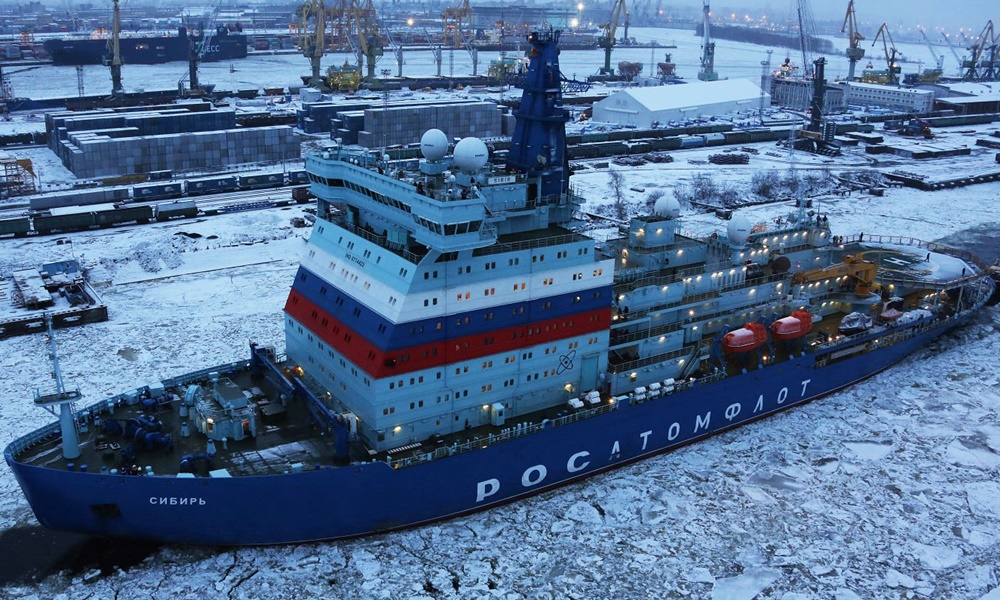
NS Sibir (“атомный ледокол Сибирь”) is a new-generation and currently the world’s largest nuclear-powered icebreaker. “NS” stands for “nuclear ship.” The vessel is state-owned (by the Russian Federation through FSUE Atomflot) and operated by Rosatom. Atomflot provides maintenance and technical services for all Russian nuclear icebreakers and also manages the country’s special-purpose vessel fleet.
The vessel (IMO number 9774422) is Russia-flagged (MMSI 273123123) and registered in Murmansk.
Active Russian nuclear icebreakers besides NS Sibir include Rossiya (2027/Project Leader), Ural (2022), Arktika (2020), Yakutia (2024), Chukotka (2026), Leningrad (2028), Stalingrad (2030), and 50 Let Pobedy (2007).

Sibir is the second vessel in the “Project 22220” (LK-60Ya) class of nuclear icebreakers, a series of seven units designed and built in Russia.
Construction began with the keel-laying ceremony on May 26, 2015. The vessel (hull/yard number 05707) was launched on September 22, 2017, and officially delivered and commissioned on December 24, 2021. NS Sibir entered service in January 2022.
These ships are currently the world’s largest and most powerful icebreakers, exceeding the dimensions of the earlier “nuclear cruise ship” 50 Let Pobedy by 14 m in length and 4 m in width.
Negotiations between Atomflot and USC (United Shipbuilding Corporation) were lengthy. In 2013, the federal government allocated RUB 86.1 billion (~USD 1.3 billion) for the project. Rosatom proposed a lower cost—RUB 77.5 billion (~USD 1.2 billion)—but Baltic Shipyard declined. A new tender in December 2013 set the shipbuilding cost at RUB 84.4 billion.
Due to the vessel’s dual-draft design (8.7 m / 10.5 m), Sibir operates along the Northern Sea Route and serves both Arctic sea passages and river estuaries. Operational areas include the Barents Sea, Kara Sea, Pechora River, Yenisei estuary, and the Ob River (Gulf of Ob).
Russia’s nuclear icebreaker fleet is used exclusively in the Arctic Ocean for escorting commercial vessels and assisting research stations in ice-covered regions north of Siberia. These ships also support scientific expeditions and Arctic cruise operations. Their reactors must operate in cold waters for optimal cooling efficiency.
NS Sibir vessel details
Project 22220 nuclear icebreakers have a minimum draught of 8.6 m (28 ft) and a maximum of 10.5 m (34 ft). The dual-draft configuration enables operations in both deep-sea and shallow river environments.
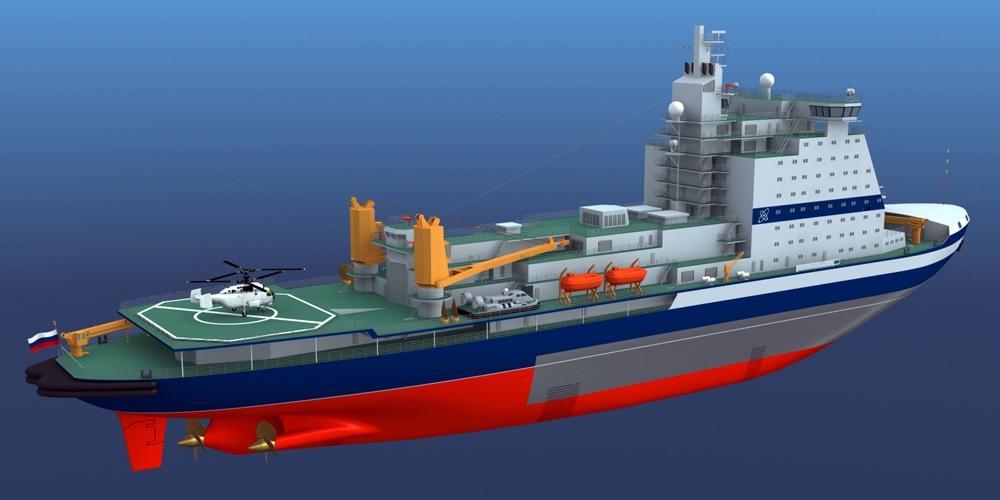
Each ship carries two RITM-200 nuclear reactors generating a combined thermal output of 350 MW. Propulsion output is 110 MW. The previous-generation design delivered 60 MW (hence the “LK-60” designation). The RITM-200, developed by OKBM Afrikantov, is a pressurized water reactor producing 55 MWe. It uses up to 20% enriched uranium-235, requires refueling every 7 years, and has a planned 40-year service life. The same reactor type is used for Russia’s newest aircraft carriers (Project 23000E).
Sibir’s maximum icebreaking capability is 2.8 m (9 ft) at a cruising speed of 1.5–2 knots (2.8 km/h / 1.7 mph).
In May 2015, Russia announced plans to develop new-generation nuclear icebreakers capable of breaking ice up to 4.5 m (15 ft) thick, with propulsion power of 110 MW—nearly double that of Project 22220 units.
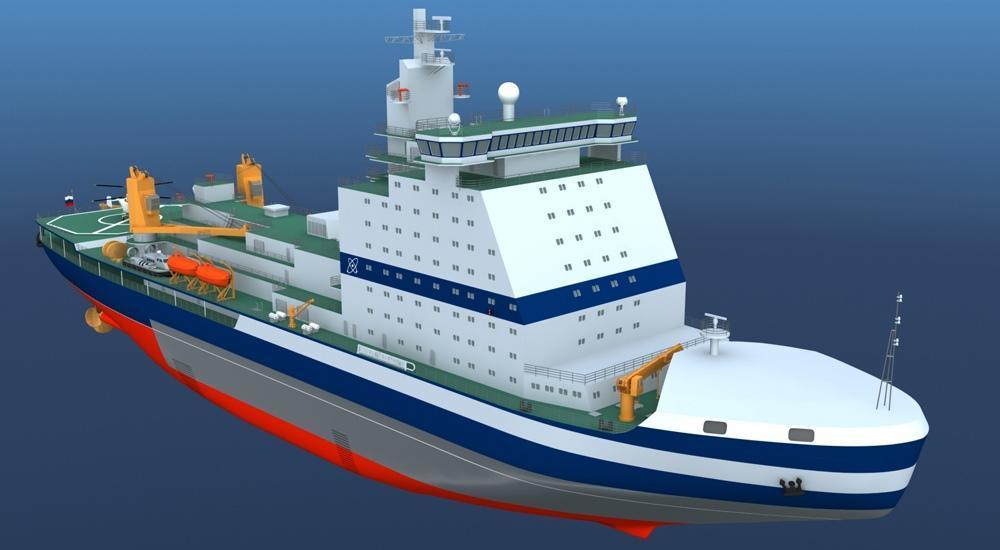
The steel for Sibir (“Mill 5000” thick plate) was supplied by MMK (Magnitogorsk Iron and Steel Works), one of the world’s top steel producers and supplier of over 50% of Russia’s shipbuilding steel. Mill 5000 is used in naval vessels, tankers, and ice-class ships, and is certified by Lloyd’s Register and Bureau Veritas.
The next photo shows the old NS Sibir.
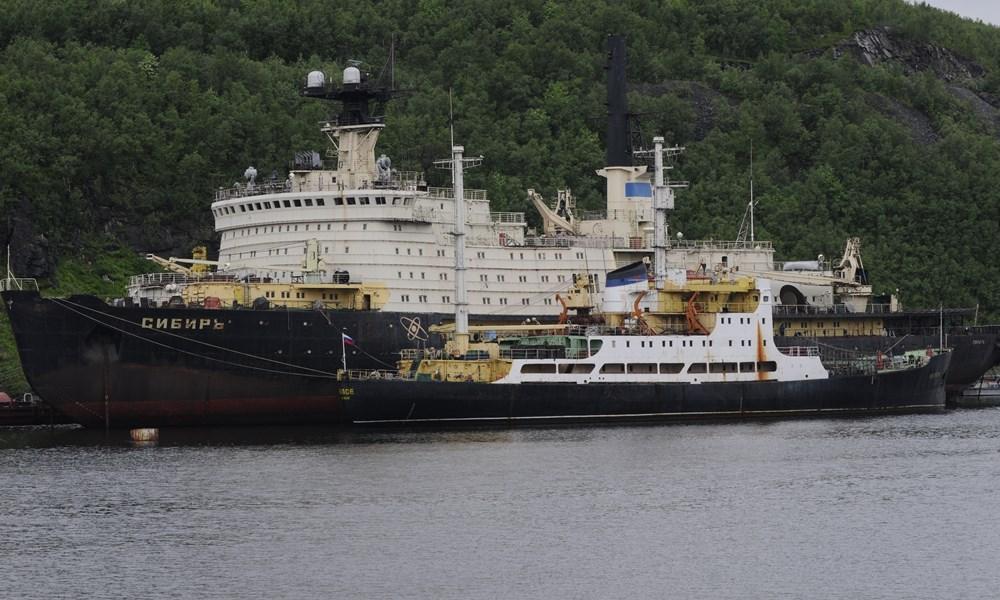
The old Sibir (1977-built) was decommissioned in 1992. NS Sibir (IMO 7604491) belonged to the Arktika-class nuclear ships—the world’s largest and most powerful icebreakers of their time. The vessel was state-owned and operated by MSCO (Murmansk Shipping Company), later transferred to Atomflot.
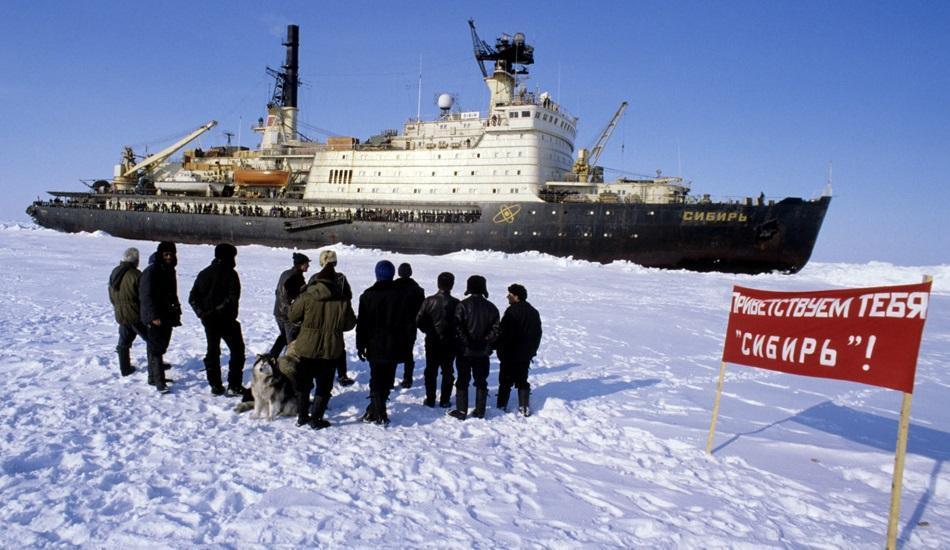
The old icebreaker was one of ten Russian nuclear ships and one of six vessels of its class, along with the old Arktika (1975–2008), Rossiya (1982), Sovetskiy Soyuz (1990), Yamal (1992), and 50 Let Pobedy (2007).
Interestingly, the old NS Sibir was the only Russian nuclear icebreaker whose superstructure was not painted red. After retirement in 1992, the vessel remained laid up in Murmansk until at least 2012 awaiting scrapping.
NS Sibir is equipped with: 1 dining room, sauna, library, auditorium, passenger lounge, volleyball court, gymnasium, 1 indoor heated swimming pool, infirmary, 1 elevator, and 1 helipad (Mi-2 transport helicopter).
- Deadweight: 9,000 tons
- Displacement: 33,540 tons
- Clear path width: 50 m (164 ft)
- Draught: 8.6 m (min), 10.5 m (max)
- Height: 52 m (171 ft)
- Icebreaking capability: 2.8 m (9 ft)
- Ice class: 9 (highest)
- Design service life: 40 years
- Range: unlimited
- Powerplant: 2× RITM-200 reactors (175 MW each; 350 MW total)
- Propulsion: 3 shafts (110 MW combined)
Project 22220 ships have an endurance of 6 months (provisions) and 7 years (nuclear fuel).
Note: In areas with poor AIS coverage, tracking the vessel’s real-time position may not be possible.
You can view CruiseMapper’s complete list of icebreakers and icebreaking research ships in the “itinerary” section of our Icebreakers hub.
Photos of NS Sibir icebreaker
Other Rosatom-Rosmorport Russia cruise ships
NS Sibir icebreaker Wiki
The vessel’s construction officially began with the keel-laying ceremony held on May 26, 2015, at the Baltic Shipyard in Sankt-Petersburg, Russia. The nuclear-powered ship (IMO number 9774422) is Russia-flagged (MMSI 273123123).
On September 22, 2017, the world’s largest icebreaking vessel was launched (floated out from the drydock) at the Baltic Shipyard. The ship’s first nuclear reactor (RITM-200 steam generator/power plant) was delivered and installed in November 2017, followed by the second reactor in December. Each RITM-200 reactor has a thermal capacity of 175 MW (350 MW combined output).
NS Sibir was delivered to FSUE Atomflot and commissioned on December 24, 2021.
In August 2019, a shipbuilding contract was signed for two additional “Project 22220” vessels—Yakutia and Chukotka—bringing the total to five units. The cost per ship was set at RUB 50 billion (~USD 720 million / ~EUR 640 million).
The vessel is named after Siberia (Sibir), one of the world’s largest geographical regions, extending from the Ural Mountains eastward to the Pacific Ocean, bordered by the Arctic Ocean to the north and Kazakhstan–Mongolia–China to the south. The Yenisei River symbolically divides Siberia into Western and Eastern regions.
On September 5, 2021, Rosatom Deputy Director Maxim Kulinko announced that year-round navigation along the Northern Sea Route required two additional Project 22220 icebreakers (a 6th and 7th unit). In April 2022, the Russian Federation announced plans to allocate RUB 118 billion (~USD 1.7B / EUR 1.6B) for these vessels (cost per unit RUB 59B / USD 851M / EUR 807M), with scheduled deliveries in 2028 (Leningrad) and 2030 (Stalingrad).
Since Project 22220 ships can operate in both deep-sea areas and shallow river estuaries, ROSATOM effectively received two types of icebreakers for the price of one, reducing overall fleet-modernization costs substantially.
NS Sibir and her sisterships play a crucial role in Russia’s strategy to maintain year-round commercial and military operations along the Northern Sea Route (NSR). By 2030, the NSR is expected to support over 150 million tonnes of cargo annually. The Russian Government appointed ROSATOM as the lead organization for the route’s six-year infrastructure program, funded at RUB 734.9 billion (USD 11.37B / EUR 10.17B). Of this amount, RUB 274 billion came from the federal budget, while RUB 460+ billion was provided by investors—the largest being ROSATOM, ROSNEFT, and NOVATEK.
ROSATOM (founded 2007) is a state-owned nuclear energy corporation headquartered in Moscow. It includes more than 360 companies and organizations focused on scientific research, nuclear weapons development, and the world’s only fleet of nuclear icebreakers. In 2017, ROSATOM generated 202,868 billion kWh of electricity (18.9% of Russia’s total). Its construction portfolio includes 33 nuclear power-plant units across 12 countries. The corporation also manufactures related equipment, produces medical isotopes, conducts research, develops supercomputers and software, and invests in renewable energy technologies (including wind turbines). ROSATOM controls 17.7% of the global nuclear fuel market and ~35% of the world’s uranium enrichment services.
ROSNEFT (founded 1993) is a state-controlled oil and gas corporation headquartered in Moscow. The company specializes in exploration, extraction, production, refining, and transportation of natural gas and petroleum. ROSNEFT is Russia’s 3rd-largest company and the country’s 2nd-largest state-controlled enterprise (after Gazprom). It is the world’s 24th-largest oil company by revenue (FY2017: USD 103 billion / EUR 92.09 billion).
NOVATEK (founded 1994) is Russia’s 2nd-largest natural gas producer and the world’s 7th-largest publicly listed natural gas company by production volume. NOVATEK is listed on the London (LSE) and Moscow (MCX) stock exchanges. Major shareholders include Leonid Michelson (CEO, ~28%), Volga Group (23%), Total SA (France, ~16%), and Gazprom (9.4%).