

Sunflower Sapporo ferry
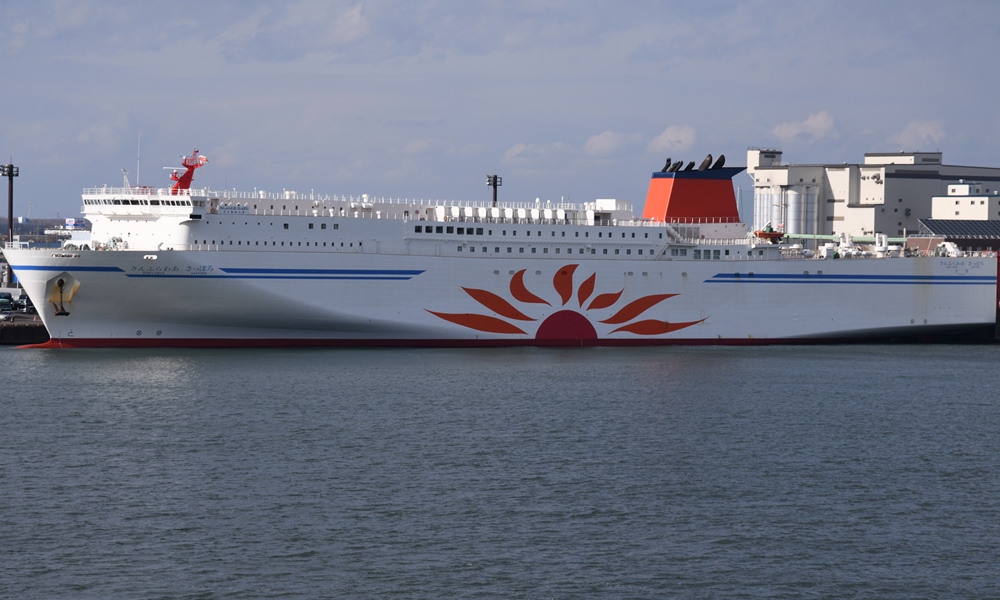
Sunflower Sapporo ferry current position
The current location of Sunflower Sapporo ferry is in East Asia cruising at speed of 22.2 kn (41 km/h | 26 mph) en route to Sapporo-Tomakomai. The AIS position was last reported 5 minutes ago.
Current PositionSpecifications of Sunflower Sapporo ferry
| Year of build | 2017 / Age: 9 |
| Flag state | Japan |
| Builder | JMU-Japan Marine United Corporation (Isogo-Yokohama, Japan) |
| Class | cruiseferry (Ro-Pax ship) |
| Ferry route / homeports | Oarai-Tomakomai/Sapporo City |
| Engines (power) | Wartsila (21 MW / 28161 hp) |
| Speed | 24 kn / 44 km/h / 28 mph |
| Length (LOA) | 200 m / 656 ft |
| Beam (width) | 27 m / 89 ft |
| Gross Tonnage | 13816 gt |
| Passengers | 636 |
| Crew | 46 |
| Cars | 146 |
| Freight vehicles | 160 |
| Decks | 8 |
| Cabins | 97 |
| Decks with cabins | 3 |
| Sister-ships | Sunflower Furano |
| Owner | Mitsui OSK Lines Ltd (via Mitsui OSK Passenger Line) |
| Operator | MOL Ferries Ltd (via MOL Ferry Co Ltd) |
Sunflower Sapporo ferry Review
Review of Sunflower Sapporo ferry
Sunflower Sapporo ferry is a Ro-Pax/Ro-Ro passenger vessel operated by the Japan-based company MOL FERRIES (a subsidiary of Mitsui OSK Passenger Line). The ship has a maximum capacity of 636 passengers and a cargo capacity of 146 cars plus 160 lorries (semi-trailers/13-meter trucks). She was inaugurated in October 2017 and currently operates on the Honshu–Hokkaido ferry route Oarai-Tomakomai/Sapporo City (route distance 470 mi / 755 km) with a crossing time of approximately 18 hours.
Departures from Oarai are at 7:45 PM, with arrival in Tomakomai at 1:30 PM the following day.
Ferry Sunflower Co Ltd has operated the Oarai–Tomakomai route since 1993. Since 2017, the sister ship Sunflower Furano has also been deployed on the same route.
The vessel (IMO number 9761554) is currently Japan-flagged (MMSI 431009847) and registered in Osaka.

Sunflower Sapporo in Japanese is さんふらわあ さっぽろ.
The new ferry's name honors the original Sunflower Sapporo (built in 1998 as "Varuna," IMO 9184574), which had 9 decks, a passenger capacity of 630 (increased to 1,264 after a 2018 drydock refit), and cargo capacity for 77 vehicles plus 154 trucks (expanded to 490 vehicles after reconstruction).
The original Sapporo was built for Higashi Nihon Ferry (in service 1998–2002), later acquired by MOL Ferry (2002–2017), and subsequently by Seaworld Express Ferry (2017–2022). Under Seaworld Express, she was renamed "Queen Mary" (South Korea-flagged / MMSI 440332640, homeported in Mokpo). In 2022, the vessel (24 years old) was sold for scrap, departing Korea on September 17 and arriving at Chittagong Bangladesh on October 7, where she was later beached and dismantled.
Decks and Cabins
The cruise ferry Sunflower Sapporo has a total of 97 staterooms, all fitted with individually controlled air-conditioning, TVs, refrigerators, and kettles, with most featuring en-suite bathrooms.
Passenger accommodations include 1 Balcony Suite, 20 Premium Balcony Rooms, 68 Superior Rooms, 5 Pet Cabins, 6 Comfort Rooms (capsule-style sleeping spaces for 20–32 passengers), 3 Tourist Rooms (with folding mattresses and partition curtains for 11–25 passengers), and 70 Truck Driver cabins (single occupancy).
All passenger cabins are air-conditioned. Bathrooms are fitted with WC (toilet), washbasin, shower, hairdryer, hangers, trash can, and cups. MOL Ferries provides bed linens, service towels, and toiletries (toothbrushes, hand soap).
The new Sapporo ship features 21 balcony cabins, all with wheelchair-friendly bathrooms (including bathtubs) and private step-out terraces furnished with two deckchairs. The five Whizpet Rooms ("Superior With Pet Room" category) feature linoleum flooring. Private Single cabins (トラック乗務員様専用スタンダードシングル) are designed for truck drivers and have shared bathrooms. Private Bed cabins feature internal stair access to upper berths, while Tourist Bed cabins are Japanese-style group rooms with floor bedding.
Like all new Sunflower vessels, Sapporo features a Dog Run (outdoor dog exercise area) and significantly expanded onboard retail space (approximately three times larger than the original vessel).
The ship has 8 decks, of which 3 accommodate public venues and staterooms, while 5 are garage decks for wheeled cargo, passenger vehicles, and trucks.
Shipboard facilities and amenities
Onboard facilities include a large public bath, a buffet-style restaurant, a cafe lounge (exclusive to top-tier suite passengers on Deck 8), an indoor playground (Kids' Corner), a baby changing room, public restrooms, and dedicated truck driver facilities (bathhouse, cafeteria/restaurant, and lounge).
Below is an overview of Sunflower Sapporo's staterooms, venues, and facilities by deck.
Midship on Deck 7 are all Balcony Rooms (1 Western-style Suite and 19 Premium rooms), along with 1 Barrier-Free Suite (with large round windows). Forward on Deck 7 are the navigation bridge/wheelhouse and the adjacent Captain's Suite and officers' quarters. An open-air Observation Deck (展望デッキ) is accessible via aft stairs.
On Deck 6 are an observation deck with two assembly stations (aft portside and starboard), Buffet Restaurant (with table and counter seating, baby chairs, and Western, Japanese, and Chinese cuisine with a children's menu), Game Corner (arcade and claw machines), Truck Driver Cafeteria (ドライバー食堂), and passenger accommodations in the Superior category.
On Deck 5 are the Boarding Hall (atrium lobby with Reception Desk, Information Office, souvenir shop, and digital signage), Kids' Land (indoor playground), two Grand Baths (separate for men 紳士展望浴場 and women 婦人展望浴場, each with sauna, spa pools, large windows, and changing facilities), dedicated truck driver facilities (bathhouse and lounge), a 24-hour shower room, Baby Care Room (ベビーケアルーム with water heater), Ladies' Powder Room (化粧室 with large mirror and hairdryer), two Pet Cage Rooms (ペットケージルーム with cages, washbasin, and air-conditioning), Dog Run (ドッグラン, accessed via stairs), and passenger accommodations (Superior, Comfort, Tourist, and Standard Single cabins).
Pet Cage Rooms are chargeable and require advance reservation. Cages are medium-sized (55x53x72 cm).
The Grand Baths are complimentary; however, passengers with tattoos, body art, or those under the influence of alcohol are not permitted to use these facilities.
The Promenade (midship-starboard on Decks 5–6) is Japan's first one-sided atrium design on a cruise ferry, featuring an open-plan lounge with large round windows, comfortable seating (leather sofas, armchairs, and poufs), and scenic ocean views.
The two-deck-high Atrium (Decks 5–6) features large windows and is connected by a grand staircase and elevator. On Deck 5, near the staircase, is the Photo Gallery and Photo Corner for themed selfies. Sailor uniforms and hats are provided complimentary for both adults and children.
The shop offers a wide range of Sunflower-branded merchandise (including toys and puzzles), as well as food, beverages (including alcohol), clothing, and daily necessities.
The ship features numerous coin lockers, PIN-secured lockers for valuables, and refrigerated lockers (for food and beverages). There are also coin-operated laundry facilities (3 washing machines at JPY 300, 3 dryers at JPY 100, detergent included), a smartphone charging station (JPY 100), and a payphone.
Vending machines on Decks 5 and 6 sell canned beverages (soft drinks, water, alcohol), cup noodles, and packaged snacks.
Buffet Restaurant pricing (updated 2023) is as follows: Breakfast (JPY 1,200 per adult / JPY 900 per child aged 6–12 / free for preschoolers), Dinner (JPY 2,200 per adult / JPY 1,100 per child aged 6–12 / free for preschoolers). Beverages include draft beer (JPY 500), sake (JPY 250), shochu (JPY 250), and Sunflower Kobe Wine (JPY 1,570 per bottle / JPY 940 half bottle).
A discounted 2-meal buffet ticket (dinner + breakfast) costs JPY 2,900 per adult and JPY 1,700 per child (6–12 years). Alcoholic beverages are also available for purchase.
Buffet tickets include access to the Drink Bar (soft drinks, coffee, tea, and juices). Set meals are available separately, including "Today's Meat," "Today's Fish," and "Today's Crew Meal," starting from JPY 1,000.
Buffet tickets can be purchased from the ticket machine at the restaurant entrance. Dinner service begins at 6:00 PM. Menu items vary seasonally.
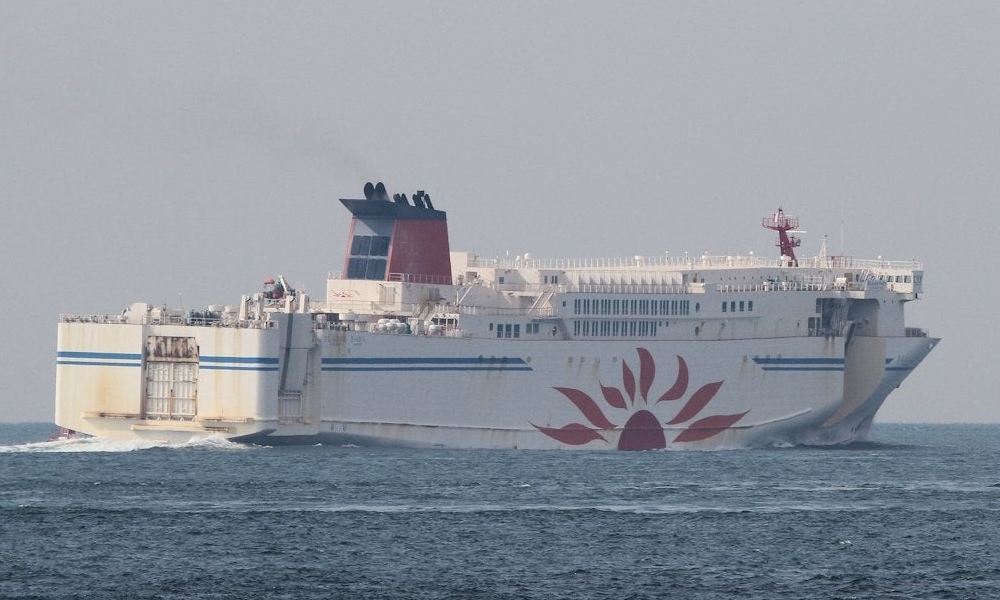
Vehicle decks span five levels (Decks 1–5), with Deck 4 serving as the boarding deck (portside access).
The passenger boarding gate is located on Deck 4 (portside), with elevator access to the Lobby/Reception on Deck 5.
Boarding begins approximately 2 hours prior to departure. Priority boarding is granted to vehicle drivers. Online reservations allow automated check-in via self-service machines.
All onboard emergency instructions are displayed in staterooms, on TV screens, and at the ship's assembly (muster) stations located aft on Deck 6 (portside and starboard).
Life jackets are issued at the emergency assembly stations (非常集合場所).
In case of emergency, the use of elevators/passenger lifts is prohibited.
The ship's top deck serves as a helipad for emergency helicopter landings.
From all cabin decks, direct stair and elevator access is provided to the vehicle decks below.
Smoking is prohibited throughout the ship (including observation decks), except in designated smoking areas located aft on Deck 5 (near pet facilities), Deck 6 (near the starboard assembly station), and Deck 7 (near the stairs).
Car decks
The Sunflower Sapporo has a total of five garage decks for wheeled cargo. Decks 4 and 5 are designated for trucks (13 m semi-trailers), while Decks 1–3 are for passenger vehicles (cars and vans). The cargo garage is accessed via three rampways: two forward (bow-starboard and bow-stern) and one aft (mid-stern with axial ramp door).
The vessel is equipped with approximately 40 CCTV cameras (installed on all cargo decks and in the engine room) for early fire detection.
Disabled passengers or those requiring special assistance should contact the ship's Reception on Deck 5 (open 24 hours).
After parking, apply the handbrake and place the vehicle in park or 1st gear, then switch off the ignition, alarm, electrical equipment, and headlights. Lock the vehicle.
Take only valuables and essential hand luggage from your vehicle.
Make a note of your vehicle's location and garage deck number/stairway before leaving the car deck.
Access to the cargo decks during the voyage is prohibited.
When disembarking, do not start the engine until instructed in order to avoid air pollution.
The shipowner MOL Ferries (founded in 2023, headquartered in Oita City Japan) is a cargo and passenger company operating six large vessels (three pairs of sister ships) on the Japanese island routes Osaka–Beppu, Osaka–Shibushi, and Kobe–Oita. MOL Ferries (operational since October 1, 2023) consolidates the fleets of the MOL Group's subsidiaries Ferry Sunflower Ltd (founded in 2009) and MOL Ferry Co Ltd (founded in 1969).
Photos of Sunflower Sapporo ferry
Sunflower Sapporo ferry ship related cruise news
- Cruise Industry
Japanese ships to offer Starlink High-Speed Internet
Mitsui O.S.K. Lines and KDDI Corporation have jointly announced their plans to trial Starlink, a cutting-edge satellite broadband service, on MOL...
August 4, 2023 - show more news
Other Mitsui OSK Lines cruise ships
Sunflower Sapporo ferry Wiki
The shipbuilding order for the two newbuilds (Furano and Sapporo) was placed on October 17, 2014. Both vessels were intended for the Oarai–Tomakomai route (Honshu/Ibaraki to Hokkaido/Iburi).
The vessel Sunflower Sapporo (JMU yard/hull number 5095) was launched (floated out from drydock) on August 10, 2016, completed and delivered to MOL Ferry Co Ltd on October 24, 2017 (initially scheduled for August 28 but postponed due to outfitting delays), and entered service on October 25, 2017. Her maiden voyage departed from Tomakomai to Oarai on October 25.
The shipbuilder is JMU (Japan Marine United Co Ltd), and the ferry was constructed at JMU's yard in Isogo, Yokohama City.
Compared to the JMU-built, 2018-launched sister ships Satsuma and Kirishima, the 2017-built Furano and Sapporo are slightly smaller (-200 GT), with approximately 16% lower cargo capacity (in terms of truck capacity), around 20% fewer staterooms (97 vs 117), about 2.5 times less public space, fewer barrier-free, group, and pet-friendly cabins, approximately 20% fewer reserved seats, a 2.5 times smaller entrance hall/lobby, a 1.5 times smaller restaurant, and a 1.7 times smaller public bath (with a 24-hour shower room).
Compared to the 1993/1998-built namesakes, the new Furano and Sapporo were designed with larger gross tonnage, approximately 30% more private passenger rooms, double the passenger vehicle capacity, and about 10% greater truck capacity, but with slightly reduced passenger capacity (636 vs 703).
All JMU-built ferries are equipped with a hybrid CRP (contra-rotating propeller) propulsion system consisting of two propellers arranged on the same axis but rotating in opposite directions. Both propellers are driven by electric motors powered by diesel generators. The propulsion system also includes four thrusters (360-degree azimuthing propellers with electric motors), including two at the bow and two at the stern.
The new ferries Sapporo and Furano became Japan's first passenger ships with hybrid propulsion. For improved fuel efficiency, the hull form was optimized, resulting in enhanced performance (reduced resistance and improved vertical motion).
The powerplant is based on two Wartsila marine diesel engines (model 12V32E) with a total output of 21 MW (28,160 hp). Wartsila also supplied the gearbox and control systems.
The design of Satsuma and Kirishima was developed by Flux Design (with Tomoyuki Watanabe as Managing Director) and features an aerodynamically rounded bow (designed to utilize diagonal headwinds for additional propulsive efficiency), as well as larger interior spaces and passenger accommodations.
The shipbuilder JMU (Japan Marine United Corporation) was established in January 2013 through the merger of Universal Shipbuilding Co Ltd (founded in 2002) and IHI Marine United Co Ltd (founded in 1995 and fully owned by IHI Corporation). JMU's current majority stakeholders are IHI Corporation (35%), JFE Holdings (35%), and Imabari Shipbuilding Co Ltd (30%). JMU specializes in cargo shipbuilding, including large container ships, VLCCs (Very Large Crude Carriers), bulk carriers, LNG carriers, Suezmax oil tankers, car carriers, offshore support vessels, floating structures, Ro-Pax/passenger and car ferries, as well as patrol vessels and warships (destroyers and minesweepers).