

Nippon Maru
Former names : MHI 1188, MARY
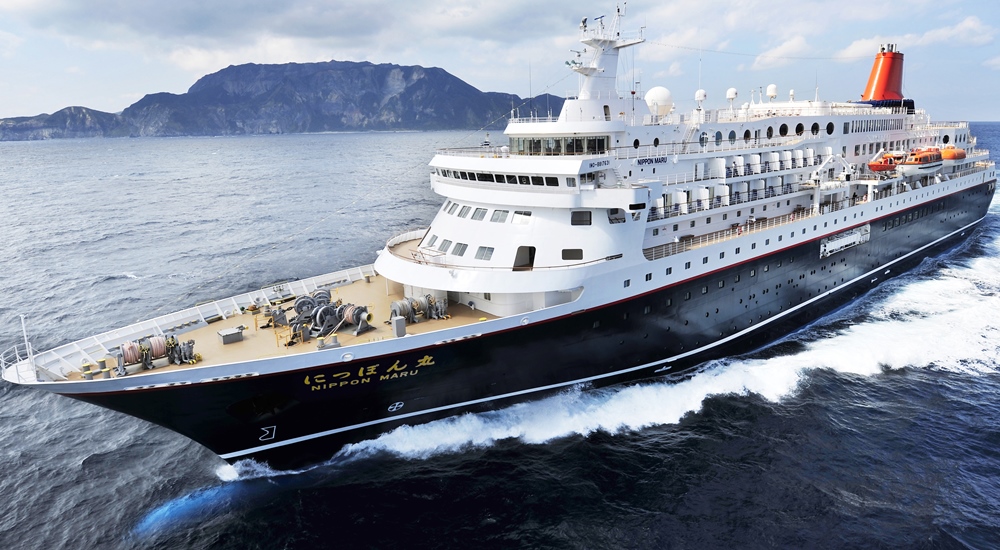
Specifications of Nippon Maru
| Year of build | 1990 / Age: 36 |
| Builder | Mitsubishi Heavy Industries (Kobe, Japan) |
| Ferry route / homeports | Kobe (Japan) |
| Building cost | USD 59 million |
| Speed | 18 kn / 33 km/h / 21 mph |
| Length (LOA) | 167 m / 548 ft |
| Beam (width) | 24 m / 79 ft |
| Gross Tonnage | 22472 gt |
| Passengers | 398 - 607 |
| Crew | 230 |
| Decks | 9 |
| Cabins | 184 |
| Decks with cabins | 6 |
| Last Refurbishment | 2020, Alang-scrapped in 2026 |
| Former names | MHI 1188, MARY |
| Owner | Mitsui OSK Lines Ltd (via Nippon Maru Co Ltd) |
| Operator | MOL Cruises Ltd (via Mitsui Ocean Cruises) |
Nippon Maru Review
Review of Nippon Maru
The 1990-built/2026-scrapped MS Nippon Maru was constructed in Japan by Mitsubishi Heavy Industries/MHI (in Kobe) and delivered to Mitsui OSK in September 1990.
The vessel (IMO number 8817631) was Japan-flagged (MMSI 431302000) and registered in Tokyo.
In November 2022, Takeshi Hashimoto (President and CEO of Mitsui OSK Lines Ltd) announced that the company was considering a USD 710 million investment in two newbuild cruise ships, with options for two additional sisterships of the same class.
In June 2025, it was announced that in May 2026 the 36-year-old Nippon Maru would be retired from service and sold for scrapping. During its service with MOL Cruises Ltd, the vessel completed 2,000+ voyages, carried 600,000+ passengers, visited 400+ Japanese and foreign ports, and sailed ~5.33 million km (3.31 million mi) - equivalent to circumnavigating the globe 133 times.
On June 19, 2026 (last reported AIS data), the vessel was beached at the Alang Ship Breaking Yard (India) for dismantling and scrapping. The vessel was temporarily renamed MARY and reflagged to Comoros (MMSI 620800451).
History – construction and ownership
The vessel’s keel-laying ceremony was held in October 1989 at MHI’s Kobe-Osaka shipyard. Construction began under hull number 1188. The ship was launched on March 8, 1990, and delivered to Mitsui OSK on September 22nd. The inaugural voyage departed on September 27th, sailing from Kobe to Keelung–Taipei (Taiwan) and Hong Kong (China).
The vessel was operated by Mitsui OSK Passenger Line/Mitsui Ocean Cruises, a subsidiary of MOL/Mitsui OSK Lines, one of the world’s largest container shipping companies. MOL (founded in 1884) is headquartered in Tokyo and is a core company of the Mitsui Group.
MOL’s current fleet includes container ships, bulk carriers, LNG carriers, tankers, ro-ro vessels (including ferries), and two MOPAS-operated cruise ships—Nippon Maru and Mitsui Ocean Fuji (formerly Seabourn Odyssey; 2009-built/2023-acquired).
MOL Group also plans to order two new cruise ships designed with a maximum passenger capacity of around 600.
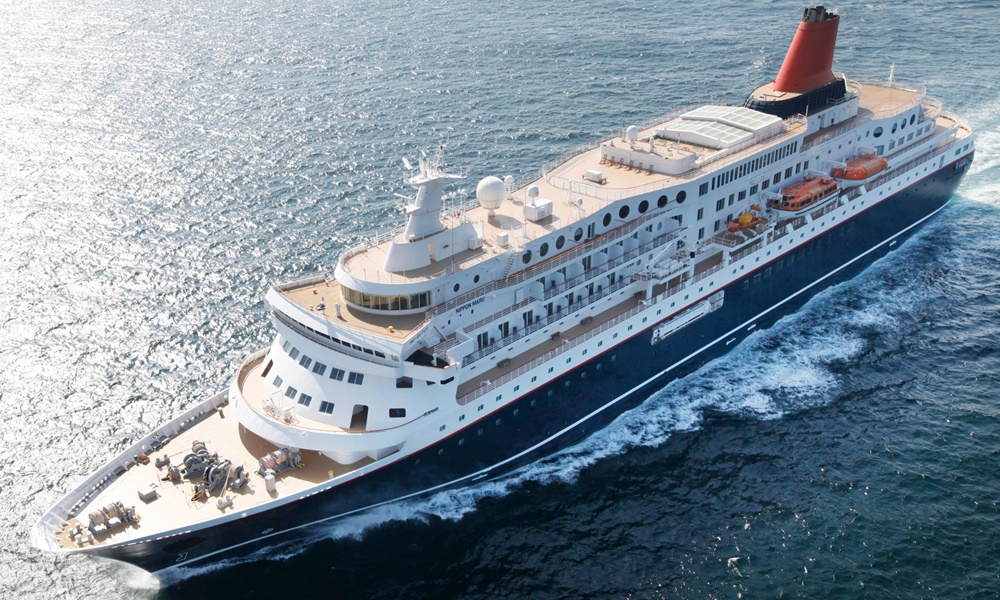
During the 2008 drydock refurbishment, Nippon Maru’s hull was repainted black. MOL’s other liner, Fuji Maru (1988-built), was decommissioned in December 2013. Nippon Maru’s last drydocking for general maintenance was in 2020.
Curiously, before selling the vessel for scrap, MOL removed numerous objects and artworks from the ship as part of the Nippon Maru Memorial Goods Project. The initiative allowed former passengers and crew members to purchase a variety of items, including furniture, light fixtures, decorative objects, and works of art.
Decks and Cabins
Nippon Maru had a total of 194 passenger staterooms, including 9 Suites located forward on Deck 6, immediately adjacent to the Navigation Bridge/Wheelhouse.
There were 9 passenger-accessible decks, of which 6 had cabins.
Three midship lifts/elevators served Decks 1 through 7.
Deck 0 was a service deck with a starboard midship tendering area and crew-only spaces (machinery, crew cabins, storage, Messhall).
On Deck 1 were the Infirmary/Clinic and additional crew facilities.
On Deck 2 were the Mizuho Restaurant (midship–aft Main Dining Room), the Main Entrance/Lobby Hall (port and starboard entrances, Reception/Front Desk, Cruise Salon/Sales Office), the Smoking Lounge (midship–starboard), and one Utility Room.
On Deck 3 were the Tour Desk (shore excursion information and bookings), the Dolphin Photoshop, two Utility Rooms, and four Laundry Rooms. Aft were the two Grand Baths (men’s and women’s), each with adjacent Dressing Rooms/Lockers.
On Deck 4 were the aft Dolphin Hall (lower level), one Utility Room, and the wraparound Promenade Deck.
On Deck 5 were the Beginner’s Luck Casino Lounge & Bar, Conference Room, E-Café & Library (Reading Lounge), Card Room, Boutique Anchor, Buoy Shop, the upper level of Dolphin Hall, and the Dolphin Lounge. This deck also carried the 6 service boats (two tenders, two lifeboats, two rescue boats).
On Deck 6 were the Kasuga Restaurant (a-la-carte specialty dining), Shiosai (Sushi Bar), Midship Bar, Mermaid Theater (main show lounge/cinema), Umi Lounge, and the Navigation Bridge/Wheelhouse (with the Captain’s Suite and officers’ quarters).
On Deck 7 were the aft Sports Deck, port and starboard Sports Verandas (outdoor gym zones), Lido Terrace, the lower Sun Deck, the wellness complex (Oasis Gym & Studio, Spa & Beauty Salon), and the bow-facing Horizon Lounge & Bar with its outdoor Horizon Deck.
On Deck 8 were the upper Sun Deck, the Walking Track, the Sliding Roof (retractable glass cover over the Lido Pool area), and the funnels/smokestacks.
Shipboard facilities and amenities
Facilities include the Main Dining Room (complimentary), a Sushi Bar (a-la-carte, featuring fresh fish sourced locally), Horizon Bar Lounge, Café and Library, Mermaid Theater (for live performances), Lido Terrace (indoor lounge on Lido Deck), the Sun Deck with swimming pool, and the Wellness Complex (SPA, Hair Salon, Gym, Sauna, treatment rooms, and two indoor baths with aft-facing views).
The ship also offers a Card Room and a Casino.
Mitsui OSK cruise fares generally range from USD 400–500 per person per night (double occupancy). As a luxury product, cruises are all-inclusive except for alcoholic beverages.
Nearly all Mitsui OSK cruise passengers are Japanese.
Onboard cuisine is predominantly traditional Japanese, complemented by Western options.
Itineraries
Previously operating exclusively in East Asia, in 2001 the ship completed her first around-the-world cruise. Nippon Maru’s itinerary program ranges from short overnight sailings to extended voyages around Japan and throughout Southeast Asia.
Mitsui OSK’s “One Night Cruise” program consists of three themed offerings, each carefully curated to provide a relaxed travel experience and expand Japan’s homeport cruise market.
In 2017, the “Tonde” fly-cruise program was introduced, offering a full circumnavigation of Kyushu Island (Japan’s third largest). The itinerary visited all Kyushu prefectures—Fukuoka, Kumamoto, Nagasaki, Oita, Saga, Kagoshima, Miyazaki, and Okinawa. The roundtrip from Hakata–Fukuoka City included calls to Beppu, Miyazaki City, Kagoshima, Tokunoshima, Misumi, and Karatsu.
The Kyushu-themed cruise became highly popular for combining sea travel with flights and trains, and for featuring regional specialties from each prefecture.
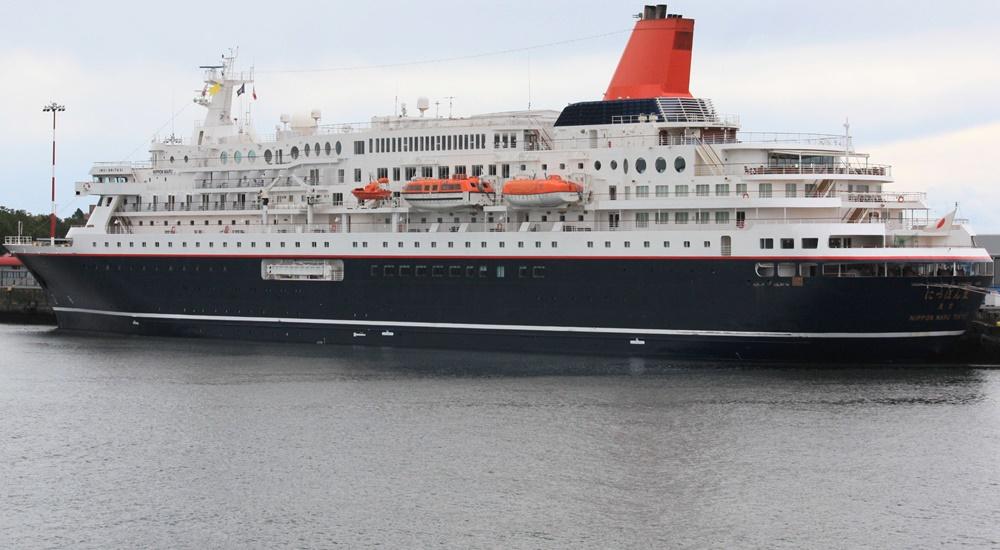
In 2018, Nippon Maru operated exclusively in Japan, offering 1- to 8-day voyages. In spring, the ship sailed to the Okinawa Islands and Taiwan. The fly-cruise program incorporated domestic and international flights to and from major cities. MOL Cruises plans itineraries combining domestic and international voyages, themed events, and local festivals. Longer voyages also visit the USA’s Pacific territories—Saipan Island and Guam Island (Micronesia). Mitsui OSK is also considering adding one or two Southeast Asian cities as alternative homeports.
MS Nippon Maru currently calls at approximately 150 Japanese ports.
The annual “Grand Cruise” is a two-month circumnavigation of Japan.
“Island Cruise” itineraries visit two UNESCO World Heritage Sites—Ogasawara/Bonin Islands and Yakushima Island.
“Fly and Cruise” itineraries also include Hokkaido Island (Shiretoko Peninsula, Otaru/Sapporo, Rebun Island), Okinawa Island, and Taiwan (Keelung).
Asian-themed voyages include the “Taiwan Grand Cruise” (visiting Keelung–Taipei, Kaohsiung, Hualien) and the “Gourmet Cruise” (to Hong Kong, Keelung, Kaohsiung).
“South Pacific Islands Cruise” itineraries from Kobe include calls to Yokohama, Guam Island (USA), Tahiti Island (French Polynesia), and Hawaii (USA).
Due to the Coronavirus crisis, in 2020 Nippon Maru suspended all Mitsui OSK Cruises scheduled between March and November. The revised program—focused mainly on Japanese coastal voyages—operated between November 2020 and August 2021 and included 37 departures. Passenger capacity (398 lower berths) was limited to 40–60%, and 20 cabins were designated for onboard quarantine.
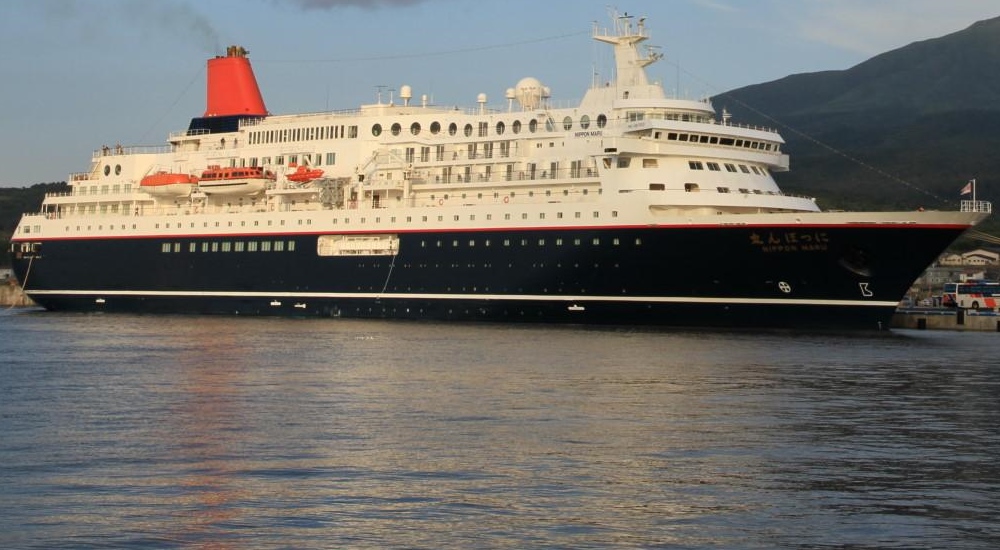
Photos of Nippon Maru
Nippon Maru ship related cruise news
- Cruise Industry
MOL Cruises announced Mitsui Ocean Sakura ship's Japan debut
MOL Cruises, Mitsui O.S.K. Lines' cruise subsidiary, has unveiled its new Japan-registered cruise ship, Mitsui Ocean Sakura (fka Seabourn Sojourn...
September 19, 2026 - Cruise Industry
Japanese cruise ship Nippon Maru completes final voyage after 35 years at sea
The Japanese vessel Nippon Maru returned to homeport Yokohama on Sunday, May 10th, following its final voyage, concluding a 35-year career during...
May 10, 2026 - Cruise Industry
MOL Cruises’ next ship named MITSUI OCEAN SAKURA (Seabourn Sojourn)
Mitsui O.S.K. Lines (MOL) has confirmed that its subsidiary, MOL Cruises Ltd, will introduce a new cruise vessel in late 2026 under the name MITSUI...
August 19, 2025 - Cruise Industry
Nippon Maru to conclude service in May 2026 after 35 years with Mitsui Ocean Cruises
MOL Cruises Ltd., the operator of Mitsui Ocean Cruises, has announced that its flagship vessel Nippon Maru will be retired from service on May 10th...
June 5, 2025 - Cruise Industry
Mitsui Ocean Cruises launches new shore excursion program for 2024-2025 season
For over a century, Mitsui Ocean Cruises has navigated the extensive 18,000-mile coastline of Japan, presenting tourists with an in-depth exploration...
November 13, 2024 - Cruise Industry
Seabourn Odyssey begins final journey before refit and renaming as Mitsui Ocean Fuji
The renowned luxury ship Seabourn Odyssey is currently on her final voyage through Alaska, marking the end of her service with Seabourn before...
August 20, 2024 - Cruise Industry
Japanese ships to offer Starlink High-Speed Internet
Mitsui O.S.K. Lines and KDDI Corporation have jointly announced their plans to trial Starlink, a cutting-edge satellite broadband service, on MOL...
August 4, 2023 - Cruise Industry
International cruise shipping restarts in Japan after ~3-year COVID-related pause
International cruise shipping restarted in Japan on Thursday, December 15th, after an almost 3-year suspension due to the COVID crisis. Operations...
December 17, 2022 - Cruise Industry
Japan’s Mitsui OSK Lines to launch 2 new cruise ships
Japan’s Mitsui OSK Lines (MOL/containership company) announced it is looking to diversify into the cruising business. The company's Board of...
November 28, 2022 - Cruise Industry
Cruise ships are back in Japan with COVID safety measures
Japan's cruise business is getting back on track as ships gradually resume sailings with COVID safety measures in place after canceled voyages due to...
November 16, 2021 - show more news
Other Scrapped Cruise Ships cruise ships
Nippon Maru Wiki
Ship’s powerplant consists of two Mitsubishi marine diesel engines (model 8UEC52LA) with a combined output of 15.7 MW. The hybrid contra-rotating propulsion system includes a bow thruster and two controllable pitch propellers (one forward CPC and one aft propeller with Kamome rudder). The configuration employs a conventional forward-located CPC driven by the main engine, paired with an aft motor-driven “rudder propeller.”
Alongside her Japanese officers and key service personnel, the ship employs 130 Filipino crew members. The shipowner MOL was founded in 1884. MOL’s passenger shipping services began in 1908 with Transpacific routes between Japan and Central–South America. In 1939, two newbuild ocean liners were launched—Argentina Maru and Brazil Maru. Mitsui OSK Passenger Line was established in 1970.

On December 13, 2018, during an official ceremony, Mitsui OSK Passenger Line received an award for its “Nippon Maru One Night Cruise” program. In 2018, this program offered three themed voyages:
- (September 21–22) “Yokohama–Kobe Bread Festival Cruise,” featuring a variety of freshly baked breads
- (October 22–23) “Autumn Setonaikai Inland Sea,” offering food specialties from nine prefectures in the Seto Inland Sea (Setonaikai), including special breakfasts with local delicacies
- (December 25–26) “Kobe–Yokohama C to Sea Cruise,” featuring themed onboard events
The “Cruise of the Year” award recognized MOL Group for its contributions to Japan’s cruise industry through product innovation and enhanced service offerings. The annual award is presented by the Japan Oceangoing Passenger Ship Association and the Ministry of Land, Infrastructure, Transport and Tourism, and is sponsored by the Japan Tourism Agency and the Japan Association of Travel Agents.
Nippon Maru ship refurbishments review
On July 12, 2019, MOL announced a scheduled drydock refurbishment of Nippon Maru.
The February–April 2020 drydocking project resulted in the following deckplan modifications:
New bow-facing family cabins with large, slanted, non-opening floor-to-ceiling windows were added forward on decks 4 and 5. Most of these staterooms (Ocean View Suites) are triples (max capacity 3 guests), while some are designed for families and groups (max capacity 6 guests).
Neptune Bar was relocated to the Horizon Lounge (forward on Deck 7).
Wi-Fi coverage was upgraded to shipwide, with the exception of Dolphin Hall.
Several interior areas and all passenger staterooms received new carpeting.
The vessel’s main machinery was upgraded—including the replacement of older HDDDEO (Heavy Duty Diesel Engine Oil) engines with new engines operating on LSFO (low-sulfur marine fuel oil). The project also included hull cleaning and repainting.
Nippon Maru’s previous major refit was completed in 2010, when additional passenger staterooms were added to Deck 6, along with new venues such as Horizon Lounge (a forward-facing bar lounge on Deck 7) and the wellness complex “Spa and Salon.” During the 2010 drydock, the hull also received MOL’s new royal-blue livery, and round-shaped porthole windows were installed.